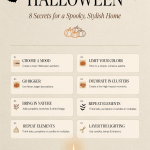
Halloween decorating has a reputation for going one of two ways. There is the delightfully over-the-top version: inflatable ghosts on the lawn, orange string lights around every window, plastic skeletons climbing the roof, fake spiderwebs stretched from tree to tree, and enough pumpkins to stock a small farm. Then there is the other extreme: the home that barely acknowledges Halloween at all. Perhaps there is one tasteful pumpkin on the kitchen island and a vaguely autumnal wreath on the front door. But somewhere between those two approaches is a sweet spot that interior designers understand particularly well. A beautifully decorated Halloween home can still be spooky, whimsical, nostalgic, and fun. The difference is that the decorations feel integrated into the house rather than simply placed on top of it. Designers think about Halloween much the same way they think about decorating a room. They consider scale, repetition, color, lighting, texture, focal points, and negative space. Instead of asking, “Where can I put another Halloween decoration?” they ask, “How do I want this room to feel?” That subtle shift changes everything. Whether your dream Halloween home feels like an old English manor, a charming New England cottage, an abandoned Victorian mansion, or simply a slightly moodier version of your everyday home, these are the decorating tricks designers use to make Halloween feel sophisticated without taking away the fun.
1. Start With a Halloween Mood, Not a Shopping Cart
One of the biggest differences between designer Halloween decorating and ordinary seasonal decorating happens before anything comes out of storage. Designers establish a direction. Halloween décor becomes difficult when every object is chosen independently. A cute felt ghost goes into the cart. Then a black glitter pumpkin. Then an orange pillow. Then a gothic candelabra. Then a vintage-inspired ceramic witch. Individually, each item might be wonderful. Together, they may tell five completely different stories. Instead, decide what kind of Halloween you are creating. Perhaps it is old-world gothic, with aged brass candlesticks, burgundy velvet, black taper candles, antique portraits, dark florals, and tarnished silver. Maybe you prefer nostalgic Halloween, with jack-o’-lanterns, black cats, paper decorations, vintage-style signs, candy buckets, and cheerful orange accents. Or perhaps your style is natural and moody, using pumpkins, branches, dried foliage, moss, gourds, candlelight, and subtle black details. You could even lean into whimsical haunted house, where floating witch hats, oversized spiders, bats, ghosts, and skeletons are intentionally exaggerated.
There is no requirement that Halloween décor be serious to look good. In fact, some of the best Halloween homes are incredibly playful. What makes them successful is consistency. Choose three or four words before you decorate. For example: Moody + historic + romantic + eerie
Or: Playful + nostalgic + colorful + whimsical
Or: Natural + understated + rustic + autumnal
Those words become your filter. Suddenly it becomes much easier to determine which decorations belong in your home and which can stay at the store.
2. Build a Restricted Color Palette
Halloween comes with a built-in color scheme, but designers rarely feel obligated to use all of it. Orange, purple, lime green, black, and white may immediately communicate Halloween, but combining every traditional Halloween color can quickly make a room visually busy.
Instead, designers usually edit the palette. Black and warm white can create an elegant haunted-house look. Black, rust, cream, and brown feel autumnal and sophisticated. Burgundy, plum, black, and aged brass can make a room feel like a Victorian manor. Muted orange, dusty green, cream, and natural wood work beautifully in a cozy cottage. For a more playful home, orange and black can absolutely remain the stars. Simply repeat those colors intentionally instead of introducing several unrelated accent colors.
The secret isn’t eliminating Halloween colors. It is controlling them. Try following a simple rule: choose two dominant colors, one supporting color, and one metallic or natural finish.
For example: Black + cream + rust + brass.
Or orange + black + white + natural wood.
This immediately creates visual continuity throughout the house.
3. Decorate the House You Already Have
Great seasonal decorating works with your home’s existing personality. A modern home does not need to suddenly become a Victorian haunted mansion simply because October arrived. Likewise, a traditional home doesn’t need neon Halloween signs if they feel disconnected from everything else in the room. Look at the materials, colors, and architectural details already present in your home.
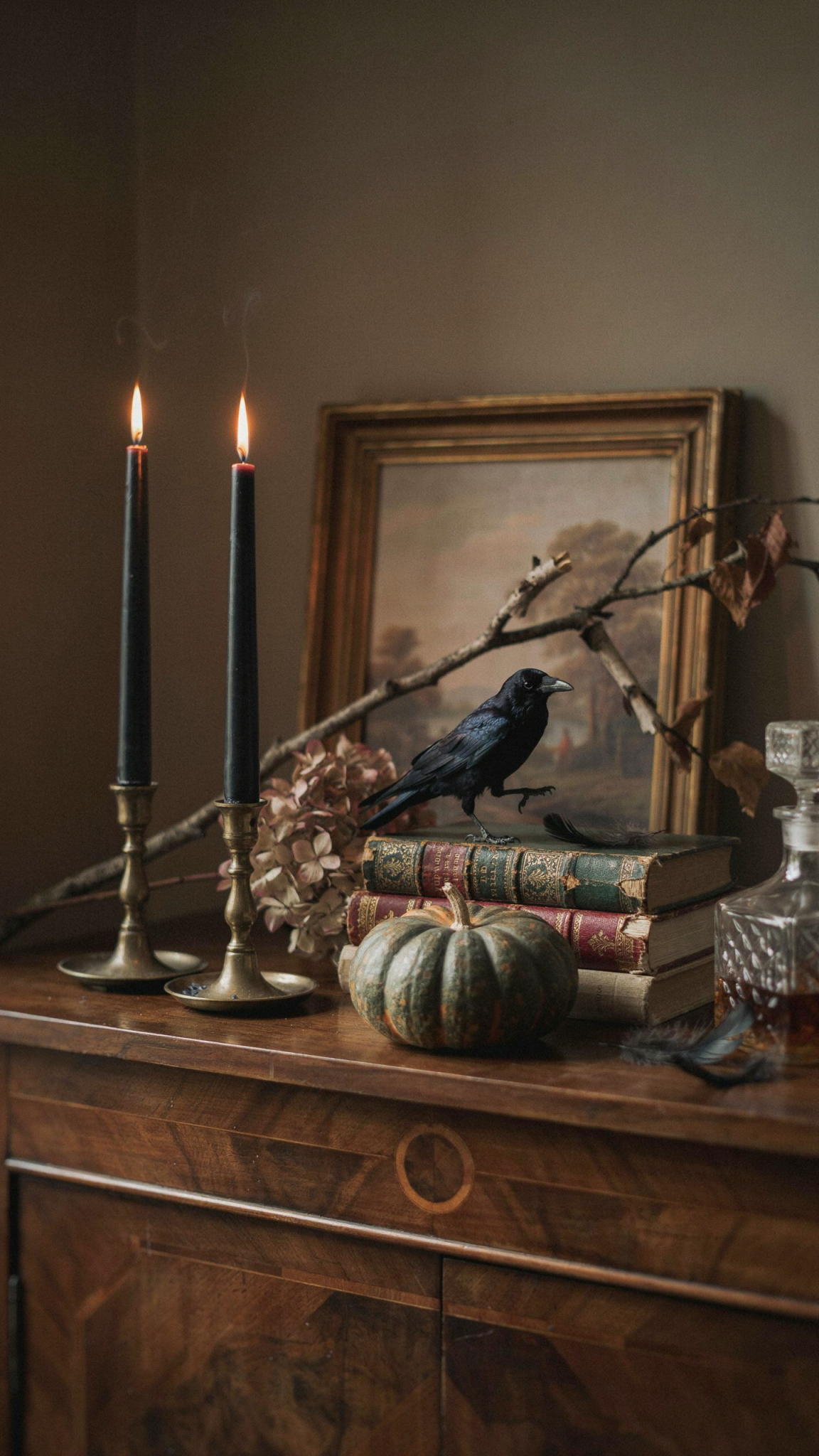
If you have warm woods, linen upholstery, vintage furniture, and brass lighting, Halloween might naturally lean toward aged candlesticks, amber glass, old books, branches, ravens, and dark florals. If your home is contemporary and neutral, oversized black spiders, sculptural pumpkins, graphic bats, and dramatic lighting might feel much more appropriate.
If your home is colorful and eclectic, Halloween is an opportunity to embrace saturated orange, purple, whimsical ghosts, painted pumpkins, and quirky vintage finds. Halloween decorating looks most sophisticated when it feels like your house dressed up for Halloween—not someone else’s house temporarily moved into yours.
4. Edit Before You Add
This is one of the least glamorous designer tricks and one of the most important. Before adding seasonal décor, remove some everyday décor. If your mantel already contains artwork, a mirror, two candlesticks, a vase, framed photographs, a plant, and decorative objects, adding six pumpkins and a flock of bats will probably make it feel cluttered. Instead, temporarily pack away a few everyday accessories.
Clear the coffee table. Remove some objects from the entry console. Simplify the mantel. Take a few pillows off the sofa before introducing seasonal ones. Think of your house as having a visual capacity. Halloween decorations need somewhere to breathe. Removing everyday objects gives seasonal pieces enough negative space to make an impact. Ironically, displaying fewer things can make the Halloween decorations you own look significantly better.
5. Use Scale to Make Halloween Look Expensive
One of the easiest ways to make seasonal decorating look more professionally styled is to stop relying on lots of small objects. Designers love scale. Imagine a fireplace mantel covered with fifteen tiny Halloween figurines compared with a mantel featuring one enormous arrangement of dark branches, three substantial pumpkins, and a dramatic group of taper candles. The second arrangement commands attention. Large decorations create focal points and allow the eye to rest. This doesn’t mean everything needs to be oversized. Rather, establish a hierarchy.
Choose one large element, several medium elements, and only a few smaller accents. An oversized spider crawling across an exterior wall can be far more effective than twenty small decorations scattered around the porch. A six-foot branch arrangement in the entry can create more atmosphere than a dozen Halloween signs. A group of thirty bats sweeping dramatically across one wall will generally look more intentional than placing bats randomly throughout the house. Scale creates drama. Halloween is the perfect holiday to use it.
6. Cluster Decorations Instead of Spreading Them Everywhere
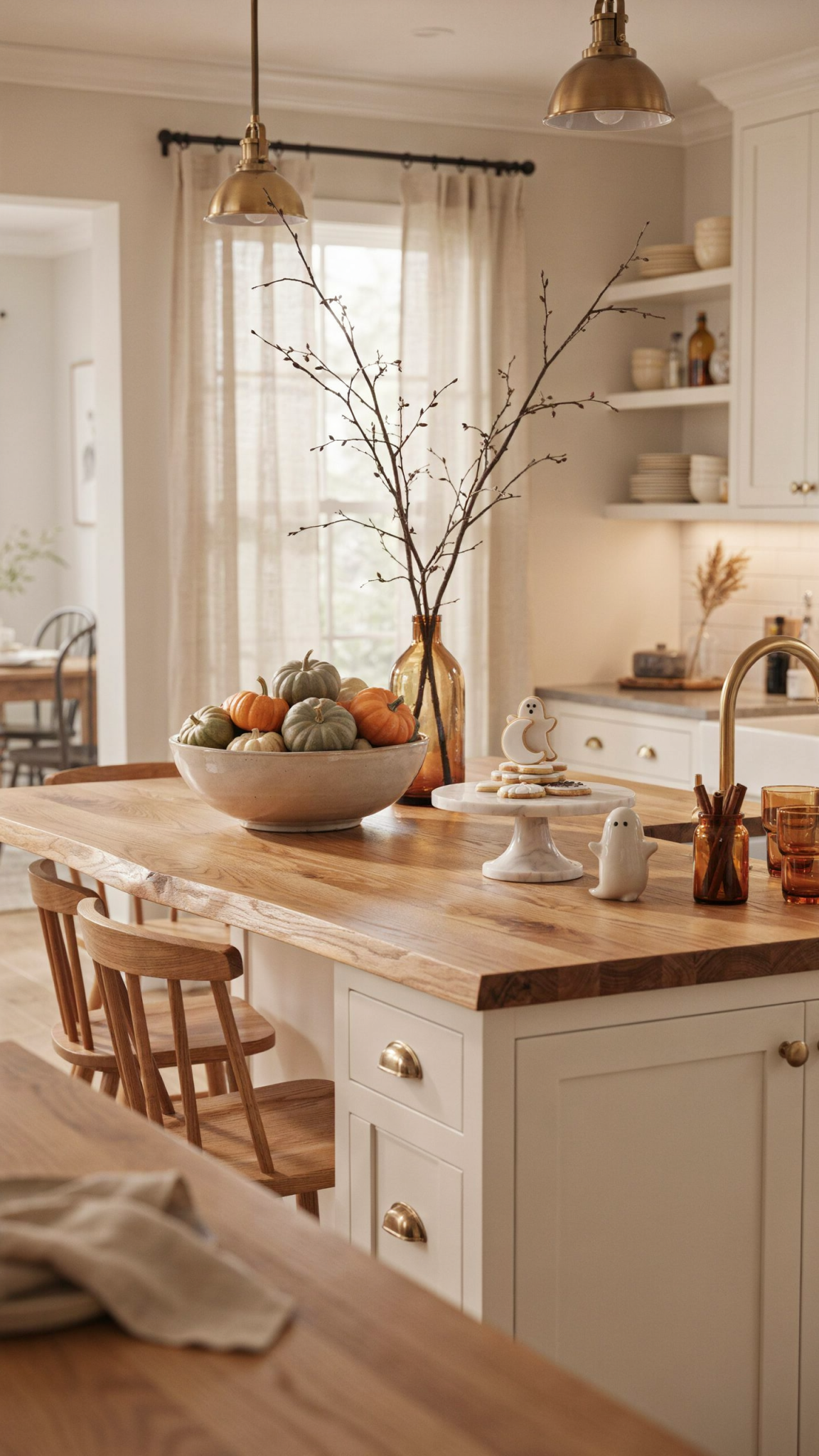
Another designer trick is concentration. Instead of putting one Halloween item on every available surface, create several highly decorated moments. Perhaps the entry table gets a dramatic Halloween vignette. The fireplace becomes the main focal point in the living room. The kitchen island gets a beautiful bowl of pumpkins. The dining room receives dark candles and a moody centerpiece. The rest of the home can remain relatively restrained. This creates rhythm. Your eye moves from moment to moment rather than processing constant visual clutter. It also makes decorating much easier. You do not need enough Halloween décor to fill an entire house. You need enough to create several memorable scenes.
7. Treat the Entryway Like a Movie Trailer
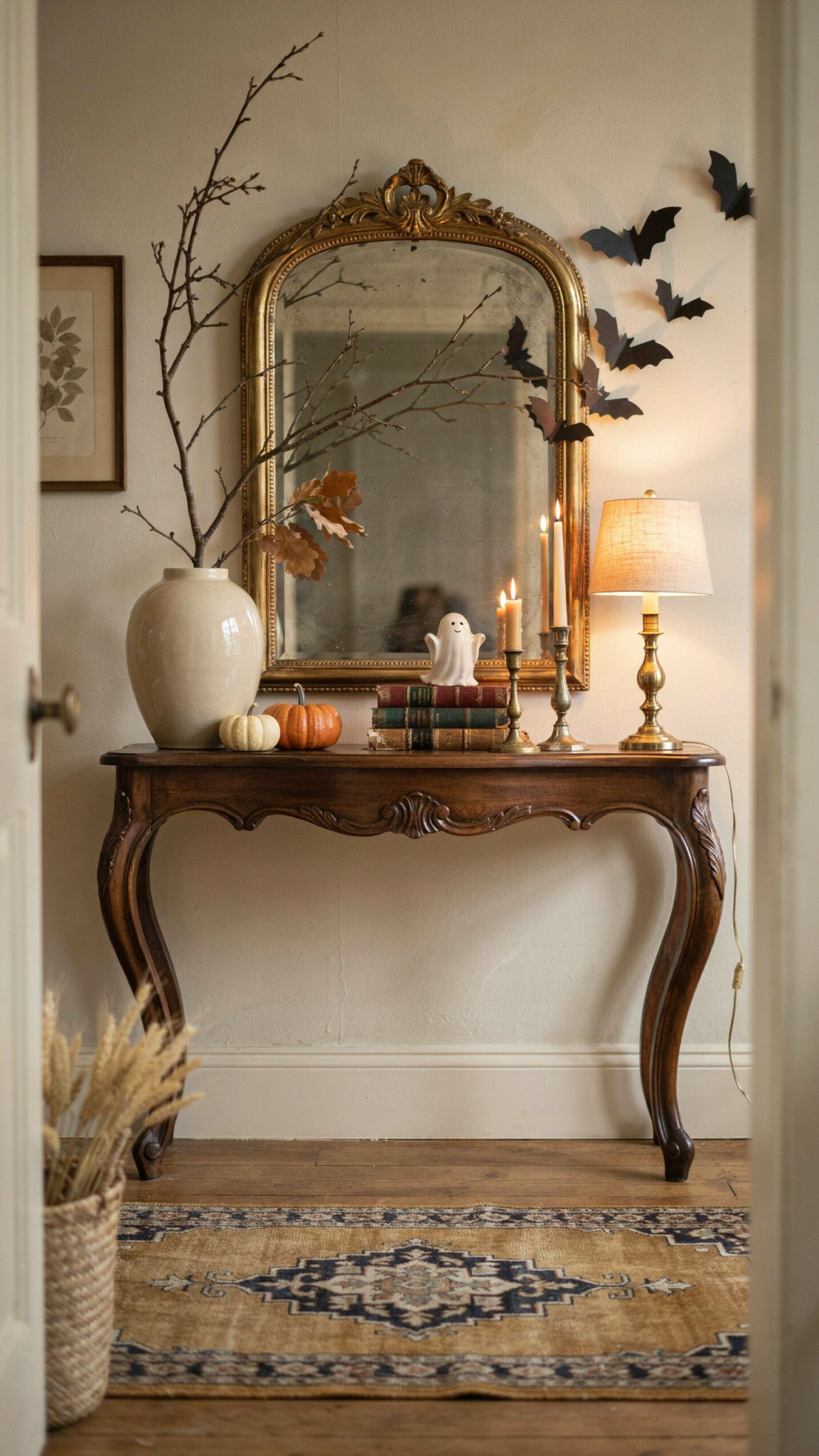
The entry should tell visitors what kind of Halloween house they are entering. It doesn’t need to reveal everything. It simply needs to establish the mood. An antique-style mirror with black taper candles, a vase overflowing with crooked branches, several pumpkins, and a few bats climbing the wall may be enough. Or perhaps it is playful: a skeleton sitting on the bench, witch hats hanging overhead, and a bowl of candy waiting on the console.
Lighting is especially important here. A small lamp with a warm bulb instantly creates atmosphere. So do battery-operated candles, lanterns, and string lights tucked discreetly into branches. The goal is not necessarily to make the entry dark. It is to make it glow.
8. Make the Mantel the Star
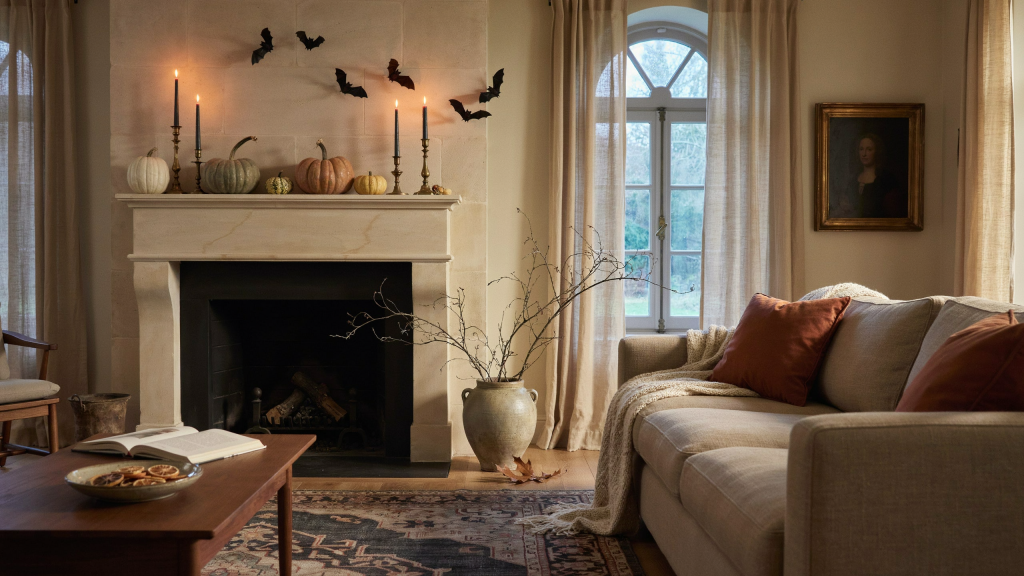
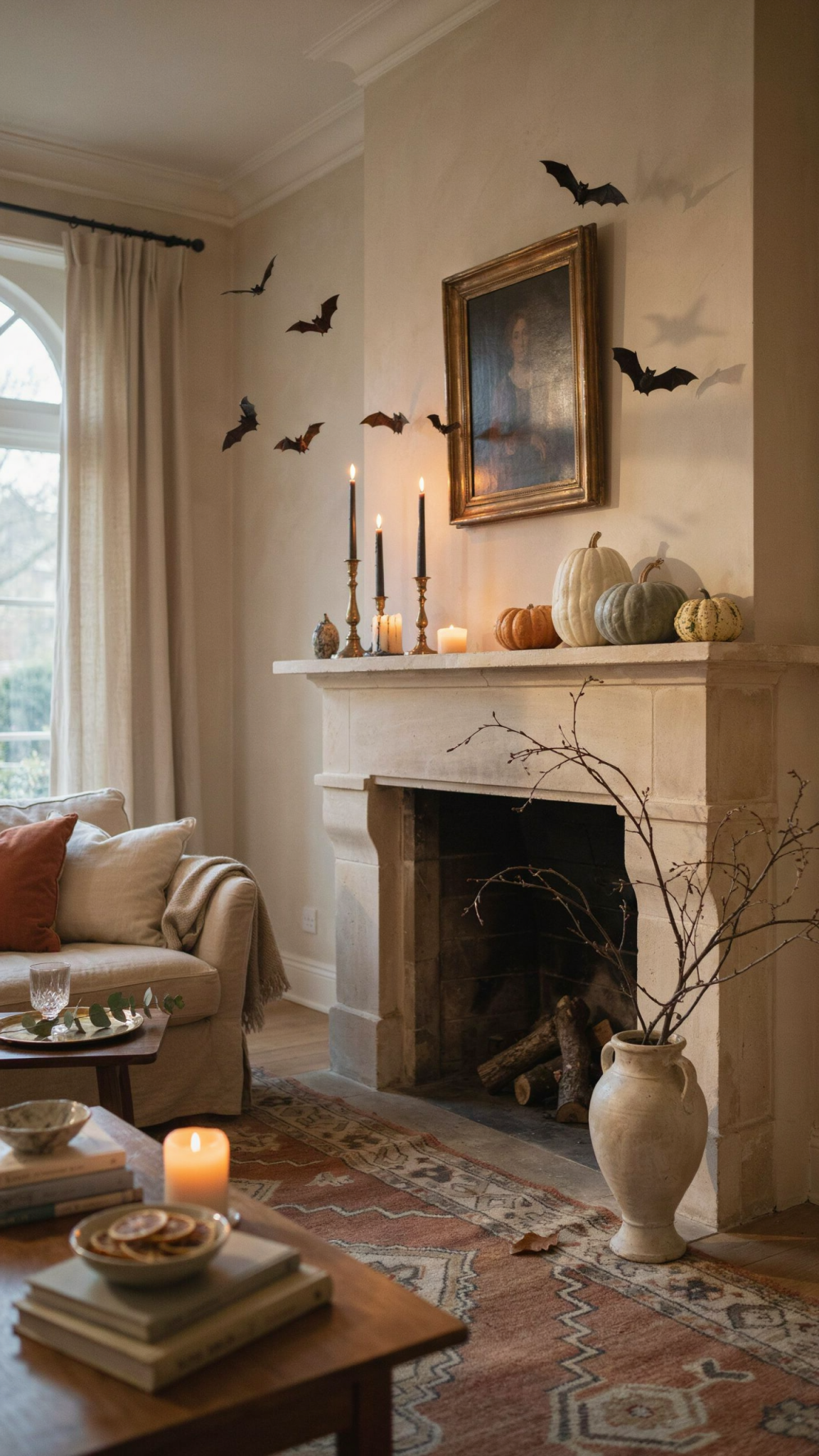
If you have a fireplace, Halloween practically begs you to decorate it. Architecturally, fireplaces are already natural focal points, which means seasonal decorations placed there automatically feel important. Start with the largest visual element. This might be artwork, a mirror, a wreath, an oversized spiderweb, or a dramatic arrangement of branches. Then layer around it. Try pumpkins in varying sizes. Add tall candlesticks. Lean an antique-looking portrait against the wall. Let black gauze drape slightly over the edge. Introduce ravens, bats, or spiders sparingly. Then step back.
A designer mantel typically has movement. Objects are not all the same height or evenly spaced. Some pieces overlap. Some are tall. Some sit low. And there is usually at least a little empty space. For Halloween, asymmetry can be particularly effective because it makes an arrangement feel slightly unsettled—which happens to be perfect for the season.
9. Look to Nature Before the Halloween Aisle
Some of the most beautiful Halloween decorations aren’t technically Halloween decorations at all.
Branches are a perfect example. Bare, crooked branches instantly create a slightly eerie silhouette. Place them in a large urn or vase and suddenly a completely ordinary entryway feels like October. Other natural materials work beautifully too. Think dried hydrangeas, pampas grass, moss, fall leaves, dried seed pods, pinecones, grapevine, wheat, feathers, and of course pumpkins and gourds. Nature provides irregular shapes and imperfect textures that manufactured seasonal décor often lacks. It also bridges the gap between Halloween and fall. Once Halloween is over, remove the bats and spiders while leaving the branches, pumpkins, and foliage in place. Your house can transition into November without starting over.
10. Mix Real Pumpkins With Decorative Ones
There is something about real pumpkins that instantly makes seasonal décor feel richer. Their imperfect stems, subtle color variations, and irregular shapes bring life to a display. That doesn’t mean every pumpkin needs to be real. Designers often mix natural and artificial materials. A few beautiful faux pumpkins can be reused year after year, particularly unusual finishes or sizes that would be difficult to find naturally. Then fill in the arrangement with real pumpkins from the grocery store, farmers market, or pumpkin patch. Try mixing traditional orange pumpkins with muted green, white, peach, or deeply textured heirloom varieties. The combination keeps the display from looking overly manufactured.
11. Use Repetition for Maximum Impact
Repetition is one of the easiest design principles to borrow for Halloween. One bat is a decoration. Thirty bats become an installation. One pumpkin is seasonal. Twenty pumpkins lining the front steps become a statement. One witch hat hanging from the ceiling might look accidental. A dozen floating hats create magic. Repetition allows inexpensive decorations to become dramatic. This is particularly helpful if you are decorating on a budget. Instead of buying ten different things, buy or make multiples of one inexpensive thing. Paper bats are perhaps the ultimate example. Arrange them so they appear to emerge from behind a mirror, climb across the fireplace, or sweep around a doorway. The effect comes from quantity and movement rather than the cost of the individual pieces.
12. Create Movement
Designers rarely arrange decorations in perfectly straight, static lines unless symmetry is intentional. Halloween decorating becomes particularly interesting when objects appear to move. Bats can travel diagonally across a wall. Spiders can crawl upward from the floor. Mice silhouettes can scurry along a baseboard. Pumpkins can cascade down porch steps. Branches can lean dramatically to one side. The eye naturally follows these arrangements. Movement makes the decorating feel immersive rather than merely decorative. When hanging bats, for example, don’t create an evenly spaced polka-dot pattern. Start with a concentrated cluster and gradually spread them apart as they move across the wall. Vary their size and angle. Suddenly they look like a flock rather than stickers.
13. Layer Old and New
One reason designer Halloween rooms often feel richer is that not everything appears to have been purchased from the seasonal aisle this year. Vintage and antique objects are incredibly effective at Halloween because age naturally adds mystery. Old brass candlesticks. Tarnished silver trays. Vintage books. Ornate picture frames. Old mirrors. Stone urns. Wooden boxes. Antique portraits. Apothecary-style bottles. None of these objects needs to be spooky. Placed in the right context, they become spooky. A stack of old books beside a brass candlestick feels perfectly normal in January. Add a raven and black taper candle in October and suddenly it feels like the library of a mysterious old mansion.Thrift stores, antique malls, estate sales, and your own cabinets can be better sources of Halloween décor than the Halloween aisle.
14. Don’t Underestimate Candlelight
If there is one decorating tool capable of transforming Halloween instantly, it is lighting. Turn off the bright overhead lights. Suddenly everything changes. Lamps, candles, sconces, lanterns, and string lights create shadows and depth that daylight simply cannot. For safety, battery-operated candles are incredibly useful. Today’s better versions can create a surprisingly convincing flicker and can be placed in locations where real flames would be impractical. Use candles in groups rather than individually. Mix heights. Place some on books. Put others inside lanterns. Cluster them on a mantel. Line them down the dining table. A group of mismatched candlesticks is particularly beautiful for Halloween. Black candles feel dramatic, while ivory candles create a more traditional old-world look. Deep burgundy can be stunning in rooms with warm wood and brass. Halloween décor should look good during the day. But it should become even better after sunset.
15. Make Your Everyday Art Part of the Decorating
You do not necessarily need Halloween artwork. Sometimes existing artwork can simply be styled differently. Place removable bats around a landscape painting. Hang a tiny witch hat from the corner of a portrait. Drape faux cobwebs very lightly around an ornate frame. Lean an old portrait on the mantel surrounded by candles. You can also temporarily replace a few framed prints with inexpensive vintage-inspired Halloween images, silhouettes, botanical illustrations, old anatomy drawings, or black-and-white landscapes. The frames can stay. Only the artwork changes. It is an inexpensive way to make a room feel dramatically different without introducing another freestanding decoration.
16. Use Textiles Carefully
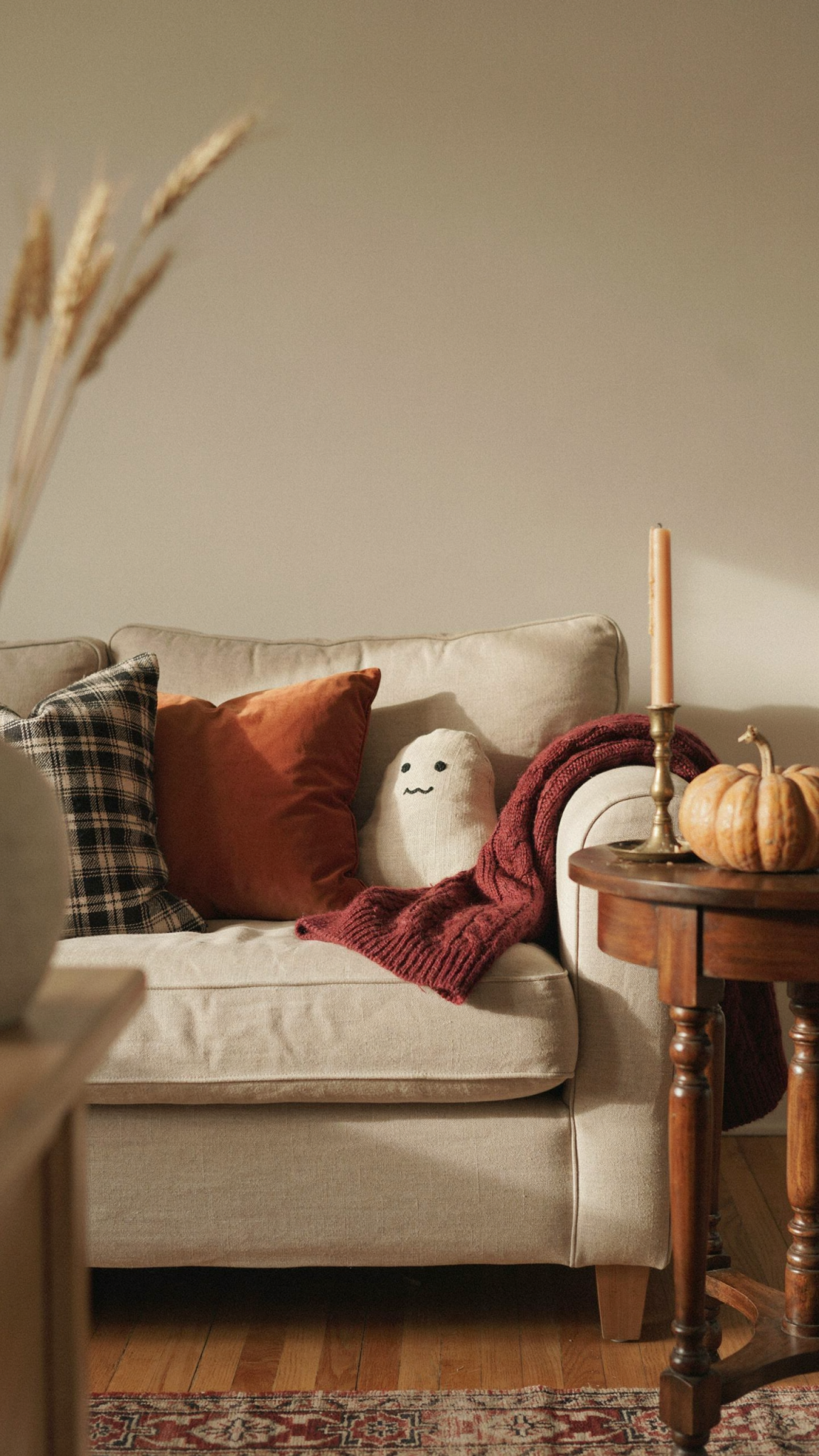
Seasonal pillows can be fun, but designers rarely replace every pillow in a room with a holiday-themed version. Instead, change the mood through texture and color. A rust velvet pillow feels autumnal without saying Halloween. A black-and-cream plaid works through October and beyond. A dark burgundy throw adds richness. A chunky brown blanket makes the sofa feel cozier. Then perhaps add one overtly Halloween pillow—a ghost, black cat, pumpkin, or embroidered phrase. That one pillow suddenly feels charming rather than overwhelming. The same idea applies to kitchen towels, bedding, and table linens. Not everything needs a motif. Let color and texture do much of the seasonal work.
17. Give Skeletons a Personality
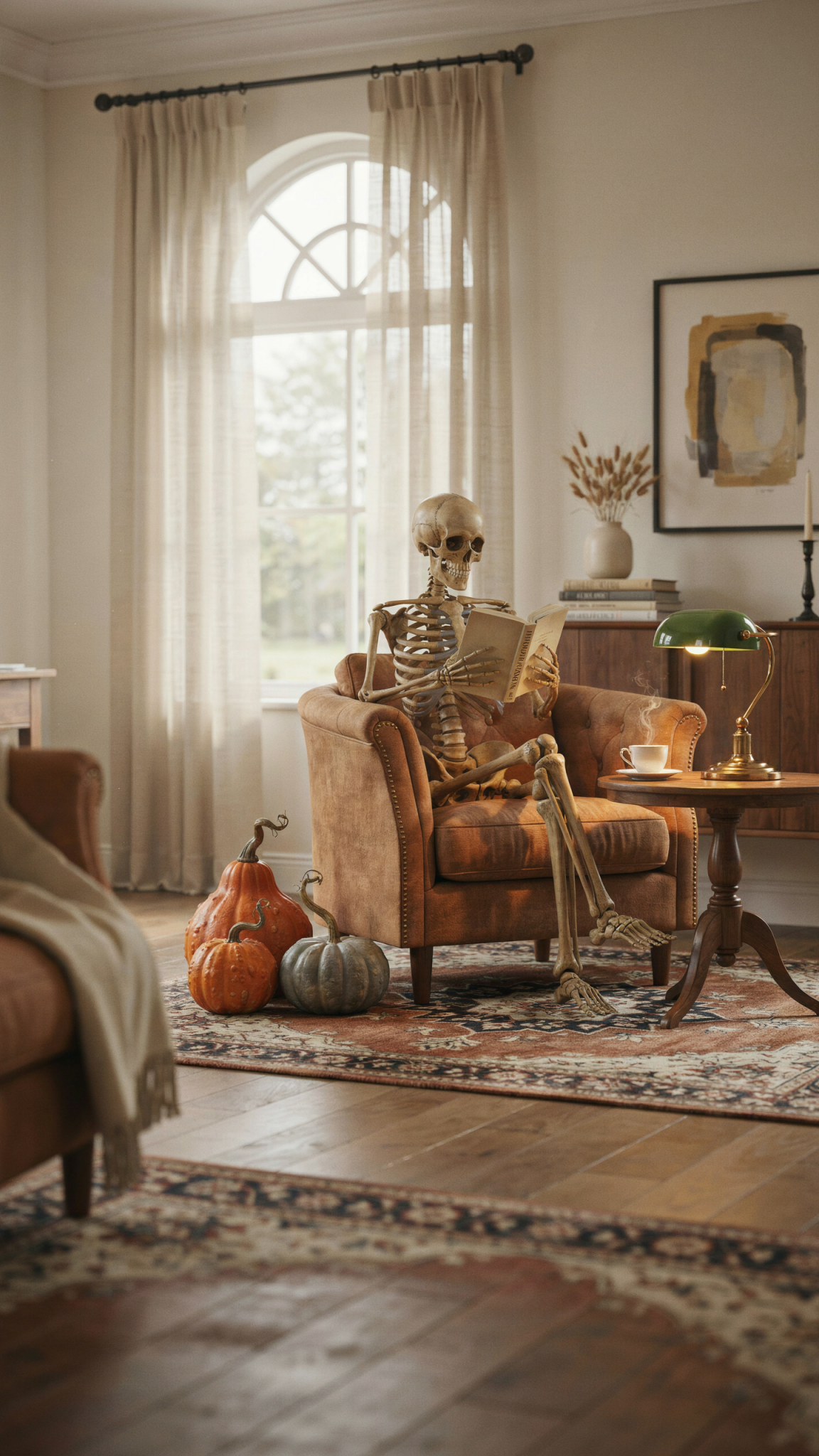
Skeletons have become Halloween decorating staples for good reason. They are inherently funny. Instead of simply standing a skeleton in the corner, designers often treat it almost like another person in the room. Sit one at the dining table. Let one read a book in an armchair. Place one at the piano. Have a skeleton hold a serving tray at a party. Put one on the porch drinking coffee. Humor creates memorable decorating moments. And because skeletons are neutral in color, they actually work surprisingly well with sophisticated interiors. The trick is restraint. One skeleton doing something funny can be far more effective than five skeletons randomly positioned around a room.
18. Create One Unexpected Moment
Great decorating usually contains an element of surprise. Halloween gives you permission to push this idea further. Put a giant spider somewhere visitors won’t notice immediately. Hide tiny mice along the baseboards. Place glowing eyes in the bushes. Hang a ghost outside a second-story window. Let a skeleton peek through a glass door. Place a miniature Halloween scene inside a cabinet. These details reward people for looking around. Children especially love discovering Halloween surprises throughout a house. Not every decoration needs to announce itself from across the room. Some of the best ones are discovered.
19. Style the Kitchen Without Covering Every Counter
Kitchens can be tricky because seasonal decorations compete with functional space. Keep most countertops clear. Instead, choose one or two areas. A kitchen island is perfect for a large bowl filled with mini pumpkins. Open shelves can receive a few black or orange accents. A cake stand can display Halloween treats. A large vase of dark branches can sit on the counter. If you have glass-front cabinets, subtly introducing black dishes, amber glass, or seasonal mugs can change the mood without cluttering the room. Food can also become décor. A jar filled with candy corn, a bowl of apples, caramel apples on a cake stand, or beautifully decorated Halloween cookies instantly communicates the season.
20. Turn the Dining Table Into an Experience
Halloween tablescapes are an opportunity to be theatrical. Start with a base layer. This might be a linen tablecloth, dark runner, or simply the bare wood of the table. Then create a centerpiece that runs lengthwise rather than building one enormous arrangement that blocks conversation. Scatter pumpkins.
Add moss or branches. Mix candlesticks at different heights. Use small bud vases with dark flowers. Tuck in subtle spiders or miniature skulls. Black napkins can make ordinary dishes feel Halloween-ready. Vintage silverware and mismatched glassware can create a collected, old-world feeling. And don’t feel obligated to use Halloween plates. Plain white dishes often provide exactly the visual break an elaborate table needs.
21. Think Beyond Orange Flowers
Florals can completely change Halloween décor. Instead of a traditional bouquet, look for flowers with unusual shapes and deep colors. Burgundy dahlias, dark red roses, purple calla lilies, chocolate cosmos, rust chrysanthemums, and dried hydrangeas can all create a wonderfully moody arrangement. Greenery can be equally dramatic. Eucalyptus, olive branches, magnolia leaves, and trailing vines provide movement. You can also create arrangements entirely from branches. For something intentionally eerie, allow the arrangement to be imperfect and sprawling rather than neat and symmetrical. Halloween is one occasion where flowers can look slightly wild.
22. Decorate Vertically
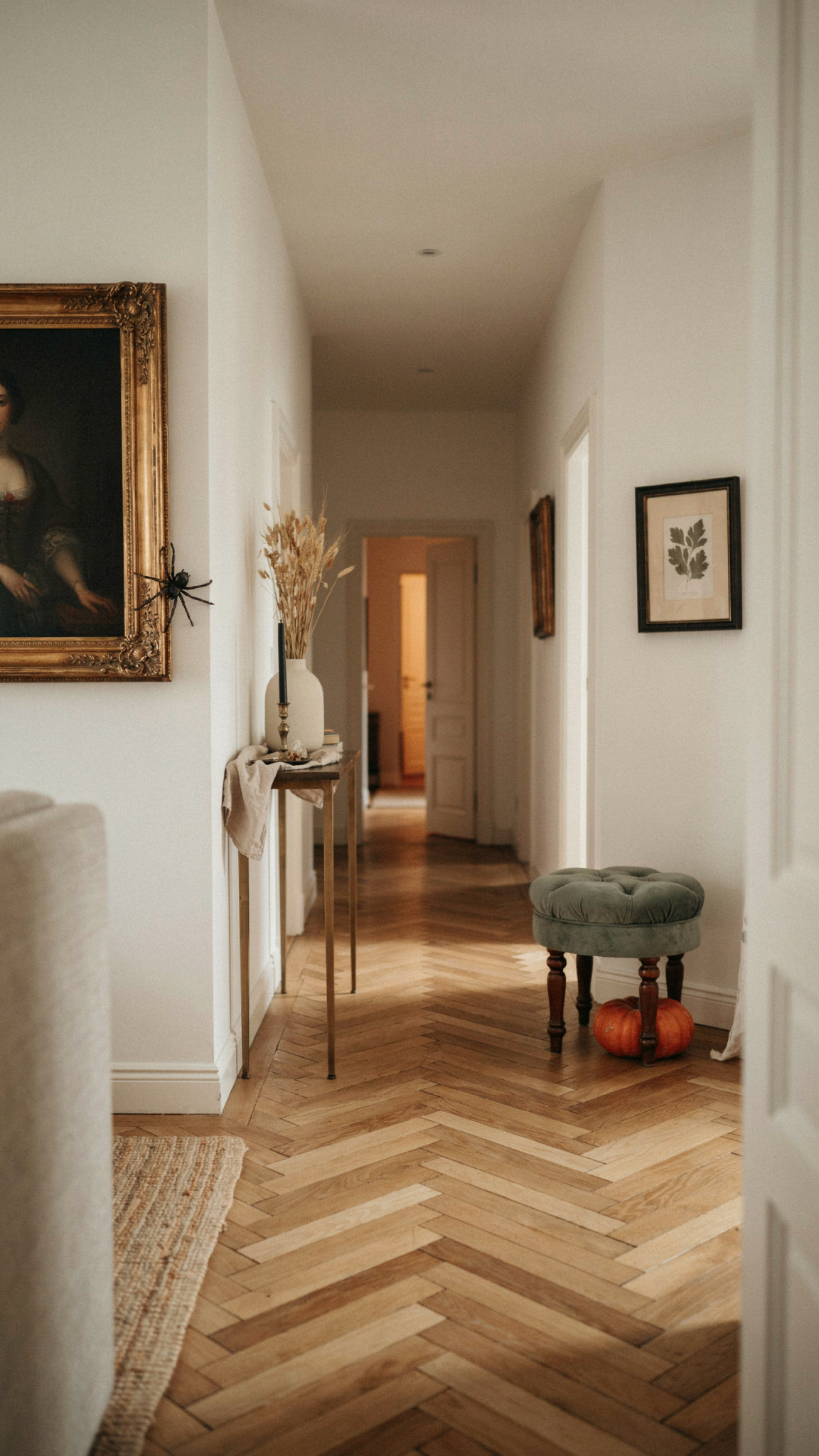
A common decorating mistake is keeping everything at tabletop height. Designers use the entire visual field. Hang decorations from ceilings. Place branches that extend upward. Allow bats to climb walls. Decorate above doorways. Hang wreaths on interior doors. Use tall candlesticks and floor-standing lanterns. Vertical decorating creates immersion. Floating witch hats are especially effective in an entry or covered porch because they occupy space that is normally empty. Even a simple room can feel completely transformed when decorations move beyond the furniture.
23. Don’t Forget the Floor
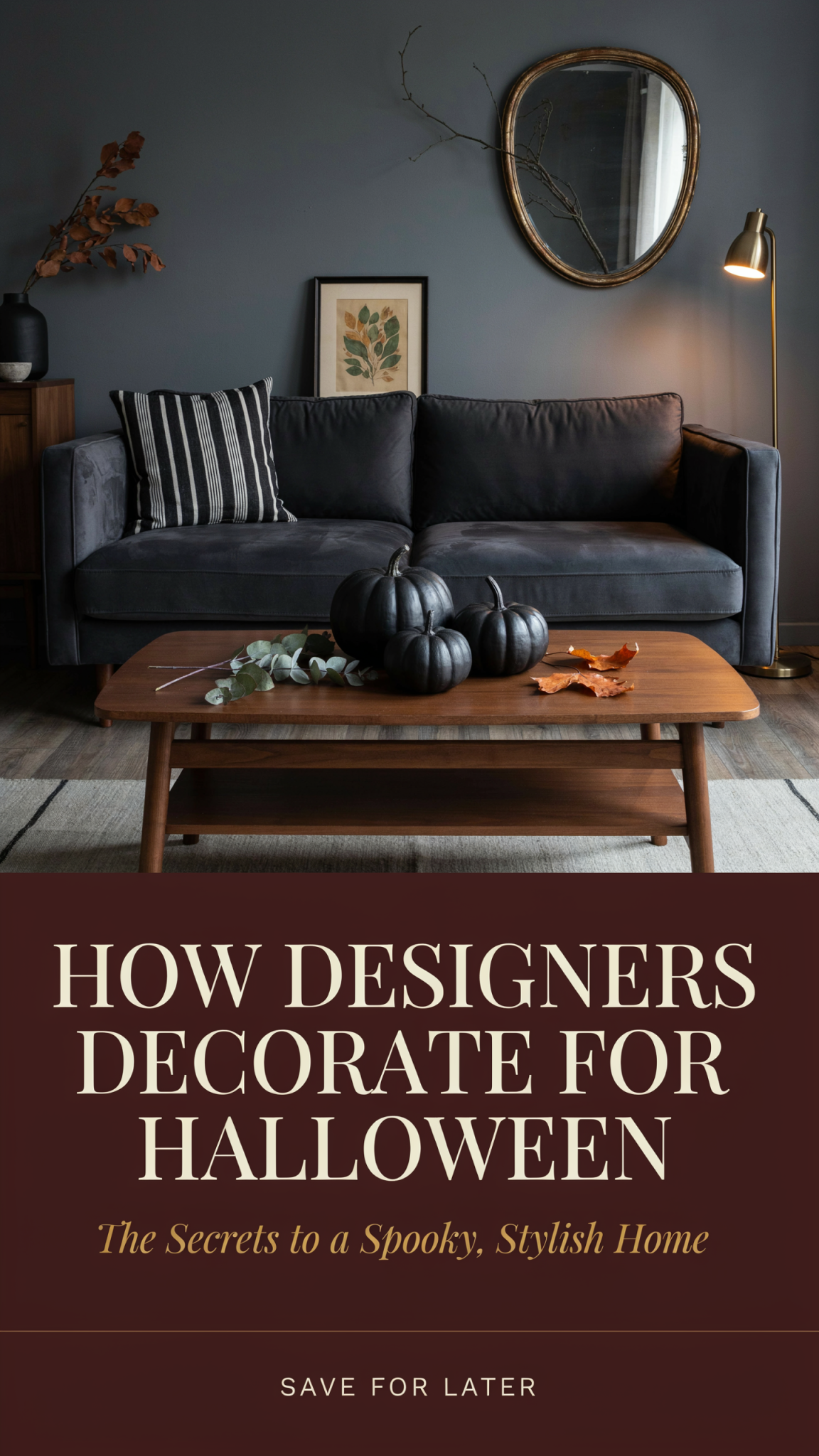
The opposite is also true. Some Halloween decorations should live low. Pumpkins clustered beneath a console table help ground a display. Lanterns look wonderful sitting directly on the floor. A basket filled with blankets can incorporate autumn colors. Small mice silhouettes running along the baseboard create an inexpensive surprise. A skeleton dog beside the fireplace adds humor without cluttering a tabletop. Using different heights makes seasonal decorating feel dimensional.
24. Make the Porch Tell One Strong Story
Outdoor Halloween decorating can become chaotic particularly quickly because the scale is larger. Instead of trying to use every Halloween theme at once, choose a story. Perhaps your house has been invaded by spiders. Use giant spiders crawling across the exterior, webs concentrated around the porch, and a few smaller spiders leading toward the front door. Maybe it is a pumpkin house. Cover the steps with pumpkins, place jack-o’-lanterns near the door, and add warm lanterns. Or create a ghostly porch with white fabric ghosts floating from trees and subtle white pumpkins below. A strong theme allows even elaborate outdoor decorating to feel cohesive.
25. Layer the Front Steps
Front steps are one of the best places to use abundance. Pumpkins look particularly beautiful when they cascade organically rather than being positioned one per step. Start with larger pumpkins near the bottom and around the doorway. Fill gaps with medium and smaller pumpkins. Mix colors and shapes. Then layer in lanterns, mums, branches, or baskets. For Halloween, add a few strategic spooky details: perhaps rats tucked among the pumpkins, black crows sitting on the railing, or spiders climbing toward the door. The fall décor creates the foundation. Halloween becomes the final layer.
26. Use Black as Punctuation
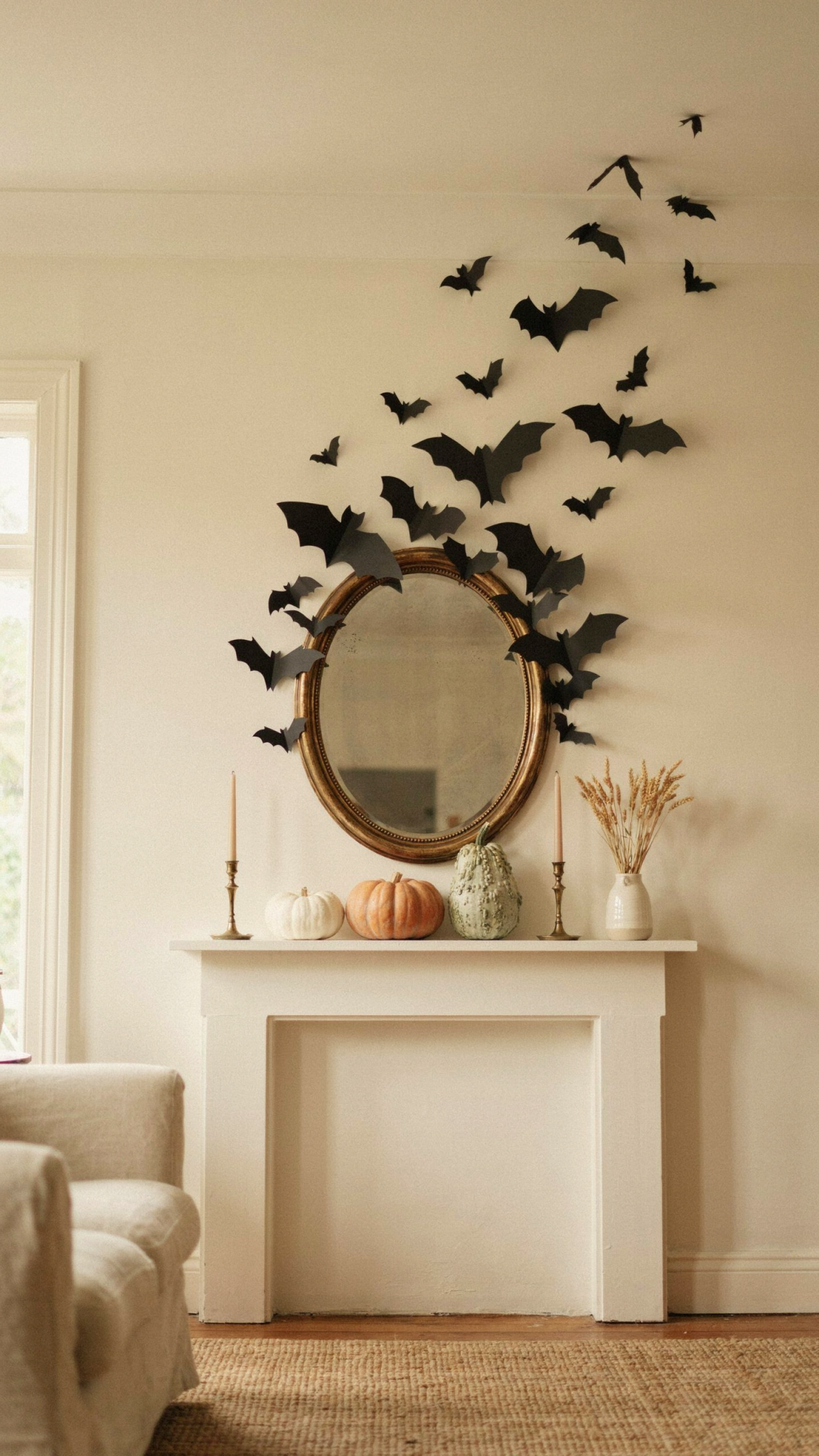
You don’t need to turn your house black to make it feel like Halloween. Instead, use black strategically. Think of it like punctuation. A black taper candle. A black ribbon around a wreath. Several black bats. A dark pillow. A black vase. A small raven. Repeated throughout the room, these elements create rhythm. This is especially effective in neutral homes where too much orange might feel disconnected from the existing palette. Black works with nearly every interior style, which makes it one of the easiest ways to introduce Halloween without changing the character of your home.
27. Avoid Too Many Signs and Words
Halloween signs can be adorable, but words naturally command attention. If every room contains signs saying “BOO,” “SPOOKY,” “TRICK OR TREAT,” “HOCUS POCUS,” and “HEY BOO,” your eye ends up reading the room rather than experiencing it. Designers generally use typography sparingly. Choose one or two signs you genuinely love. Then allow objects, texture, lighting, and color to communicate Halloween everywhere else. A beautifully carved pumpkin doesn’t need a sign explaining that it is October.
28. Mix Cute With Creepy
A sophisticated Halloween house doesn’t need to be sophisticated every second. Contrast is what makes decorating interesting. An elegant antique console can hold a silly ceramic ghost. A serious dining room can have miniature skeletons seated at the table. A beautifully styled bookshelf can include one tiny spider. An elaborate arrangement of branches can have bats hidden among them. These unexpected combinations prevent the house from feeling like a showroom. Halloween should still make people smile.
29. Give Kids a Place to Go All In
If you love restrained Halloween décor but your children love purple lights, googly-eyed monsters, glitter pumpkins, and everything that glows in the dark, you don’t necessarily need to choose. Give them territory. A playroom, bedroom, craft area, or kids’ bathroom can become Halloween headquarters. Let them make paper ghosts. Hang their homemade decorations. Display Halloween artwork. Create a shelf of spooky books. Add window clings and colorful lights. This actually makes the rest of the house easier to edit because there is already a place where Halloween can be wonderfully excessive. Designer decorating does not mean removing personality. It means giving different ideas the right place to shine.
30. Make Halloween Interactive
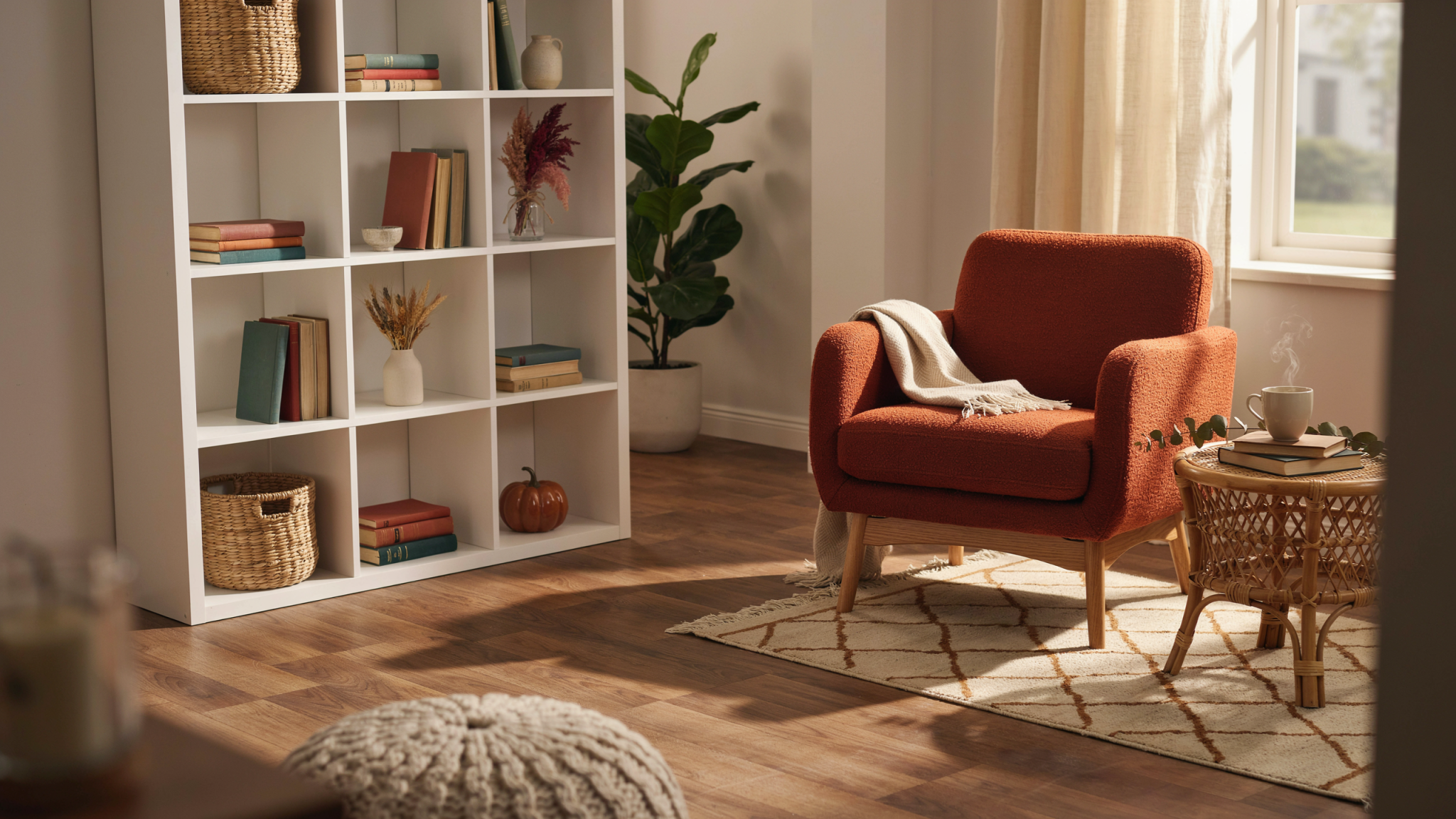
The most memorable Halloween homes aren’t necessarily the ones with the most beautiful decorations. They are the ones people experience. Fill a bowl with Halloween candy. Create a basket of spooky books near the sofa. Set out a Halloween puzzle. Place a cauldron near the entry for treats. Make a simple potion-making station for children. Leave pumpkins available for painting. Create a Halloween movie basket with popcorn, blankets, and favorite films. A home isn’t a photograph. The best decorating encourages people to actually enjoy the season.
31. Let Some Rooms Stay Normal
You do not have to decorate every room. In fact, you probably shouldn’t. Leaving visual breaks makes the decorated spaces feel more special. Perhaps the primary bedroom stays calm. Maybe the home office remains mostly unchanged. The guest bathroom might receive only a seasonal hand towel and small pumpkin. Restraint creates contrast. When visitors move from an ordinary hallway into a dramatically decorated dining room, the transformation feels much stronger.
32. Create a Day-to-Night Transformation
When you finish decorating, evaluate the house twice. First during the day. Then again after sunset. You may discover that something that looks beautiful at noon disappears completely at night. Or that your overhead lighting destroys the atmosphere you worked so hard to create. Experiment. Turn off the ceiling lights. Switch on table lamps. Light candles. Add a small lamp to a dark corner. Place battery-operated candles inside jack-o’-lanterns. Add discreet string lights to an arrangement of branches. At night, Halloween becomes less about the objects themselves and more about the shadows they create.
33. DIY the Things You Need in Quantity
Designer-looking Halloween décor doesn’t have to be expensive. In fact, many of the best effects depend on inexpensive materials used in large quantities. Cut bats from black cardstock. Make ghosts from cheesecloth. Paint inexpensive pumpkins. Create paper silhouettes for windows. Use branches from the yard. Tie black ribbon around existing wreaths. Print vintage Halloween images for frames. Make giant spiders from inexpensive craft materials.
When an idea requires twenty or thirty pieces, DIY often makes much more sense than buying each one individually. Spend your money on a few pieces you will use year after year. Make the rest.
34. Invest in a Small Halloween Capsule Collection
Instead of accumulating random seasonal décor indefinitely, create a Halloween capsule collection. Choose several foundational pieces that work with your home and can be restyled every year.
This might include: A collection of brass candlesticks. Several high-quality faux pumpkins. A large black urn. Battery-operated taper candles. A beautiful Halloween wreath. A set of black lanterns. A few realistic ravens. An oversized spider. Neutral skeletons. A collection of paper or reusable bats.
Each year, combine these pieces differently. Add inexpensive natural materials and one or two new accents. Over time, your Halloween collection becomes more cohesive rather than simply larger.
35. Know When to Stop
Perhaps the most important designer skill is knowing when a room is finished. Halloween makes this difficult because seasonal décor is fun. There is always another empty corner. Another shelf. Another pumpkin. Another ghost. When you think you are finished, walk out of the room. Come back several minutes later and notice where your eye goes first.
Is there a clear focal point? Can you appreciate individual decorations? Does anything feel crowded? Does your eye have somewhere to rest? Try taking a photograph. Photographs are remarkably good at revealing clutter we stop noticing in person. Then remove one or two things. Designers edit constantly. Seasonal decorating is no different.
The Designer Formula for Halloween Decorating
The most stylish Halloween homes aren’t necessarily the homes with the most expensive decorations.
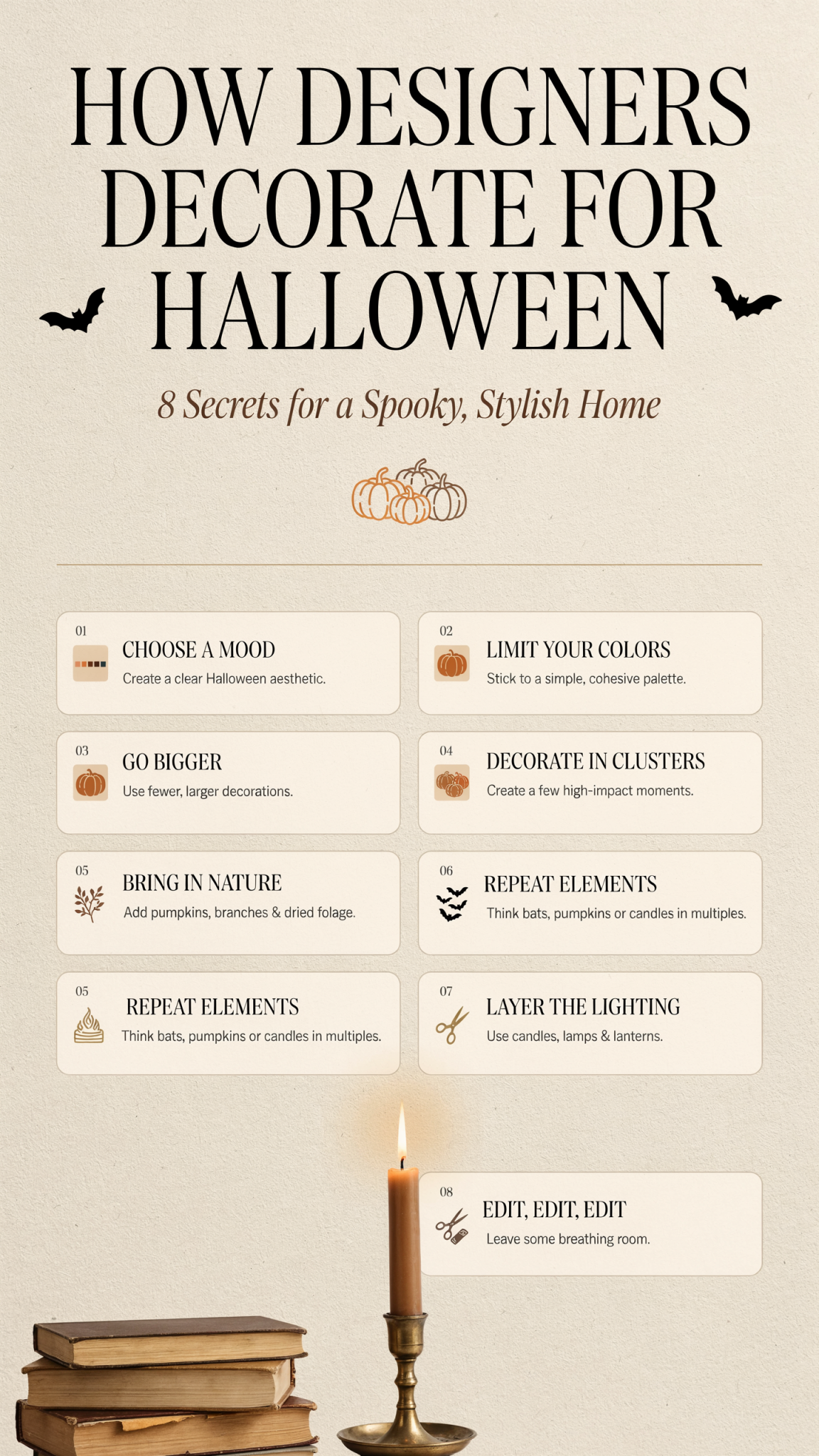
They are the homes where someone has thought about the experience as a whole. There is a color palette. There is repetition. There are changes in scale. There are focal points and quiet moments. Natural materials soften manufactured decorations. Old objects mix with new ones. Lighting changes the atmosphere.
Humor keeps things from becoming too serious. And above all, the Halloween decorations still feel connected to the people who live there. If you remember only one thing, make it this: Decorate for a feeling before you decorate for a holiday.Ask yourself what you want your home to feel like on an October evening.
Maybe you imagine the glow of candles reflected in an old mirror. Pumpkins spill down the front steps. Bare branches cast strange shadows against the wall. A handful of bats appears to be escaping through the entryway. Somewhere on the bookshelf, a tiny ghost makes your children laugh every time they notice it.
That is the magic designers are trying to create. Not simply a house filled with Halloween decorations.A house that feels different because Halloween has arrived.And sometimes all it takes is a few crooked branches, thirty paper bats, a pile of pumpkins, and the lights turned down low.