In a world obsessed with the flawless, the pristine, and the eternally new, there is a quiet rebellion taking place in our homes. It’s a move away from the manufactured and the mass-produced, and a return to materials that are honest, authentic, and have a story to tell. This is where soapstone enters the conversation, not just as a countertop material, but as a statement. It’s a choice for those who understand that the most beautiful things in life are not perfect, but are made more beautiful by their imperfections.
I’ve had a love affair with soapstone for over a decade. It has graced the kitchens of my last two homes, a silent, steadfast partner in countless family meals, late-night conversations, and creative endeavors. There’s a warmth to it, a soft, velvety touch that belies its incredible durability. It doesn’t shout for attention like a dramatically veined marble or gleam with the sterile perfection of engineered quartz. Instead, it whispers. It has a subtle, moody depth that changes with the light, a living finish that evolves with you.
Choosing soapstone is a commitment to a different kind of beauty. It’s an embrace of the Japanese concept of wabi-sabi—the art of finding beauty in imperfection and profundity in nature. It’s for those who aren’t afraid of a scratch here or a water ring there, because they understand that these are not flaws; they are memories. They are the patina of a life well-lived. This article is more than just a list of pros and cons. It’s an exploration of a material that challenges our modern obsession with perfection and invites us to create a home that is not just beautiful, but soulful. but soulful.
The Alchemist’s Stone: What Exactly Is Soapstone?
At its heart, soapstone is a metamorphic rock, a humble testament to the immense power of time and pressure. Composed primarily of talc, it possesses a softness that is unique among natural stones. This high talc content is what gives soapstone its signature “soapy,” velvety feel—a tactile experience that is both grounding and deeply satisfying. But don’t let its softness fool you. This is not a delicate material. It’s incredibly dense and non-porous, qualities that make it a formidable opponent against stains and bacteria.
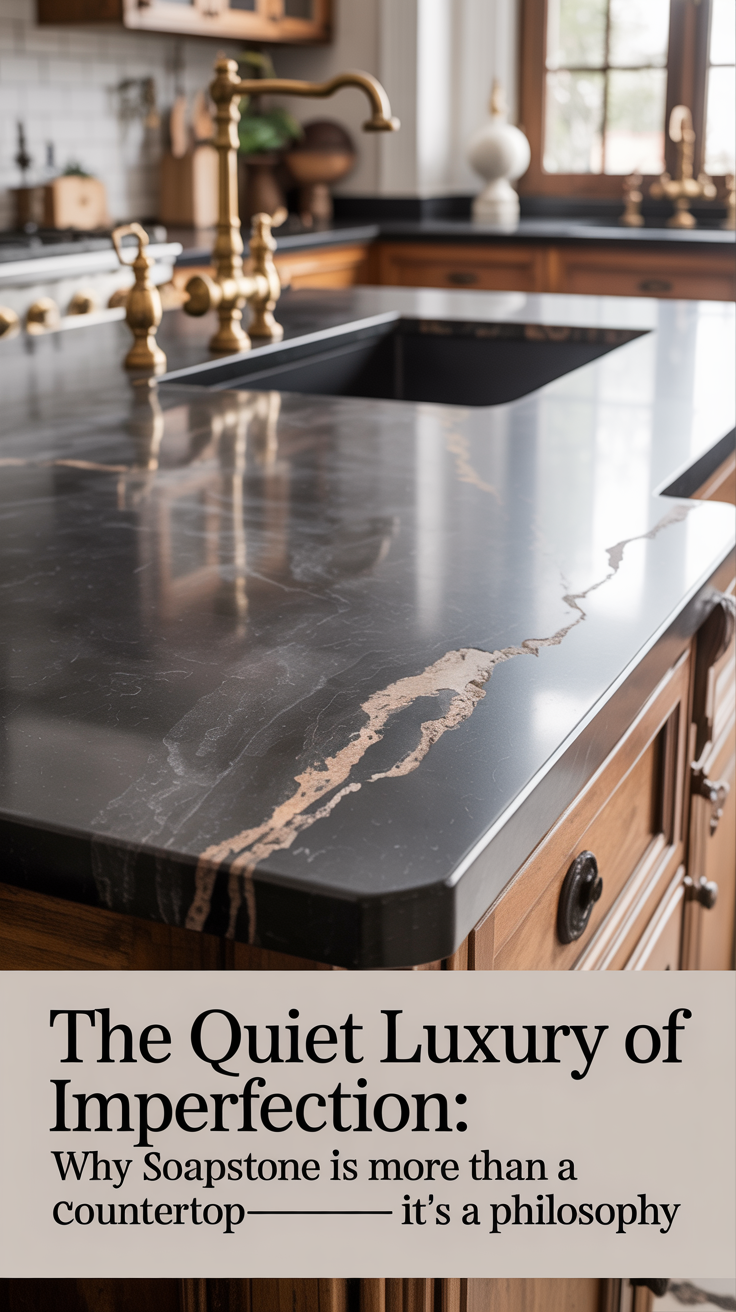
Visually, soapstone is the moody, introspective poet of the stone world. It typically appears in a palette of soft grays, deep charcoals, and sometimes, a surprising and beautiful shade of green. Its veining is subtle and gentle, like whispers rather than shouts, adding a quiet sense of movement and depth. But the true magic of soapstone lies in its transformative nature. Fresh from the quarry, it has a light, almost ethereal gray color. Over time, through a process of oxidation and daily life, it begins to darken, developing a rich, complex patina. This is the “living finish” that soapstone lovers covet. It’s a slow, graceful evolution, a visual record of the life that unfolds around it. Each scratch, each water mark, each subtle shift in color becomes a part of its story, a chapter in the narrative of your home.
The Duality of a Living Stone: Embracing Both the Light and the Shadow
To love soapstone is to love its duality. It is a material of beautiful contradictions, a stone that is both soft and strong, timeless and ever-changing. Understanding its unique character requires looking beyond a simple list of pros and cons and embracing the whole, complex picture.
On one hand, soapstone is a workhorse of almost mythical proportions. Its geological origins have blessed it with an incredible density, making it virtually impervious to stains. That terrifying splash of red wine, the dreaded turmeric spill, the forgotten puddle of lemon juice—they are no match for soapstone’s non-porous nature. They simply cannot penetrate the surface. This same quality makes it inherently antibacterial, a reassuring thought in the heart of the home. And then there is its legendary heat resistance. This is not an exaggeration. You can take a pot of boiling pasta directly from the stove and set it on the counter without a moment’s hesitation. For a passionate home cook, this is a freedom that is nothing short of revolutionary. It’s a material that invites you to live in your kitchen, to be messy, to be creative, to cook with abandon.
But the very quality that gives soapstone its soft, velvety touch—its high talc content—is also the source of its vulnerability. Soapstone is soft. It will scratch. A carelessly dragged ceramic bowl, a dropped knife, the metal buttons on your jeans as you lean against the counter—they can all leave their mark. And for many, this is where the love affair ends. The first scratch can feel like a betrayal, a flaw in the otherwise perfect surface. But this is where the soapstone philosophy truly begins. A scratch on soapstone is not a wound; it is a memory. It is a part of the story. Most minor scratches can be easily buffed out with a bit of fine-grit sandpaper or simply disguised with a touch of mineral oil. Over time, these small marks blend into the overall patina, becoming a part of the rich, textured history of your kitchen. It’s a shift in perspective, a letting go of the need for flawless perfection, and an embrace of the beauty of a life well-lived.
A World of Whispers: Exploring the Varieties of Soapstone
To speak of soapstone as a single entity is to do it a disservice. Within this family of stone lies a world of subtle variation, a spectrum of moods and personalities. While it doesn’t boast the dramatic flair of marble or the kaleidoscopic variety of granite, its nuances are a study in quiet beauty. The two main categories you’ll encounter are artistic and architectural soapstone. Artistic soapstone, with its higher talc content, is incredibly soft and is the material of choice for sculptors. It’s not suitable for countertops. What we are interested in is architectural soapstone, which has a lower talc content and is therefore harder and more durable.
Within the architectural category, you’ll find a beautiful range of options, each with its own unique character:
- Classic Grays: This is the quintessential soapstone look. Varieties like Julia or Barroca offer a soft, uniform gray with minimal, delicate veining. They are the quiet, dependable workhorses of the soapstone world, offering a timeless, versatile backdrop for any kitchen design.
- Dramatic Darks: For those who crave a bit more drama, varieties like Stormy Black or PA Original offer a deeper, almost black, base with more pronounced white or green veining. These stones have a bold, graphic quality that can be a stunning focal point in a modern kitchen.
- The Green Enigma: One of the most enchanting characteristics of soapstone is its occasional hint of green. Varieties like Belvedere or Green Mountain have a distinct green undertone that can range from a subtle, mossy hue to a deep, forest green. This is a nod to soapstone’s geological connection to serpentine, and it adds a layer of unexpected color and complexity.
Choosing a variety of soapstone is a deeply personal process. It’s about finding the stone that speaks to you, the one whose subtle whispers resonate with the story you want your home to tell. It’s a treasure hunt, and the prize is a piece of the earth that is as unique as you are.
The Art of the Supporting Actor: Designing with Soapstone
In the theater of kitchen design, some materials are destined for the leading role. They are the divas, the scene-stealers, the ones that demand all the attention. Soapstone is not one of them. Soapstone is the consummate supporting actor. It’s the one that makes everyone else on stage look better. Its quiet, understated beauty provides the perfect backdrop for other materials to shine.
This is the secret to designing with soapstone: let it be the foundation, the canvas upon which you layer other textures and colors. Its neutral, moody tones are incredibly versatile, pairing beautifully with a wide range of cabinet colors, from crisp whites and soft creams to bold navys and deep, forest greens. It has a magical ability to bridge the gap between different metal finishes, allowing you to confidently mix brass hardware with a polished nickel faucet.
But its true genius lies in its ability to amplify the beauty of other natural materials. A rustic wooden cutting board placed on a soapstone counter suddenly looks richer, its grain more pronounced. A simple ceramic vase filled with wildflowers feels more artisanal, more special. A hand-woven linen tea towel seems more textural, more inviting. Soapstone doesn’t compete; it complements. It’s the quiet, confident presence that brings a sense of harmony and balance to the entire composition. It’s the secret ingredient that makes a good kitchen design great.
The Care and Keeping of a Living Stone: A Relationship, Not a Chore
Caring for soapstone is less about maintenance and more about developing a relationship. It doesn’t demand the constant vigilance that marble requires, nor does it need the periodic sealing of granite. It is a low-maintenance partner, but that doesn’t mean it thrives on neglect. It simply asks for a different kind of attention.
Your primary choice in this relationship is whether to oil or not to oil. Oiling or waxing your soapstone will accelerate the natural darkening process, bringing out a deep, rich black color and making the veining pop. It will also help to disguise minor scratches and create a more uniform, even appearance. This is a purely aesthetic choice. Some people love the dramatic, saturated look of an oiled soapstone, while others prefer the soft, natural gray of its unoiled state. If you choose to oil, it’s a simple process: wipe on a thin layer of food-grade mineral oil or a specially formulated soapstone wax, let it sit for a few hours, and then buff off the excess. You’ll need to do this more frequently at first, and then less often as the stone develops its patina.
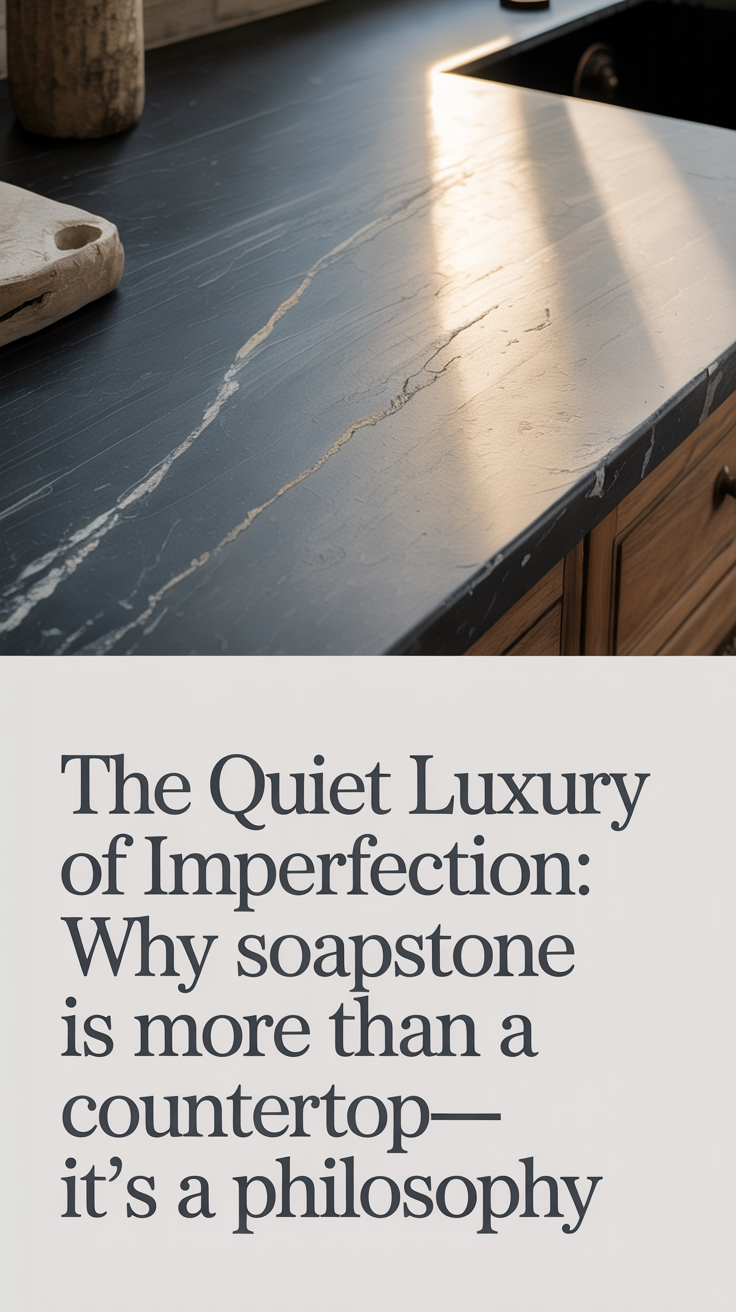
If you choose to leave your soapstone unoiled, you are choosing to embrace its evolution in real-time. You’ll see the areas around your sink and prep zones darken faster than the less-used corners. You’ll witness the subtle changes in color and texture as the stone responds to the light and the life around it. It’s a more organic, unpredictable path, and there is a certain beauty in that.
As for scratches, they will happen. And when they do, you have a choice. You can see them as flaws and rush to sand them out with a fine-grit sandpaper (which is surprisingly easy to do). Or, you can see them as memories, as part of the story of your home, and let them be. This is the heart of the soapstone philosophy. It’s a material that teaches us to let go of the need for perfection and to find beauty in the marks of a life well-lived.
A Countertop with a Soul
In the end, the decision to choose soapstone is a decision about what you value. If you value flawlessness, predictability, and a surface that will look the same on day one as it does on day one thousand, then soapstone is not for you. But if you value authenticity, character, and a material that will evolve with you, that will bear the marks of your life and your love, then you may have just found your soulmate in stone.
Soapstone is more than just a countertop. It’s a quiet rebellion against the cult of perfection. It’s a daily reminder that the most beautiful things in life are not those that are flawless, but those that have been loved, used, and have a story to tell. It’s a countertop with a soul, and in a world that is increasingly manufactured and disposable, that is a luxury worth choosing.