If you have ever stepped out onto your back porch and felt like you were standing in a bowling alley, you are not alone. The long, narrow covered patio is one of the most common architectural features in modern home builds, yet it remains one of the most perplexing spaces to decorate. It is a classic design dilemma: you have all this covered square footage, but because it is stretched out and skinny, figuring out how to actually use it feels like solving a puzzle where none of the pieces quite fit.
I have stared down this exact dilemma myself. You buy the house, thrilled about the “covered outdoor living space,” only to realize that your standard patio furniture set looks ridiculous lined up against the wall like a waiting room at the dentist’s office. If you try to face the furniture toward each other, suddenly no one can walk past without awkwardly squeezing by. It is frustrating, but I am here to tell you that this awkward, tunnel-like space has incredible potential. You just have to stop treating it like a standard square room and start playing by a different set of design rules.
In honor of recenlty “finishing” our rectangular patio, I want to how to tackle the long, narrow covered patio into a beautiful, non-weird space. I’ll share some tricks on how to make the space feel wider, how to arrange furniture so people can actually walk, and how to turn that awkward bowling alley into the most used “room” in your house.
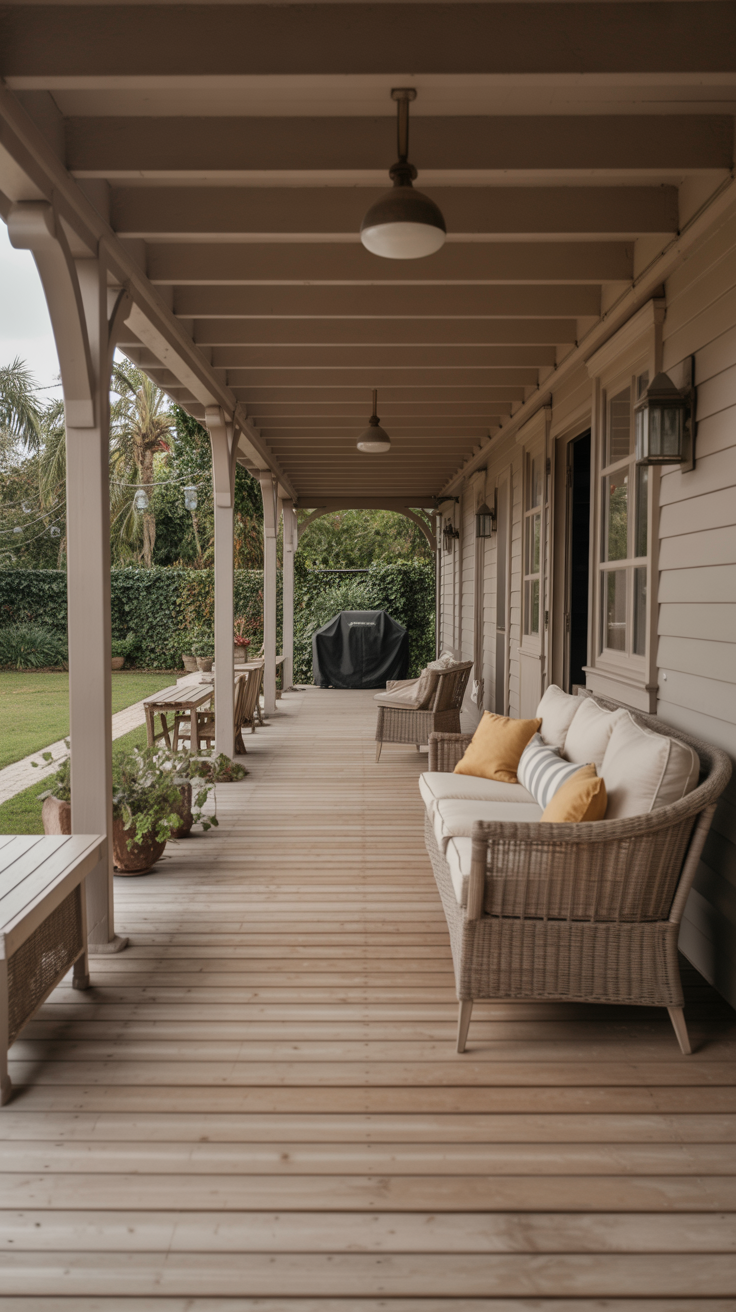
The Core Problem: Why Narrow Patios Feel So Awkward
Before we can fix the problem, we have to understand why long, narrow spaces feel so uncomfortable to begin with. It comes down to a mix of visual psychology and practical traffic flow.
When you step into a space that is significantly longer than it is wide, your eye is naturally drawn straight down the length of it, right to the far end. This creates a “tunnel effect.” Because there is nothing to stop your eye from zooming to the finish line, the narrowness of the side walls feels even more pronounced.
Practically speaking, the issue is traffic flow. In a square room, you can float furniture in the middle and walk around the perimeter. In a narrow space, the walkway has to go right through the middle of the room, or right along one edge. If your patio is only six to eight feet wide, placing a standard sofa and coffee table immediately eats up your walkway. You are left with a space where people are constantly tripping over each other, which is the exact opposite of the relaxing outdoor oasis you are trying to create.
The secret to fixing this is twofold: you have to visually widen the space, and you have to physically break it up.
Rule #1: Stop Treating It Like One Big Room
The single biggest mistake people make with a long, narrow patio is trying to furnish it as one continuous space. If you put a dining table at one end and a sofa at the other, but leave the middle empty, the space just looks like a hallway connecting two different rooms. If you try to spread one giant seating arrangement across the whole length, people end up sitting too far apart to actually have a conversation.
The solution is zoning. You have to divide and conquer.
Instead of looking at your patio as one 30-foot-long room, look at it as three 10-foot-long rooms (or two 15-foot rooms, depending on your dimensions). By creating distinct, purposeful zones, you stop the eye from traveling all the way down the tunnel. You force the eye to stop and take in each individual area, which makes the overall space feel much more intentional and significantly wider.
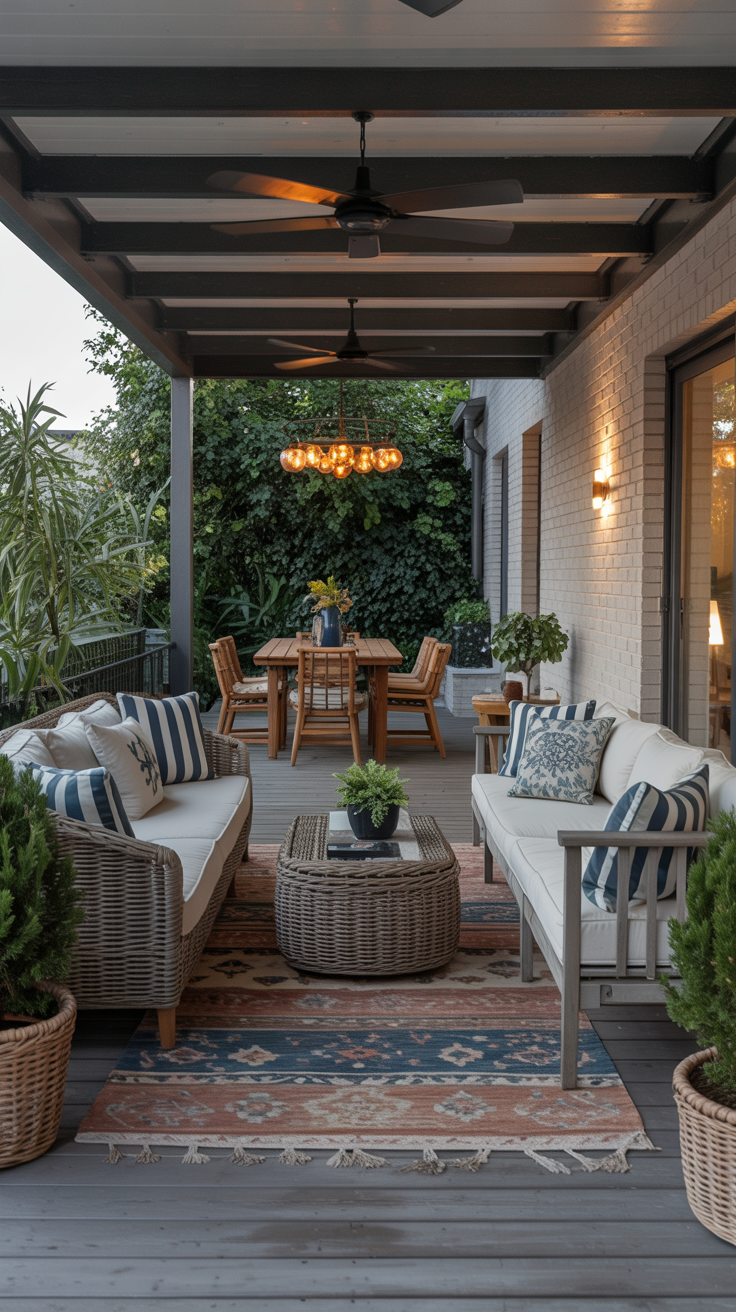
How to Define Your Zones
Creating zones doesn’t mean putting up physical walls; it means using visual cues to tell the brain, “This area is for eating, and this area is for lounging.”
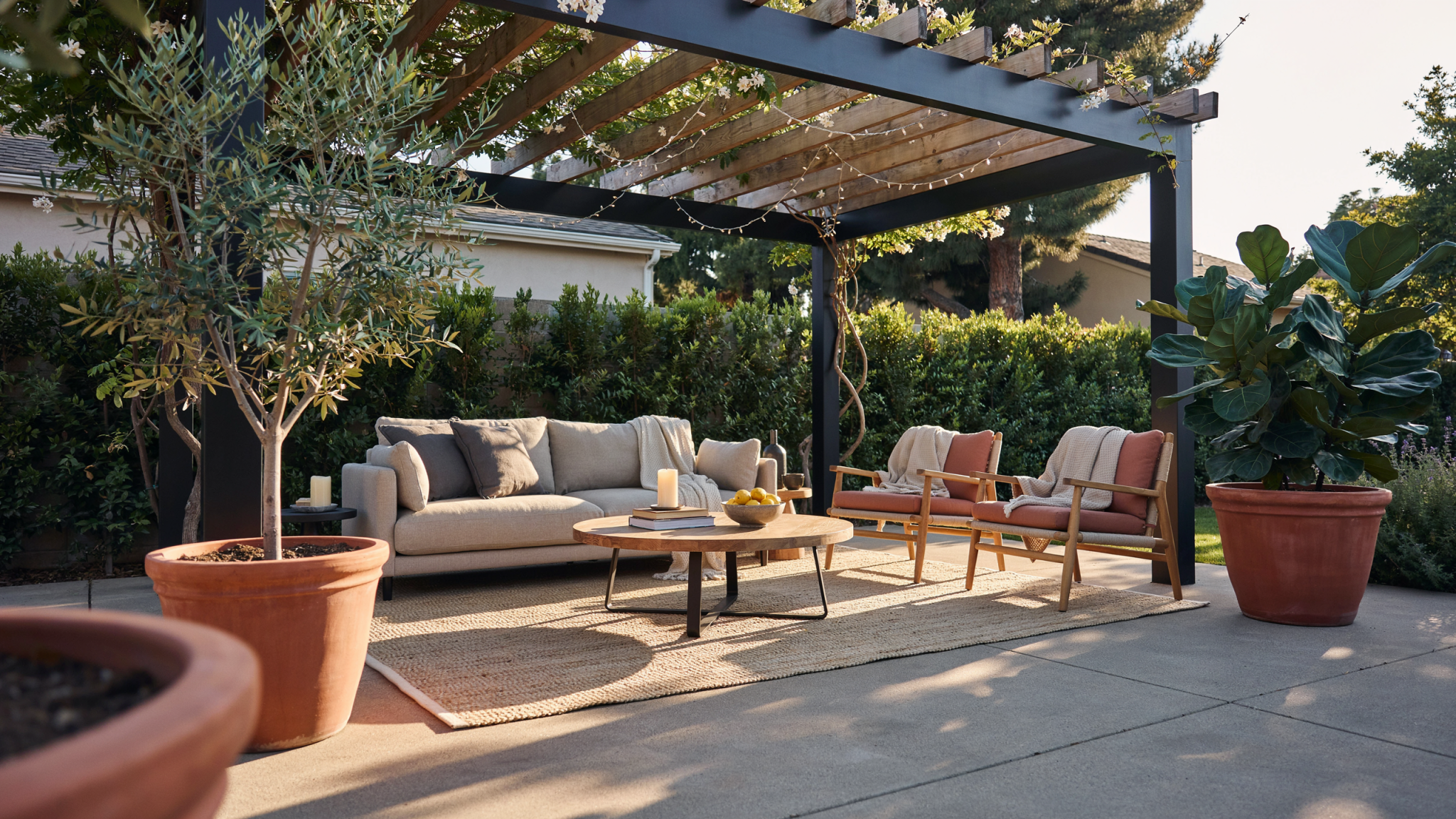
Outdoor Rugs are Your Best Friend: The easiest and most effective way to define a zone is with an outdoor rug. If you have a seating area, anchor it with a rug. If you have a dining area, put a rug under the table. The rugs act as visual boundaries. When you have two or three distinct rugs breaking up the long expanse of concrete or decking, the tunnel effect is instantly diminished.
Change the Lighting: Lighting is another powerful zoning tool. If your covered patio just has a row of identical recessed lights down the center, it reinforces the runway feeling. Instead, hang a statement pendant or chandelier over the dining zone. In the seating zone, use a floor lamp or string lights draped across the ceiling. Different lighting styles signal different functions.
Use Furniture as Dividers: You can use the back of a sofa or a pair of chairs to create a barrier between zones. A narrow console table placed behind a floating sofa can act as a room divider while also providing a place to set drinks or display potted plants.
Rule #2: Master the Traffic Flow
In a narrow space, traffic flow is king. If people have to turn sideways to shimmy past a chair, the design has failed, no matter how pretty it looks.
When planning your layout, you must establish a clear, unobstructed pathway. Generally, you need a minimum of 24 to 30 inches of clearance for a comfortable walkway. In a narrow patio, this usually means pushing the main traffic artery to one side of the space, rather than trying to route it through the middle. Practically speaking, a walkway on the edge keeps furniture further from the immediate heavy runoff of the roofline anyway.
The “One-Sided” Layout Strategy
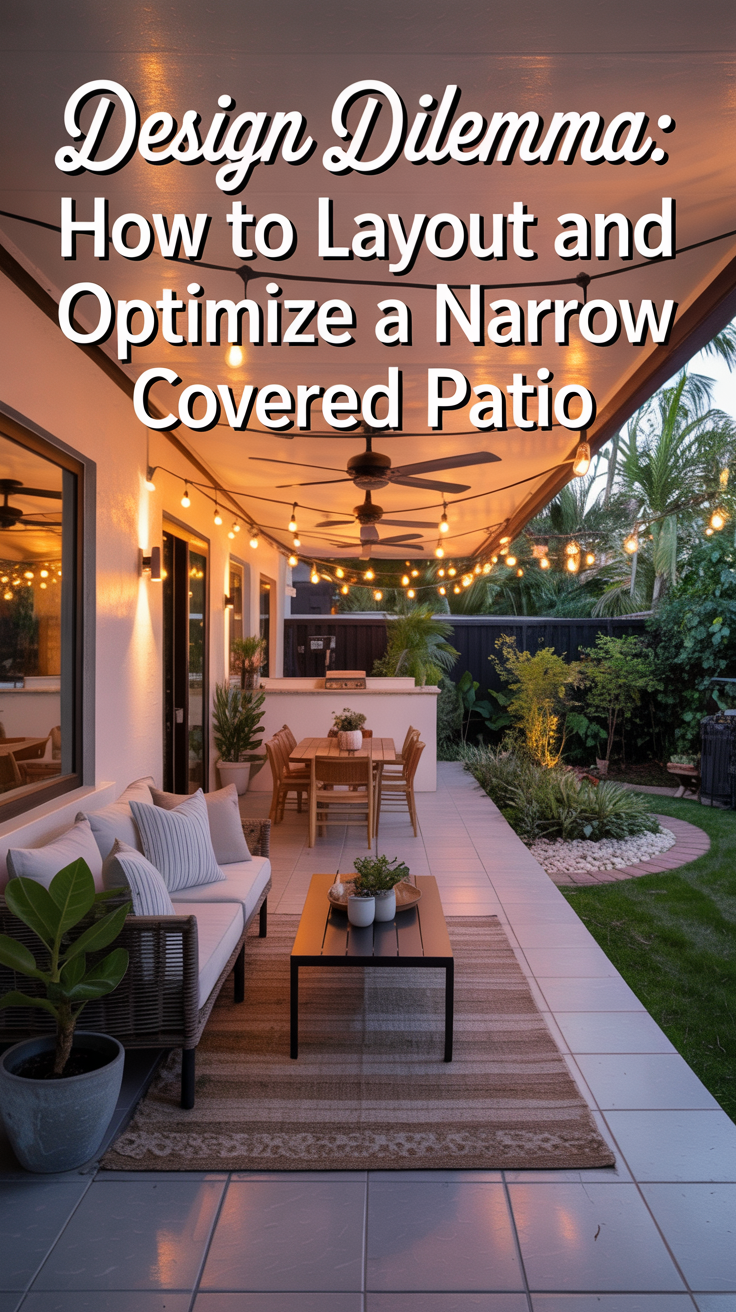
If your patio is extremely narrow (say, six to eight feet wide), your best bet is to align your furniture along the back wall of the house, leaving the outer edge (the side facing the yard) open as your walkway. This prevents people from having to weave through coffee tables and footrests just to get from one end of the patio to the other.
When using this strategy, avoid pushing every single piece of furniture flat against the wall. That creates the “waiting room” effect. Instead, angle your chairs slightly inward toward the sofa, or use a small, round coffee table instead of a long rectangular one to soften the rigid lines of the space.
The “Float and Squeeze” Strategy
If your patio is slightly wider (eight to ten feet), you might be able to float your furniture. This means pulling the sofa away from the wall and creating a walkway behind it. This is a fantastic trick because it makes the seating area feel cozy and intimate, while the walkway behind it feels like a purposeful corridor. However, you have to measure carefully to ensure you still have that crucial 24-inch clearance on the walkway side.
Rule #3: Choose the Right-Sized Furniture
This is where many narrow patio dreams go to die. You fall in love with a massive, deep-seated sectional at the furniture store, bring it home, and suddenly your patio is completely swallowed up.
In a narrow space, scale is everything. You have to be ruthless about the dimensions of the pieces you bring in.
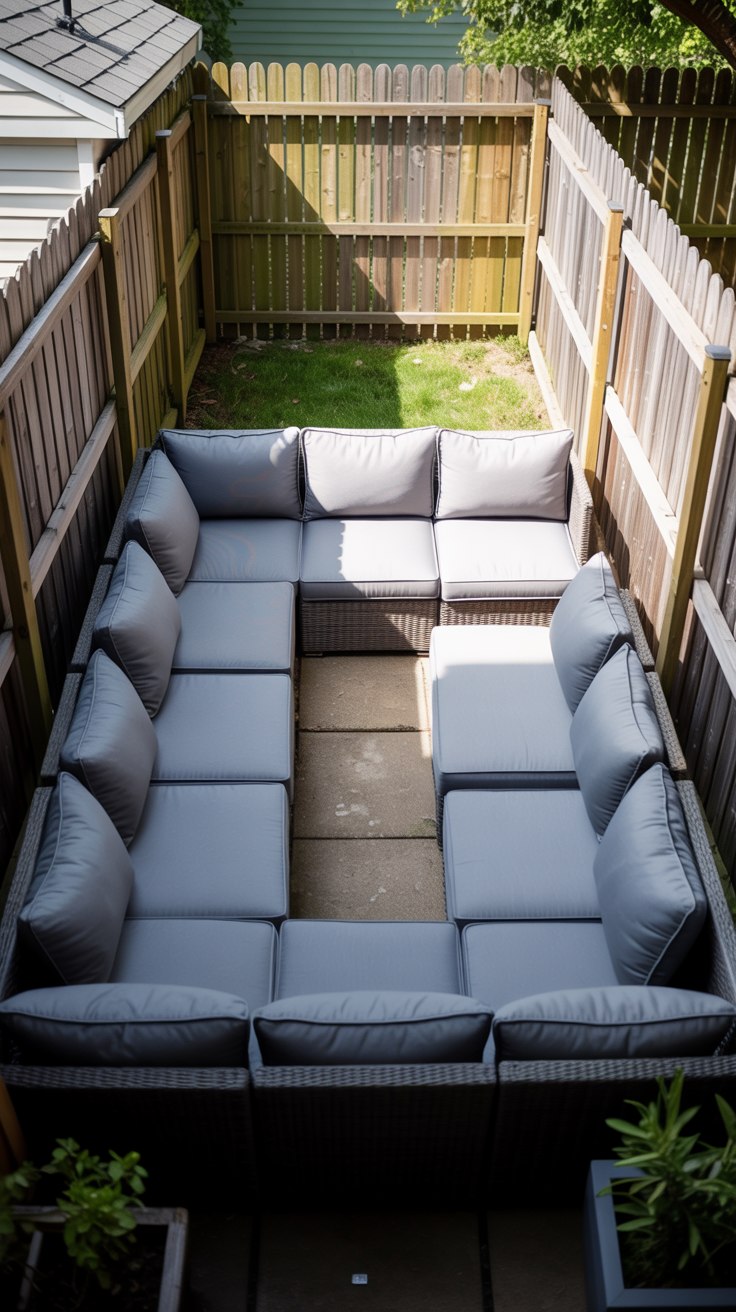
Ditch the Bulky Sectional
As much as we all love a giant sectional, they are usually the enemy of the narrow patio. They are bulky, they dictate exactly how the space must be used, and they are incredibly difficult to walk around.
Instead, opt for a standard three-seater sofa paired with two individual lounge chairs. This arrangement is infinitely more flexible. You can angle the chairs to open up the walkway, or move them entirely if you need more space for a party.
Look for “Leggy” Furniture
When furniture sits heavy and flat on the ground, it visually eats up floor space. In a narrow patio, you want to see as much of the floor as possible to create the illusion of width.
Look for sofas and chairs that are raised up on legs. When you can see the floor continuing underneath the furniture, the brain perceives the space as being larger than it actually is. The same goes for coffee tables. Choose something with an open, airy base rather than a solid block of wood or wicker.
Embrace the Bistro Set
If you want a dining area but don’t have the width for a full six-person rectangular table, don’t force it. A cramped dining table where no one can pull their chair out is miserable.
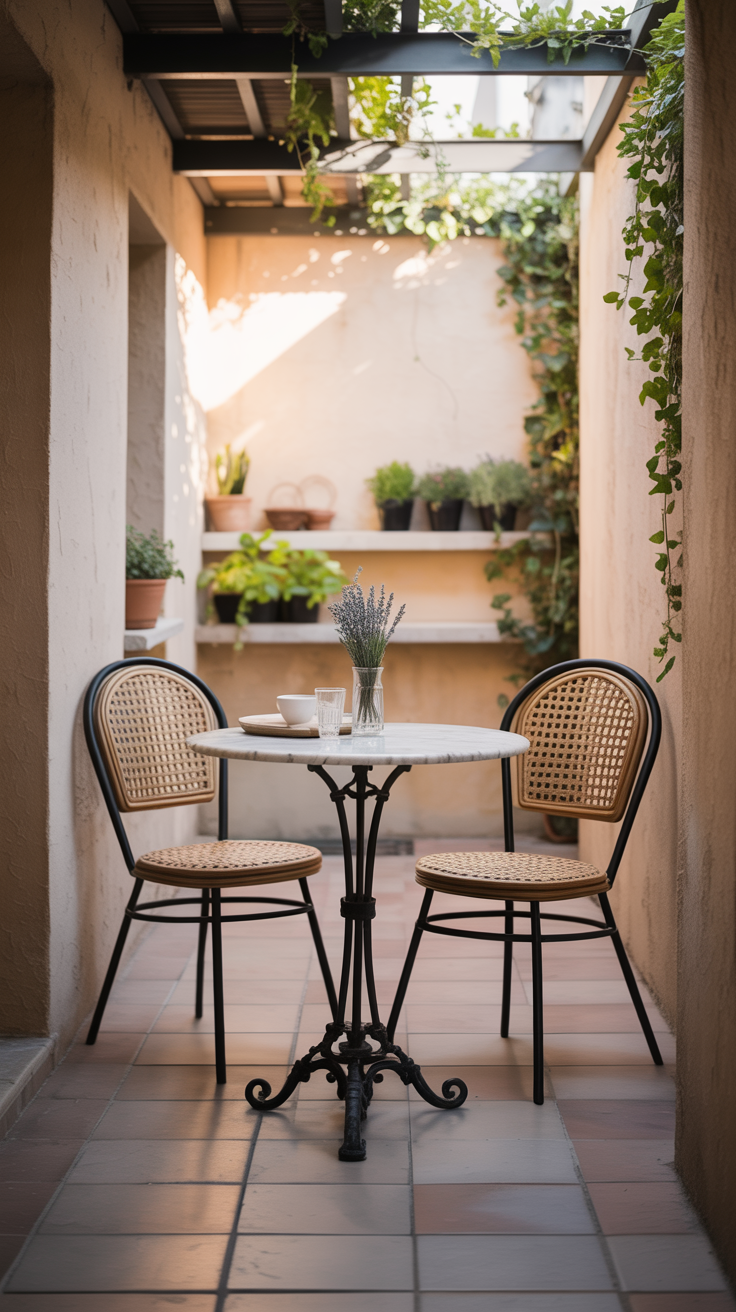
Instead, embrace the charm of a bistro set. A small, round table with two or four chairs is perfect for morning coffee or an intimate dinner, and its circular shape breaks up the rigid, straight lines of the narrow patio. If you absolutely must seat more people, look for a narrow, counter-height pub table that can sit flush against the railing or wall, with backless stools that tuck completely underneath when not in use.
Rule #4: Trick the Eye with Visual Illusions
Once you have your zones established and your appropriately sized furniture in place, it is time to use some designer magic to make the space feel wider than it actually is.
The Magic of Diagonals
Straight lines emphasize length. Diagonal lines create width. It is a simple optical illusion, but it works wonders.
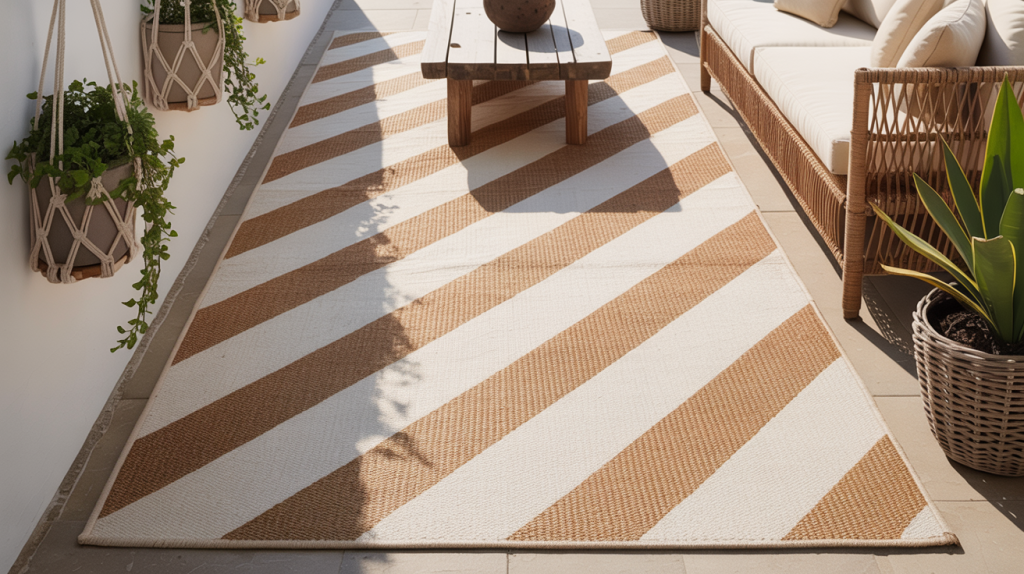
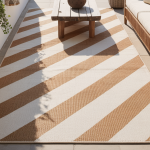
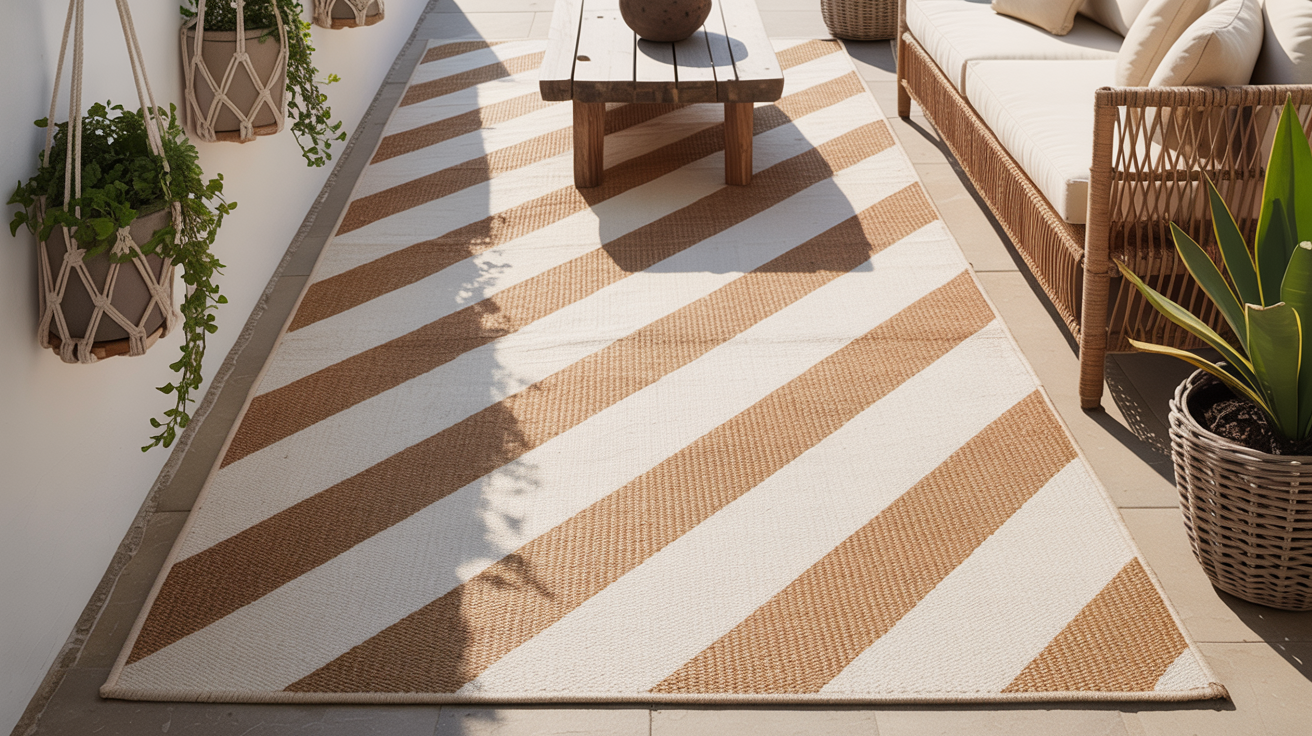
If you are laying down an outdoor rug, try placing it on a diagonal rather than perfectly parallel to the walls. If you are installing decking or tile over your concrete patio, lay the planks or tiles in a chevron or diagonal pattern. This forces the eye to move side-to-side rather than straight down the bowling alley, instantly making the space feel wider.
Draw the Eye Upward
When a space is narrow, you want to distract from the floor plan by drawing the eye up toward the ceiling. Since you have a covered patio, you have a ceiling to work with!
Install a striking ceiling fan or a beautiful outdoor chandelier. If your patio cover has exposed beams, paint them a contrasting color to make them pop. You can even paint the ceiling itself a soft, sky blue (a classic Southern porch trick) to make the space feel taller and more open.
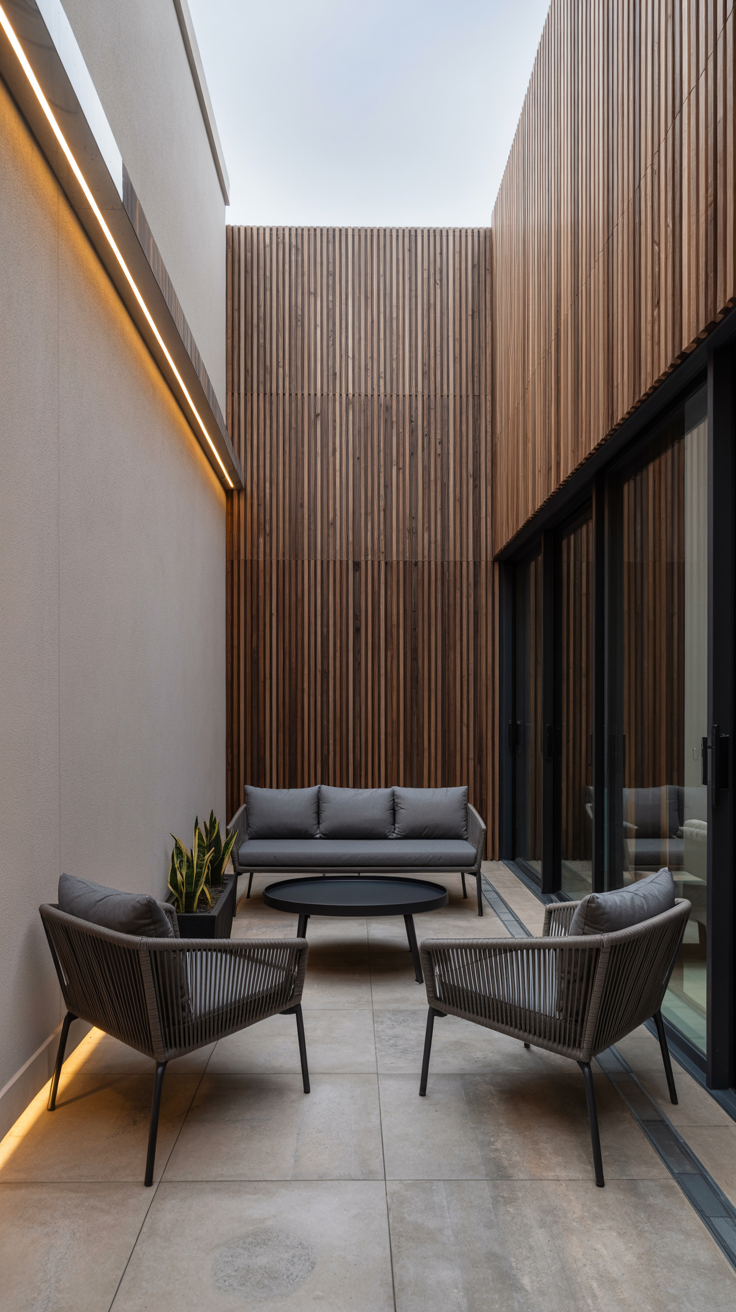
Use Mirrors Outdoors
We use mirrors indoors all the time to make small rooms feel larger, but people often forget they can use them outside, too. Hanging a large, weather-resistant mirror on the back wall of your house (under the covered patio) reflects the yard and the light, creating a “window” that visually doubles the width of the space. Just be mindful of what the mirror is reflecting. I’m guessing you want it to reflect greenery or string lights, not the side of your neighbor’s garage.
Rule #5: Soften the Edges
Long, narrow patios are defined by hard, straight lines: the wall of the house, the edge of the concrete, the straight roofline. To make the space feel inviting, softness and curves are key.
Hang Outdoor Curtains
This is one is not for everyone, but Installing outdoor curtain panels along the open edge of the patio does several things at once. First, the soft, flowing fabric immediately breaks up the hard architectural lines. Second, it adds a layer of privacy and sun protection. Third, and most importantly for a narrow space, it creates a sense of enclosure that makes the patio feel like a cozy outdoor room rather than an exposed hallway.
You don’t have to keep them closed; just having them tied back at the structural posts adds immense visual softness.
Go Crazy with Plants
Plants are the ultimate edge-softeners. But in a narrow patio, you don’t want to clutter your precious floor space with dozens of bulky pots.
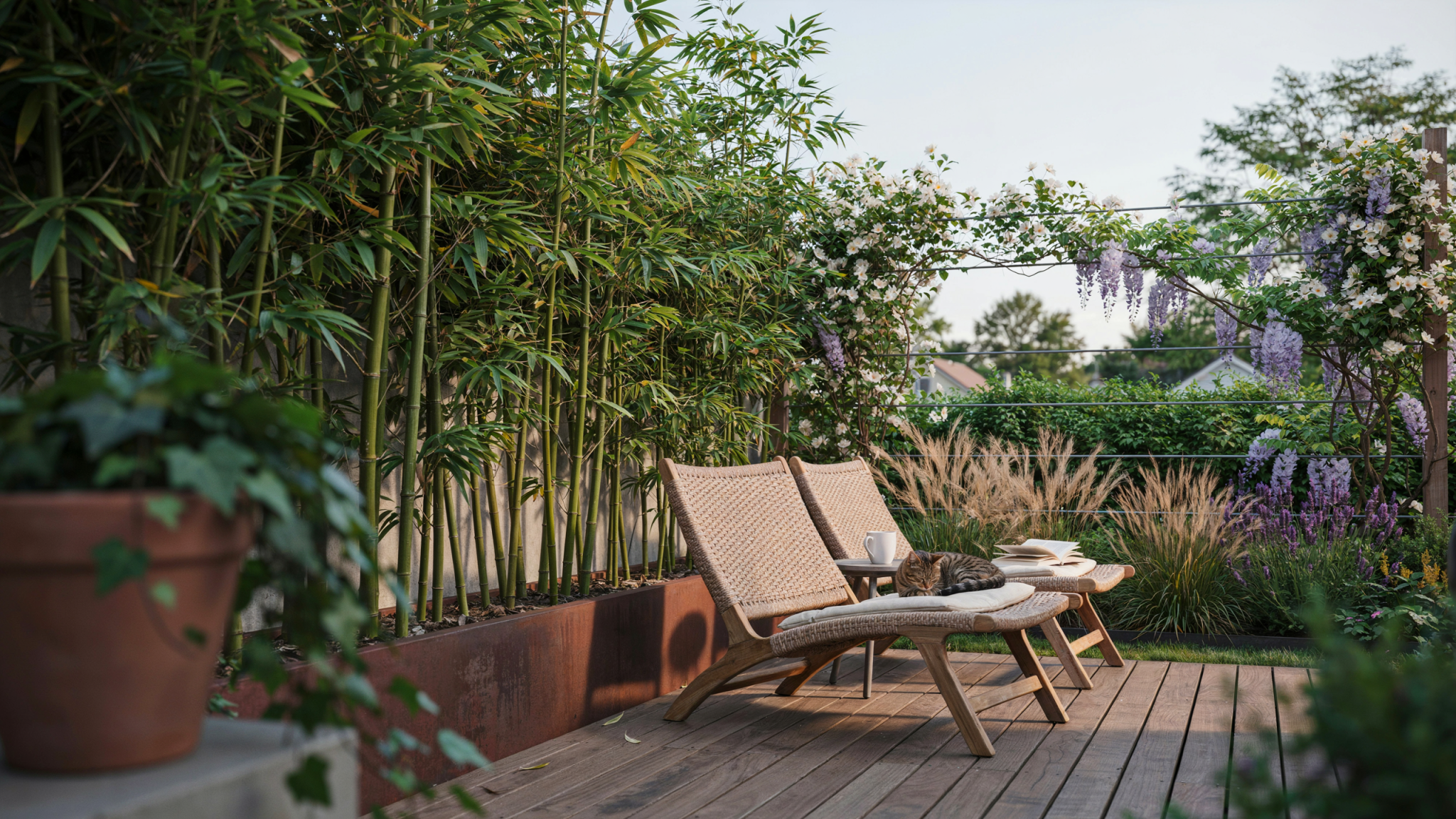
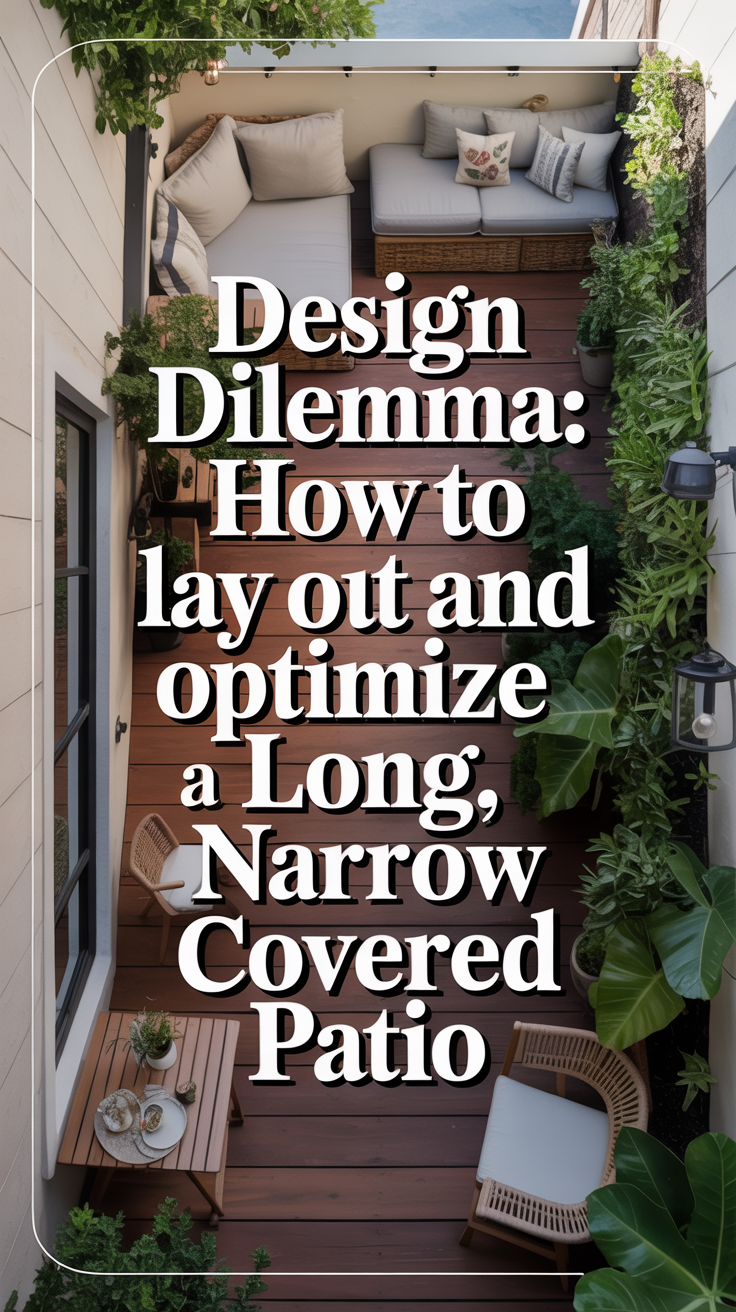
The solution is to go vertical. Install a living wall or a trellis with climbing vines on the short end walls of the patio. Hang lush, trailing ferns from the ceiling structure. Use narrow, rectangular planter boxes along the outer edge of the patio to create a soft, green boundary without eating into your walkway. The organic shapes of the leaves will blur the rigid lines of the space and make it feel lush and expansive.
Rule #6: Maximize Every Inch with Built-Ins
When you are dealing with a space that is severely lacking in width, you have to get creative with how you provide seating and storage. Freestanding furniture requires clearance all the way around it, which is a luxury a narrow patio simply does not have.
This is where built-in solutions become the hero of the narrow patio design dilemma.
The Power of the Built-In Bench
If you have a solid wall at one end of your narrow patio, or a sturdy railing along the outer edge, a built-in bench is one of the smartest investments you can make. A bench that runs flush against a wall or railing provides ample seating without encroaching into the center of the space.
Think about it: a standard dining chair requires about two feet of space just to sit in it, plus another two feet behind it so someone can pull it out and walk past. A built-in bench only takes up the depth of the seat itself (usually 18 to 24 inches), and no one needs to walk behind it.
You can pair a long, built-in bench with a narrow, rectangular dining table and a few low-profile chairs on the opposite side. When the table is not in use, the chairs can be tucked completely underneath, leaving the walkway wide open.
Sneaky Storage Solutions
Narrow patios often lack the space for a dedicated storage deck box or a bulky outdoor cabinet to hold cushions, gardening tools, or grilling supplies.
If you are constructing a built-in bench, design it with a hinged lid so the space underneath can be used for storage. If a built-in bench isn’t an option, look for dual-purpose furniture, like a sturdy, weather-resistant storage ottoman that can serve as a coffee table, extra seating, and a place to stash your outdoor throw pillows when it rains.
Vertical Gardens and Wall-Mounted Bars
We talked about drawing the eye upward, but you can also use your vertical space for practical purposes. If you love to entertain but don’t have the floor space for a bulky outdoor bar cart or a massive grill station, look to the walls.
If you want a garden but don’t have room for large pots, a vertical garden system mounted to the wall allows you to grow herbs, succulents, or trailing flowers without sacrificing a single inch of your walkwahy.
Rule #7: Embrace the “Less is More” Philosophy
When you have a challenging space, the temptation is often to over-decorate it in an attempt to distract from its awkward proportions. You buy the patterned rug, the brightly colored cushions, the oversized lantern, the collection of mismatched planters, and the bulky fire pit, hoping that if you just add enough stuff, the narrowness will disappear.
In reality, the exact opposite is true. Clutter is the enemy of a narrow space.
The Importance of Negative Space
In design, “negative space” refers to the empty areas around and between furniture and objects. In a narrow patio, negative space is just as important as the furniture itself. It is what allows the eye to rest and the space to breathe.
If you fill every square inch of your patio with furniture, planters, and decor, the space will feel chaotic, cramped, and claustrophobic. You have to be willing to leave some areas intentionally blank.
If you have created a cozy seating zone at one end and a small dining zone at the other, it is perfectly acceptable and often preferable to leave the middle section relatively open. Perhaps you just place a single, striking potted plant or a sleek, narrow console table against the wall in that middle zone. This visual “breathing room” prevents the patio from feeling like a crowded storage unit.
Keep the Color Palette Cohesive
Another way to prevent a narrow space from feeling chaotic is to maintain a tight, cohesive color palette. If you use five different bold colors and three clashing patterns, the space will feel visually overwhelming, which makes it feel smaller.
Instead, stick to a neutral base think whites, creams, soft grays, or warm taupes for your larger pieces, like the sofa, the rug, and the wall color. Then, introduce one or two accent colors through your throw pillows, planters, or a piece of outdoor art.
A monochromatic color scheme (using different shades of the same color) works well in a narrow space because it creates a seamless, uninterrupted visual flow that makes the area feel expansive and calm.
From Bowling Alley to Backyard Oasis
Tackling a long, narrow covered patio can feel daunting at first. It is easy to look at that awkward, tunnel-like space and assume it will never be anything more than a glorified walkway or a place to store the grill.
But as I’ve shared, a beautiful narrow patio starts with a shift in your perspective. You have to stop fighting the dimensions and start working with them.
By breaking the long expanse into distinct, purposeful zones, you immediately eliminate the bowling alley effect. By prioritizing traffic flow and choosing appropriately scaled, “leggy” furniture, you ensure the space is actually comfortable to navigate. By utilizing visual tricks like diagonal lines, outdoor curtains, and strategically placed mirrors, you can fool the eye into perceiving a much wider, more expansive area.
Your narrow covered patio doesn’t have to be a design dilemma. With a little creativity, a ruthless approach to scale, and a focus on intentional zoning, that awkward tunnel can easily become your favorite place to enjoy a morning cup of coffee, host an intimate dinner party, or simply unwind at the end of a long day.