If you are reading this, there is a good chance you are hiding in the bathroom. Or maybe you are sitting in your car in the driveway, taking just five more minutes of silence before you walk through the front door. I see you. I have been you.
Motherhood is a beautiful, messy, chaotic journey, but sometimes the chaos tips the scales. The toys multiply overnight, the laundry pile looks like a modern art installation, and the mental load: the endless, invisible ticker tape of appointments, meal plans, and permission slips feel heavy enough to crush you. You look around your house and instead of feeling like it is a sanctuary, it feels like a giant to-do list staring back at you.
I used to think that being a good mom meant managing it all perfectly. I thought if I just found the right planner, or woke up an hour earlier, or finally bought those matching acrylic bins for the pantry, everything would fall into place. But the truth is, you cannot organize your way out of overwhelm if the foundation of your home is built on stress.
That is when I discovered what I now call the “Calm Home” Method. It is not a rigid cleaning schedule or a minimalist manifesto that demands you throw away everything you own. It is a gentle, realistic approach to managing your home and your mental load. It is about creating systems that serve you, rather than you serving your house. It is about finding pockets of peace in the middle of the beautiful, loud, sticky reality of raising kids.
Today I want to talk about how to quiet the visual noise, establish rhythms that have actually worked for my family, and most importantly, how I’ve learned to protect my own peace.
The Invisible Weight: Understanding the Mental Load
Before we can talk about organizing the playroom or setting up a laundry routine, we have to talk about the elephant in the room: the mental load.
The mental load is the invisible, non-tangible work involved in managing a household and a family. It is knowing that the milk is almost out, that the toddler has outgrown their winter coat, and that the dog needs his heartworm medication next Tuesday. It is the emotional labor of managing everyone’s moods, anticipating needs, and keeping the family ship sailing smoothly.
Research shows that mothers overwhelmingly carry this burden. Even in households where partners split the physical chores evenly, the cognitive labor: the planning, the noticing, the delegating, almost always falls to the mom. It is exhausting. It is the reason you feel tired even when you have been sitting on the couch for an hour. Your brain is constantly running background apps, draining your battery.
The Calm Home Method starts by acknowledging this load. You cannot fix a problem you refuse to name. Once you recognize that your exhaustion is valid and that the mental load is real work, you can start taking steps to offload it.
Offloading the Brain Clutter
The first step to a calmer home is a calmer mind. When your brain is full of mental sticky notes, you cannot be present with your kids, and you certainly cannot relax.
I started doing what I call a “Brain Dump” every Sunday evening. I sit down with a notebook and write down every single thing floating around in my head. I write down the big things (schedule the pediatrician appointment) and the tiny things (buy more glue sticks). Getting it out of my head and onto paper instantly reduces my anxiety.
Once it is on paper, I categorize it. What needs to happen this week? What can wait until next month? What can I delegate to my partner? What can I completely cross off the list because it actually does not matter?
This simple practice takes the abstract, overwhelming cloud of “stuff I need to do” and turns it into a concrete, manageable list. It is the first, crucial step in creating a calm home.
Quieting the Visual Noise
Have you ever walked into a high-end spa or a beautifully designed hotel room and instantly felt your shoulders drop? That is the power of environment. Now, think about walking into your living room when it is covered in plastic toys, mail, and half-empty water bottles. Your brain registers all of that clutter as unfinished tasks. It is visual noise, and it is screaming at you.
I am not a minimalist. I love cozy blankets, stacks of books, and the sentimental art my kids bring home from school. But I had to learn the hard way that there is a direct correlation between the amount of stuff in my house and the amount of stress in my body.

The Power of the “Ruthless Purge”
You cannot organize clutter. You can put it in pretty baskets, but it is still clutter. The Calm Home Method requires a shift in how we view our possessions. We have to stop managing inventory and start curating our space.
I started with a ruthless purge. I did not do it all in one weekend, that is a recipe for burnout. Instead, I tackled one small area at a time. One drawer. One shelf. One corner of the closet.
I asked myself three questions about every item:
- Do we use this regularly?
- Does this bring me joy or make my life significantly easier?
- If my house burned down, would I replace this?
If the answer was no, it went into a donation box. The freedom that comes from letting go of things you do not need is intoxicating. When you have less stuff, you have less to clean, less to organize, and less to manage. Your home stops feeling like a storage unit and starts feeling like a living space.
Establishing “Homes” for Everything
Once you have cleared the excess, the next step is ensuring that every single item in your house has a designated home. When things do not have a home, they become “homeless clutter”—the mail that piles up on the kitchen counter, the shoes kicked off by the front door, the random chargers scattered across the house.
When everything has a home, tidying up becomes a mindless task rather than a puzzle you have to solve every night. You do not have to think about where the scissors go; they go in the designated utility drawer. You do not have to wonder where the kids’ backpacks belong; they go on the hooks in the mudroom.
This simple rule—a place for everything, and everything in its place—drastically reduces the daily friction of managing a household.
The Magic of Rhythms Over Routines
If you are anything like me, you have probably tried to implement a strict daily schedule. You mapped out your day in 15-minute increments, color-coded your planner, and swore that this was the week you were going to get your life together. And then, by 9:00 AM on Tuesday, the baby had a blowout, the toddler refused to wear pants, and the entire schedule went out the window, leaving you feeling like a failure.
The Calm Home Method rejects rigid schedules. Instead, it embraces rhythms.
A schedule is tied to the clock. A rhythm is tied to the flow of your day. A schedule says, “We eat breakfast at 7:00 AM, clean up at 7:30 AM, and start an educational activity at 8:00 AM.” A rhythm says, “After we wake up, we eat breakfast. After breakfast, we clean up the kitchen. After the kitchen is clean, we play.”
Rhythms provide structure without the pressure. They create predictability for your kids (which drastically reduces tantrums) and give you a framework for your day, but they are flexible enough to accommodate the inevitable chaos of motherhood.
The Morning Anchor
The way you start your morning sets the tone for the entire day. If you start the day rushing, yelling, and frantically searching for a missing shoe, the rest of the day will likely feel chaotic.
Creating a morning rhythm is about finding a few anchor points that ground you. For me, it means waking up just 20 minutes before my kids. I do not use this time to do chores or answer emails. I use it to drink a cup of coffee in silence, read a few pages of a book, and mentally prepare for the day.
When the kids wake up, our rhythm kicks in: get dressed, eat breakfast, brush teeth, pack bags. Because we do things in the same order every day, it becomes muscle memory. I do not have to bark orders; the kids know what comes next.
The Evening Reset
If the morning rhythm sets the tone, the evening reset saves your sanity. The evening reset is a short, focused period of time dedicated to preparing your home for the next day.
I used to spend my evenings either exhaustedly cleaning the entire house or collapsing on the couch, ignoring the mess, and waking up to a disaster the next morning. Neither approach worked.
Now, I practice a 20-minute evening reset. I set a timer, put on a podcast or some upbeat music, and focus on three main tasks:
- Clear the kitchen sink and counters. Waking up to a clean kitchen is a gift you give your future self.
- Do a quick sweep of the main living areas. I grab a laundry basket and walk through the living room, tossing in any toys, books, or random items that do not belong. I then return those items to their proper homes.
- Prep for tomorrow. I set out the coffee mugs, check the calendar for the next day, and make sure backpacks are by the door.
When the 20 minutes are up, I stop. Even if the house is not perfect, I am done. This small investment of time at night pays massive dividends the next morning.
Lowering the Bar: The Art of “Good Enough”
One of the biggest sources of overwhelm for moms is the unrealistic expectations we place on ourselves. We see perfectly curated homes on Instagram, we read articles about the importance of organic, home-cooked meals every night, and we feel like we are constantly falling short.
The Calm Home Method requires you to lower the bar. Not because you are lazy, but because you are human. You cannot be a gourmet chef, a professional organizer, a patient teacher, and a fun playmate all at the same time.
Embracing “Good Enough” Dinners
Mealtime is often the most stressful part of the day. The witching hour hits, everyone is tired and cranky, and you still have to figure out how to get food on the table.
I had to let go of the idea that every dinner needed to be a culinary masterpiece. I embraced the concept of “good enough” dinners. These are meals that require minimal prep, minimal cleanup, and zero mental energy.
We have a rotation of five simple meals that we eat almost every week. Taco Tuesday. Breakfast for dinner. Pasta and jarred sauce. Sheet pan chicken and veggies. Frozen pizza on Fridays.
Is it Pinterest-worthy? No. Does it feed my family and keep me from losing my mind at 5:30 PM? Yes. Lowering the bar on dinner was one of the most liberating things I did for my mental health.
The “Done is Better Than Perfect” Cleaning Philosophy
When it comes to cleaning, perfectionism is the enemy of peace. If you wait until you have the time and energy to deep clean the entire house, you will never do it.
Instead, adopt the “done is better than perfect” philosophy. A quick wipe-down of the bathroom counter is better than waiting for the weekend to scrub the entire bathroom. Running the robot vacuum is better than waiting until you have time to mop the floors.
I started implementing “habit stacking” for my cleaning tasks. While I am waiting for my coffee to brew in the morning, I empty the dishwasher. While the kids are in the bathtub, I wipe down the bathroom sink and mirror. By tying small cleaning tasks to habits I already do every day, the house stays reasonably clean without requiring hours of dedicated cleaning time.
Creating Sanctuaries Within Your Home
When the entire house feels chaotic, you need a place to retreat. You need a physical space that feels calm, even if the rest of the house is a disaster zone.
For a long time, my bedroom was the dumping ground for everything that did not have a home. It was where I hid the laundry baskets when guests came over. It was where the kids dumped their toys. Walking into my bedroom at the end of a long day did not feel relaxing; it felt stressful.
Reclaiming Your Bedroom
Your bedroom should be a sanctuary. It should be the one room in the house that is off-limits to the chaos.
I made a strict rule: no kids’ toys in the master bedroom. I cleared off my nightstands, invested in some comfortable bedding, and added a small lamp with a warm bulb. I stopped using my bedroom as a storage unit and started treating it like a retreat.
Now, when the day has been particularly hard, I can retreat to my bedroom, close the door, and instantly feel a sense of calm. It is a small change that makes a massive difference in my overall well-being.
The “Mom Corner”
If reclaiming your entire bedroom feels impossible right now, start smaller. Create a “Mom Corner.”
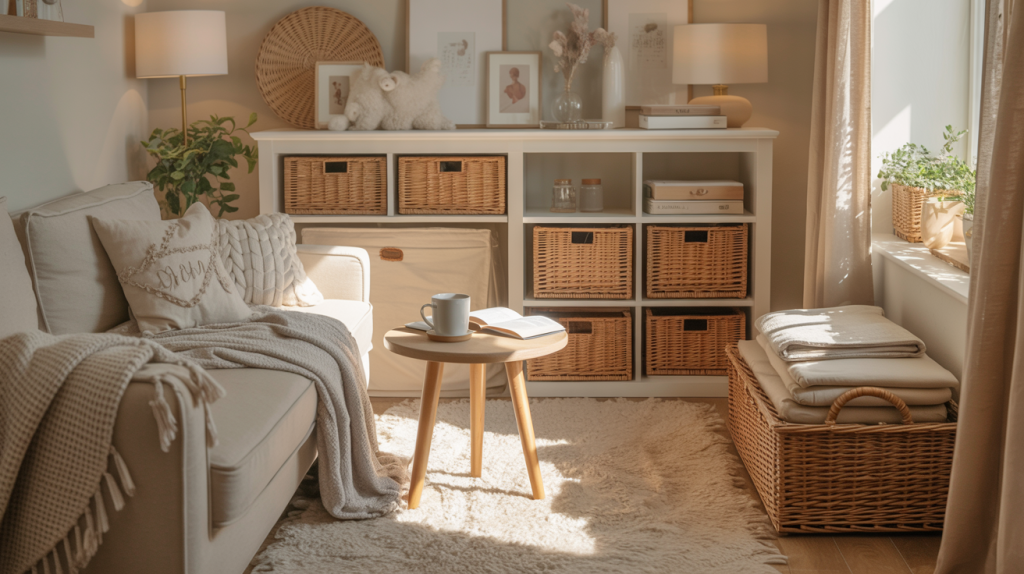
Find one small area in your house, a cozy chair by a window, a corner of the living room, or even just a specific spot on the couch and claim it as yours. Keep a basket nearby with your favorite book, a cozy blanket, and some nice lotion.
When you feel the overwhelm rising, retreat to your corner, even just for five minutes. It is a physical reminder that you matter, that your peace is important, and that you deserve a space of your own.
The Importance of Boundaries and Asking for Help
You cannot create a calm home if you are constantly pouring from an empty cup. The Calm Home Method is not just about managing your physical space; it is about managing your energy. And that requires setting boundaries and asking for help.
Saying No to the “Shoulds”
Moms are plagued by the “shoulds.” I should volunteer for the PTA. I should host the holiday dinner. I should sign my kids up for three different extracurricular activities.
Every time you say yes to something out of obligation, you are saying no to your own peace. The Calm Home Method requires you to get ruthlessly protective of your time and energy.
I started practicing the “Hell Yes or No” rule. If an invitation or opportunity does not make me say, “Hell yes, I want to do that,” then the answer is no. It was uncomfortable at first. I worried about disappointing people. But I quickly realized that my family needed a calm, present mother much more than the school needed another bake sale volunteer.
Delegating and Sharing the Load
You are not the only person who lives in your house, which means you should not be the only person managing it.
If you have a partner, it is time to have an honest conversation about the mental and physical load. This is not about nagging or keeping score; it is about functioning as a team. Sit down together, look at the master list of household responsibilities, and figure out how to divide them fairly.
And do not forget about your kids! Even young children can contribute to the household. Toddlers can put their toys in a bin. Preschoolers can help set the table. Older kids can fold laundry and empty the dishwasher.
Teaching your kids to help around the house is not just about lightening your load; it is about raising capable, responsible humans. It takes more effort up front to teach them, but the long-term payoff is a home where everyone contributes.
Finding Calm in the Midst of the Chaos
The goal of the Calm Home Method is not perfection. Your house will still get messy. Your kids will still have meltdowns. You will still have days where you feel overwhelmed and exhausted. That is the reality of motherhood.
But the Calm Home Method gives you the tools to navigate the chaos with more grace and less stress. It gives you a framework to fall back on when things get hard.
It is about recognizing that your home should be a place of rest, not a source of stress. It is about letting go of the unrealistic expectations and embracing the messy, beautiful reality of your life.
So, take a deep breath. Look around your home. It does not have to be perfect to be peaceful. Start small. Do a brain dump. Clear one counter. Establish one simple rhythm.
You deserve a home that feels like a sanctuary. You deserve to feel calm, present, and joyful in the midst of motherhood. The chaos will always be there, but you have the power to create the calm.
A Quick-Start Guide to the Calm Home Method
If you are feeling overwhelmed and do not know where to start, here is a simple, step-by-step guide to implementing the Calm Home Method this week:
Day 1: The Brain Dump Spend 15 minutes writing down every single task, worry, and to-do list item floating in your head. Get it all on paper.
Day 2: The Ruthless Purge (Mini Edition) Choose one small area—a single drawer, a shelf, or your purse—and ruthlessly declutter it. Throw away the trash, donate what you do not need, and organize what is left.
Day 3: Establish a “Home” Pick one category of items that constantly causes clutter (like mail, shoes, or backpacks) and create a designated home for it. Teach your family where it belongs.
Day 4: The 20-Minute Evening Reset Set a timer for 20 minutes tonight. Clear the kitchen sink, do a quick sweep of the living room, and prep the coffee maker for tomorrow. When the timer goes off, stop.
Day 5: Lower the Bar on Dinner Plan a “good enough” dinner for tonight. Think frozen pizza, breakfast for dinner, or sandwiches. Give yourself permission to take the easy way out.
Day 6: Claim Your Sanctuary Spend 10 minutes clearing the clutter out of your bedroom or setting up a small “Mom Corner” in the living room. Make it a space that feels peaceful to you.
Day 7: Rest Do nothing. Let the house be messy. Order takeout. Sit on the couch and watch a movie with your kids. Remember that a calm home is ultimately about a calm you.