For the past several years, the world of interior design has been a comforting, predictable space. We’ve swaddled our homes in neutral palettes, embraced the clean lines of mid-century modern, and sought refuge in the cozy minimalism of “Japandi” style. It has been an era of quiet luxury, of safe choices, of creating serene sanctuaries to escape a chaotic world. But the winds of change are blowing, and they’re carrying with them a storm of delightful weirdness. As we look toward 2026, the forecast is anything but predictable. The collective design consciousness seems to be experiencing a rebellion against the beige, a rejection of the formulaic, and a bold leap into the wonderfully strange.
The interior design trends predicted for 2026 are not gentle evolutions; they are radical departures. They speak to a future where our homes are not just passive backdrops for our lives, but active, intelligent, and deeply personal participants. We are moving from spaces that are merely beautiful to spaces that are sentient, from rooms that are simply decorated to environments that are immersive and experiential. This is a future where technology and tradition collide in the most unexpected ways, where the line between furniture and art dissolves, and where the ultimate luxury is not perfection, but personality.
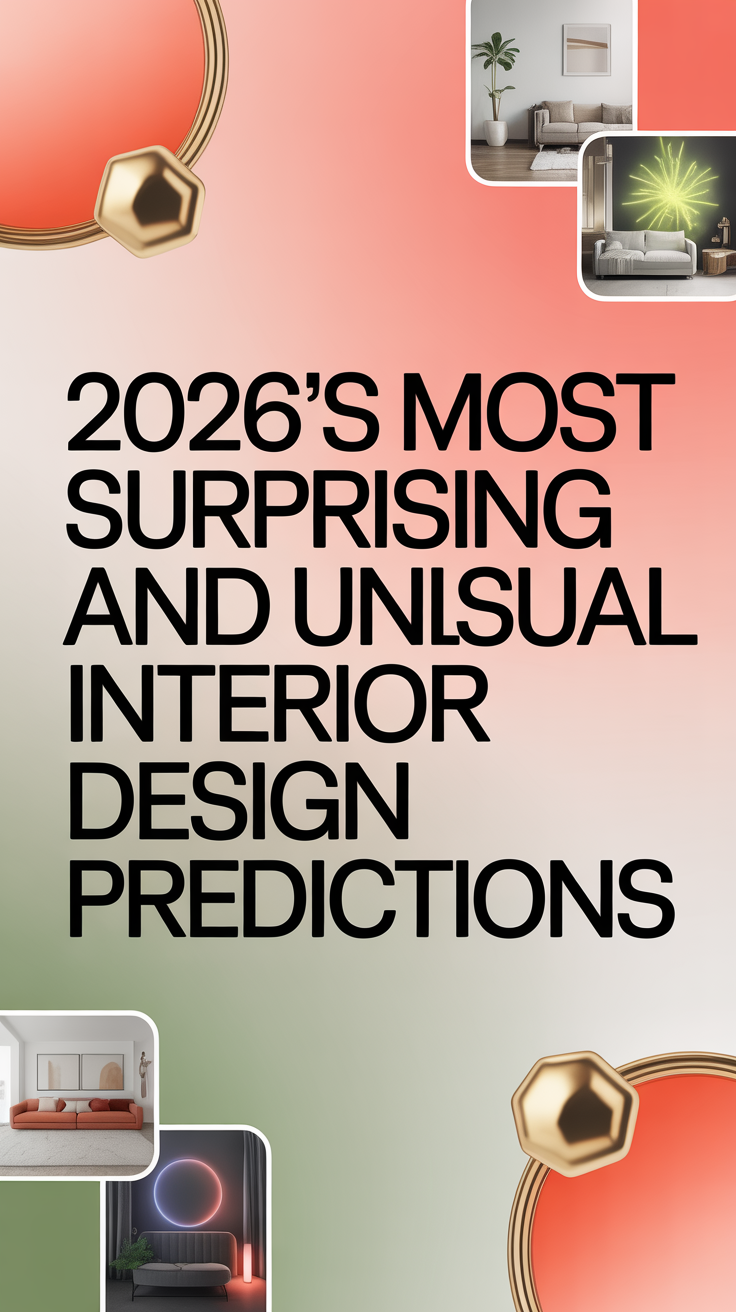
Prepare to have your assumptions challenged. The coming year will see the rise of AI-powered gardens that tend to themselves, furniture designed by algorithms for perfect ergonomic comfort, and walls that are not just painted, but embroidered. We will cocoon ourselves in bedrooms that feel like plush, upholstered wombs and gaze at digital murals that shift with the time of day. This is not the stuff of science fiction; this is the new reality of interior design. Get ready to explore the most surprising and unusual predictions that will shape the look, feel, and function of our homes in 2026.
The Sentient Home: Technology Gets Weird and Wonderful
For years, “smart home” technology has been about convenience: voice-activated lights, automated thermostats, and refrigerators that tell you when you’re out of milk. In 2026, this technology will evolve from a mere servant into a creative partner, embedding itself into the very fabric of our homes in ways that are both beautiful and bizarre.
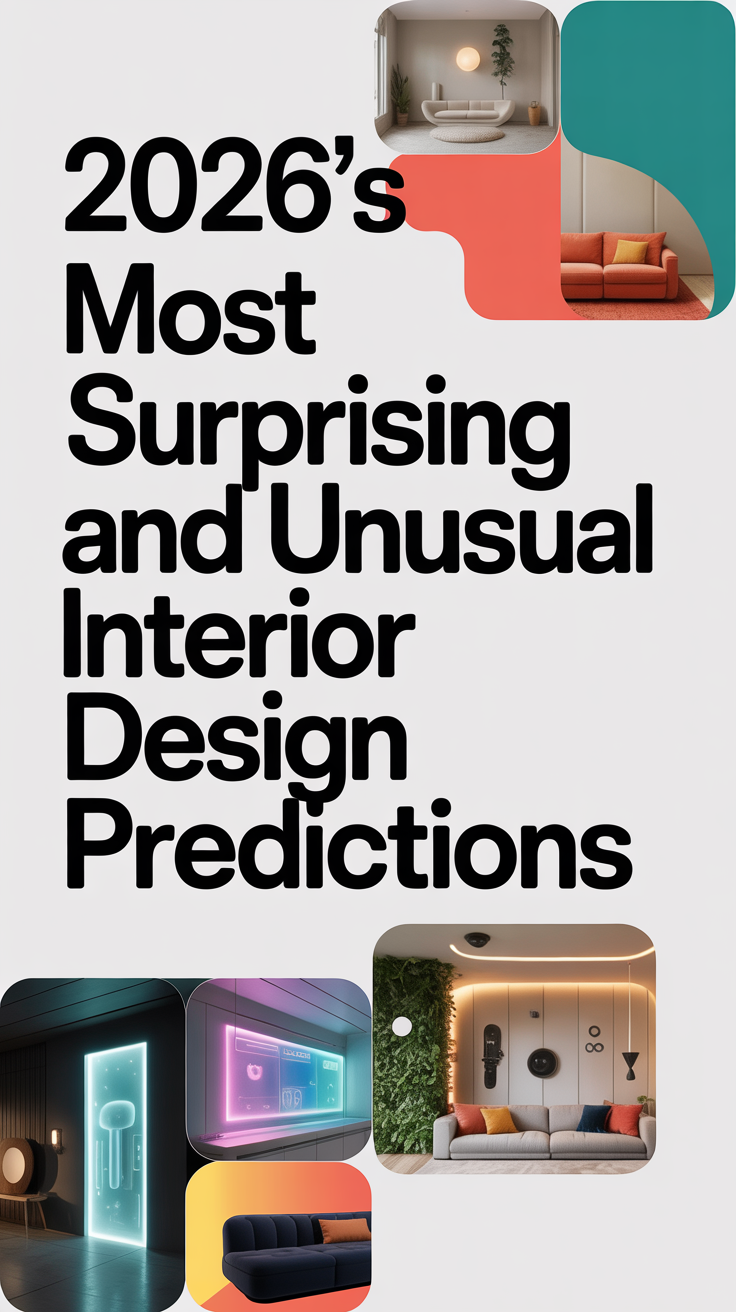
One of the most startling innovations is the rise of Digital Art and Virtual Displays. Forget static gallery walls. The future of art in the home is dynamic, ever-changing, and deeply personal. Imagine paper-thin OLED panels seamlessly integrated into a wall, displaying an AI-generated mural of waves that gently crash and fade throughout the day, their rhythm synced to the local tide. This trend moves beyond the digital picture frames of the 2010s, which simply cycled through a playlist of static images. The new virtual displays are generative and interactive. They can react to the weather, the time of day, or even the mood of the occupants, creating an ambient, evolving artwork that is unique to each moment. This is not just a screen on a wall; it is the wall itself becoming a canvas for digital light and color.
This fusion of nature and technology takes an even more surprising turn with the advent of AI-Powered Indoor Gardens. The biophilic design trend—the integration of nature into our built environments—is not new. However, the 2026 iteration goes far beyond a few potted plants. We are talking about fully automated, soil-free vertical farms integrated into our kitchen walls, where AI systems monitor and control light, water, and nutrient levels to grow fresh herbs and vegetables. These are not just functional; they are designed as living, breathing installations. The gentle hum of the hydroponics and the soft glow of the grow lights become part of the home’s sensory landscape. It’s a vision of a future where our homes are not just consumers of resources, but producers, creating a direct, symbiotic relationship between inhabitant and environment.
Perhaps the most invisible yet impactful technological trend is Algorithmic Ergonomics. For the first time, furniture design is being driven not just by aesthetics or traditional craftsmanship, but by vast datasets of human movement and posture. Using sophisticated algorithms, designers can now analyze thousands of body scans and pressure point maps to engineer chairs, sofas, and beds that offer a level of comfort previously unimaginable. The resulting forms are often strange and unexpected—asymmetrical, deeply curved, and almost alien in their organicism. They are not designed to conform to a pre-existing style, but to the specific, unique contours of the human body. This is furniture that doesn’t just look good; it feels like it was grown specifically for you, a perfect, data-driven embrace.
The New Craft: Tradition Remixed and Reimagined
As technology becomes more integrated into our homes, a parallel and equally powerful trend is emerging: a renewed obsession with craft, but with a decidedly futuristic twist. The most captivating trends of 2026 are not about rejecting tradition, but about hacking it, remixing it, and pushing it into new and unexpected territory.
A prime example of this is Embroidery on Wood. This is a trend that sounds impossible, a contradiction in terms. But thanks to advanced CNC routing and micro-drilling technologies, designers are now able to create intricate, threaded patterns directly onto wooden surfaces. Imagine a headboard made of solid oak, with a delicate, geometric pattern stitched into the grain. Or a set of cabinet doors where the wood is perforated with thousands of tiny holes, allowing for a cross-stitched design to be woven through. This technique adds a layer of softness, texture, and unexpected detail to a hard, natural material. It’s a beautiful and surprising fusion of digital precision and traditional handcraft.
This love of the unexpected detail continues with Freehand Artistry. In a direct rebellion against the mass-produced and the digitally perfect, there is a growing desire for the mark of the human hand. This trend manifests in hand-painted motifs on walls, fabrics, and ceramics. The key is the intentional spontaneity of the brushwork. These are not perfect, repeating patterns, but fluid, expressive lines that celebrate imperfection. A single, bold brushstroke across a set of kitchen tiles, a series of hand-drawn squiggles on a set of linen curtains—these small acts of artistic expression transform everyday objects into one-of-a-kind pieces. It’s a celebration of the wabi-sabi philosophy, finding beauty in the imperfect and the transient.
Even the forms of our furniture are becoming more expressive and sculptural. The trend of Fat Furniture sees seating—sofas, armchairs, ottomans—becoming oversized, voluptuous, and almost cartoonishly plump. These are not just places to sit; they are sculptural elements that command attention and invite a full-body embrace. The lines are soft, the curves are deep, and the overall impression is one of decadent, unapologetic comfort. This trend is a direct backlash against the spindly legs and rigid frames of mid-century modernism, offering instead a sense of grounding, stability, and playful monumentality.
The Immersive Interior: Creating Worlds Within Walls
The ultimate goal of these emerging trends is to create homes that are not just collections of beautiful objects, but fully immersive, sensory experiences. The focus is shifting from how a room looks to how it makes you feel.
Nowhere is this more evident than in the “Cocoon” Bedroom. This trend is about creating a sanctuary of ultimate comfort and intimacy. Think padded, upholstered walls that absorb sound and create a sense of enclosure. Headboards are no longer just decorative; they are massive, enveloping structures that wrap around the bed. Layers of soft, tactile fabrics—mohair, washed linen, silk—are piled high. The lighting is soft and diffused, the colors are deep and muted, and the overall effect is one of being held, of being protected from the outside world. It is a deeply emotional approach to design, creating a space that is not just for sleeping, but for retreating, for dreaming, and for finding a sense of profound peace.
This idea of the room as an experience extends to the very architecture of our homes. The “Fifth Wall” Trend encourages us to look up and consider the ceiling as a design opportunity. For too long, the ceiling has been a forgotten plane, a blank white expanse. In 2026, it will become a canvas for creativity. This could be as simple as painting the ceiling in a bold, contrasting color to add depth and drama to a room. Or it could be as elaborate as covering the ceiling in a vibrant, patterned wallpaper, creating an unexpected and immersive visual experience. This trend challenges our traditional understanding of a room’s boundaries, using the ceiling to create a sense of enclosure, expansion, or pure, unadulterated joy.
Finally, the lines between our homes and the outside world are blurring in new and interesting ways. Hospitality-Inspired Design sees us incorporating the amenities, services, and design sensibilities of boutique hotels into our own homes. This goes beyond simply having nice towels. It’s about creating dedicated spaces for relaxation and entertainment, such as a home bar with professional-grade equipment, a spa-like bathroom with a steam shower and sauna, or a living room that feels like the chic, comfortable lobby of your favorite hotel. It’s a recognition that our homes need to be more than just places to live; they need to be places that inspire, that entertain, and that cater to our every need.
A Future That is Beautifully, Wonderfully Weird
The interior design landscape of 2026 is a far cry from the safe, predictable world we’ve grown accustomed to. It is a world of beautiful contradictions, where cutting-edge technology and ancient craft traditions coexist, where data-driven ergonomics and freehand artistic expression are equally valued. It is a future where our homes will be smarter, softer, and a whole lot stranger.
These surprising and unusual trends are more than just fleeting fads. They are a reflection of a deeper cultural shift. They speak to a collective desire for more personality, more joy, and more meaning in our everyday lives. We are tired of the generic, the mass-produced, the perfectly curated Instagram feed. We are craving authenticity, even if that authenticity is a little bit weird. We want homes that tell our unique stories, that cater to our individual needs, and that surprise and delight us every single day.
So, as we move toward 2026, let us embrace the weird. Let us embroider our walls, grow our own food with the help of AI, and sink into furniture designed by algorithms. Let us cocoon ourselves in plush, padded bedrooms and gaze up at ceilings covered in fantastical patterns. The future of interior design is not about following a set of rules; it’s about breaking them. It’s about having the courage to be different, to be expressive, and to create a home that is a true reflection of your own beautiful, wonderful, and perhaps even a little bit weird, self. _n## Deeper Dives into the Strange: Unpacking the Details nTo fully appreciate the delightful eccentricity of 2026’s design landscape, we must look closer at the specific textures, forms, and technologies that define these emerging trends. It is in the granular details that the true spirit of this new era—one that champions the bespoke, the intelligent, and the unapologetically odd—comes to life.
The Mechanics of the Sentient Home
The concept of a Sentient Home moves far beyond simple automation. The AI-Powered Indoor Gardens, for instance, are not just about the convenience of fresh basil. They represent a fundamental shift in our relationship with food and nature. These systems, often integrated as floor-to-ceiling glass modules, will feature sophisticated sensors that monitor not only plant health but also the home’s ambient conditions. The AI might, for example, increase the intensity of the grow lights on a cloudy day to compensate for the lack of natural sunlight, subtly brightening the entire room. It could learn the household’s eating habits, automatically planting more cilantro if it detects a frequent use in recipes. The garden becomes a responsive, living element of the home’s ecosystem, its gentle, rhythmic cycles of light and water a calming, ever-present backdrop to daily life. Similarly, Digital Art and Virtual Displays will offer a level of personalization that makes current technology seem primitive. Imagine a display that syncs with your personal biometric data, generating calming, abstract color fields when it detects a rise in your heart rate. Or a digital “window” in a windowless room that displays a hyper-realistic, AI-generated landscape that changes with the seasons, complete with falling leaves in autumn and blooming flowers in spring. These are not just decorative features; they are therapeutic interventions, using technology to create emotionally resonant and responsive environments. The focus is on creating a sense of digital escapism, a way to transport ourselves to other worlds without ever leaving our living rooms.
The Nuances of Neo-Craft
The New Craft movement is all about the surprising juxtaposition of materials and techniques. Embroidery on Wood is a perfect example. This is not a rustic, hand-whittled craft. It involves a high-tech process where digital designs are translated into precise, CNC-routed channels or micro-drilled holes in the wood. These channels are then hand-threaded with materials ranging from traditional silk and cotton to more unexpected choices like fine metal wire or even fiber-optic strands that can be subtly illuminated. The result is a hybrid object that is both machine-made and handcrafted, a testament to the creative potential of combining digital precision with artisanal skill. Freehand Artistry also has its nuances. This is not about amateurish scribbles, but about a confident, expressive mark-making that brings a sense of energy and movement to a space. We will see this in the form of large-scale, abstract murals painted directly onto a living room wall, in the delicate, calligraphic brushstrokes on a set of ceramic dinner plates, or in the bold, gestural patterns on a hand-woven rug. The key is the artist’s touch, the sense of a human presence and a creative impulse captured in a single, unrepeatable moment. It is a celebration of imperfection in a world that is often too polished and too perfect. The trend of Fat Furniture is also more sophisticated than it might first appear. While the silhouettes are indeed large and voluptuous, the underlying construction is often highly engineered. Many of these pieces are modular, allowing for a degree of customization and adaptability. The upholstery is a key element, with a focus on rich, deeply textured fabrics like bouclé, velvet, and shearling. The color palettes are often bold and saturated, turning these large pieces into monumental statements of color. This is not just about comfort; it’s about creating a sense of playful, almost childlike, security. It’s about furniture that feels like a hug.
The Psychology of Immersion
The move towards Immersive Interiors is rooted in a deep-seated psychological need for safety, comfort, and personal expression. The “Cocoon” Bedroom is the ultimate manifestation of this. The use of upholstered walls and headboards is not just an aesthetic choice; it is an acoustic one. The soft surfaces absorb sound, creating a quiet, peaceful environment that is conducive to rest and relaxation. The layering of textiles is also a key element, with a focus on natural, breathable fibers that feel good against the skin. The lighting is often integrated into the architecture of the room, with hidden LED strips and soft, indirect sources creating a gentle, ambient glow. The goal is to create a space that feels like a retreat from the world, a personal sanctuary where one can feel completely safe and at ease. The “Fifth Wall” Trend plays with our perception of space. A dark, moody color on the ceiling can make a room feel more intimate and cozy, while a light, reflective color can create a sense of height and airiness. A bold, graphic wallpaper on the ceiling can add a sense of drama and excitement, turning a simple room into a dynamic, visually engaging space. This trend encourages us to think about our homes in a more three-dimensional way, to consider the entire volume of a room as a canvas for creative expression.
The Cultural Undercurrents: Why Now?
This dramatic shift towards the unusual and the experiential is not arbitrary. It is a direct response to the cultural, social, and technological forces that are shaping our world. The past few years have been a period of immense upheaval and uncertainty. The global pandemic, the rise of remote work, and the increasing intensity of our digital lives have fundamentally changed our relationship with our homes. We are spending more time in them than ever before, and we are asking more of them. They are no longer just places to eat and sleep; they are our offices, our gyms, our cinemas, and our sanctuaries. This increased intimacy with our domestic spaces has led to a desire for more personality, more joy, and more meaning. The minimalist, neutral aesthetic that once felt calming now feels, to many, sterile and impersonal. We are craving spaces that reflect our unique identities, that tell our stories, and that actively contribute to our well-being. The trends of 2026 are a direct expression of this desire. They are a move away from the generic and the mass-produced, and a move towards the personal, the bespoke, and the deeply meaningful. The influence of social media also cannot be overstated. While the perfectly curated, minimalist Instagram feed once dominated our aesthetic aspirations, there is a growing backlash against this culture of perfection. A new generation of design enthusiasts is more interested in authenticity, in personality, and in the beautifully imperfect. They are drawn to spaces that feel lived-in, that are full of quirky, one-of-a-kind objects, and that are not afraid to be a little bit weird. The rise of trends like Freehand Artistry and Maximalist Mirrors is a direct reflection of this shift. It’s a move away from creating a “perfect” home and a move towards creating an interesting one. Finally, the rapid advancements in technology are making it possible to imagine and create homes that were once the stuff of science fiction. The development of flexible OLED screens, the miniaturization of sensors, and the increasing sophistication of artificial intelligence are opening up a world of creative possibilities. The Sentient Home is no longer a futuristic fantasy; it is a tangible reality. And as this technology becomes more accessible and more integrated into our lives, it will continue to push the boundaries of what is possible in the world of interior design.
A Brave New World of Interiors
The interior design trends of 2026 are a clarion call to be bolder, to be more expressive, and to have more fun with our homes. They are an invitation to break free from the tyranny of good taste and to embrace the glorious, messy, and wonderful reality of our lives. This is not about throwing out everything you own and starting from scratch. It is about looking at your home with fresh eyes, about finding opportunities for joy and surprise in unexpected places. Perhaps you won’t install a full-scale AI-powered vertical farm in your kitchen, but you might be inspired to paint your ceiling a deep, inky blue. You may not opt for a data-driven, algorithmically designed sofa, but you might find yourself drawn to a piece of furniture that is a little bit plumper, a little bit curvier, a little bit more comfortable than what you would have chosen before. You might not cover your walls in digital art, but you might hang a single, hand-painted ceramic plate that makes you smile every time you see it. The future of interior design is not about a single, monolithic style. It is about a rich and diverse tapestry of ideas, where technology and tradition, minimalism and maximalism, the beautiful and the bizarre can all coexist. It is a future that is more personal, more experiential, and a whole lot more interesting. Welcome to 2026. It’s going to be a weird and wonderfully weird ride.