

I remember the exact moment I fell out of love with my living room. It wasn’t a dramatic event, no sudden realization spurred by a glossy magazine cover or a home renovation show. It was a quiet Tuesday evening. I was curled up on the sofa, a book in my lap, a cup of tea cooling on the coaster beside me. The lamp in the corner cast a warm, familiar glow. But as my eyes drifted around the room, a sense of… dissonance settled over me. The sofa, once a symbol of my first “real” adult purchase, now seemed lumpy and tired, its color a faded memory of its former glory. The rug beneath my feet, chosen in a hurry to simply “cover the floor,” felt like a stranger in my own home. The room wasn’t wrong, but it wasn’t right either. It didn’t feel like me anymore.
This feeling is a common one. Our homes are not static museums; they are living, breathing extensions of ourselves. They should evolve as we do. The living room, in particular, serves as the heart of the home—a backdrop for quiet evenings, lively gatherings, movie marathons, and heartfelt conversations. When this central space begins to feel off, it can cast a pall over the entire home. It’s a signal that a change is needed, a refresh to bring the room back into alignment with who you are today.
But where do you begin? The prospect of a living room makeover can be daunting, a puzzle with a thousand pieces. Do you start with the paint color? The window treatments? The jumble of mismatched photo frames on the wall? It’s a paralysis of choice. When faced with this very question, many interior design experts point to two key players on the living room stage: the sofa and the area rug. They are the titans of the space, the two elements with the most gravitational pull. The debate over which to tackle first is a classic in the design world. Some argue for the sofa, the room’s functional anchor. Others champion the rug, the room’s artistic soul.
Today I want to talk about the art of selecting the perfect sofa, the magic of choosing the right rug, and the often-overlooked—but critically important—layers of lighting, texture, and personal narrative that truly bring a room to life.
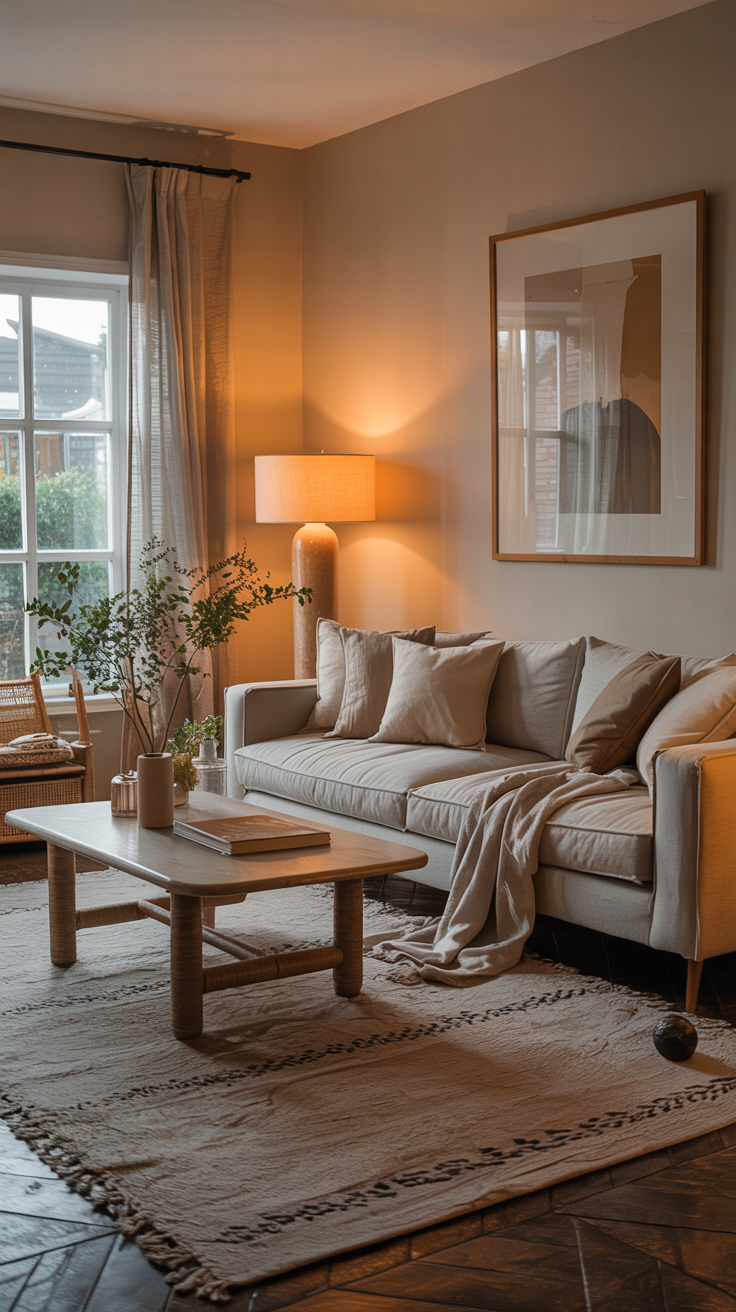
The Great Debate – Where to Begin Your Living Room Transformation
Every grand project begins with a single step. In the world of interior design, that first step is often the most debated. When you decide to refresh your living room, you’re faced with a critical choice: which single change will create the most significant and positive ripple effect? For most designers, the answer lies with one of two foundational pieces. Let’s explore the compelling arguments for both.
The Case for the Couch: The Room’s Unquestionable Anchor
There’s a strong, logical argument for starting with the sofa. As Denver-based interior designer Peggy Haddad notes, “The biggest offender I see in living rooms is a sectional or sofa that doesn’t fit the space. Or an old, worn-down sofa that’s dragging everything down.” Her point is a powerful one. The sofa is, in most living rooms, the largest and most functionally important piece of furniture. It’s the anchor around which all other elements orbit.
A well-proportioned sofa doesn’t just provide seating; it sets the tone for the entire room’s symmetry, flow, and mood. A sofa that is too large can make a room feel cramped and suffocating, hindering movement and overwhelming the space. Conversely, a sofa that is too small can feel lost and insignificant, making the room feel unbalanced and poorly planned.
Before you can make an informed decision, you must first become a detective in your own home. It’s time to critically evaluate your current sofa, not with sentimental attachment, but with a clear, objective eye. Ask yourself the following questions:
- Functionality: Does this sofa truly serve your lifestyle? If you have a large family and love to host movie nights, is your tiny two-seater loveseat forcing people onto the floor? If you live in a small apartment and value intimate conversations, is a sprawling, oversized sectional eating up valuable real estate? Consider your daily habits. Do you like to stretch out for a nap? Do you need durable, stain-resistant fabric to stand up to pets and children? A sofa that doesn’t fit your life, no matter how stylish, is a failed piece of furniture.
- Proportion and Scale: This is where many living rooms go wrong. Get out a tape measure. A good rule of thumb is to have at least 18 inches of space between the sofa and the coffee table to allow for comfortable movement. There should also be at least 3 feet of clear pathway in major traffic routes. Does your sofa adhere to these guidelines? Does it feel harmonious with the other pieces in the room, or does it loom like a giant or shrink like a violet?
- Condition: Be honest about the state of your sofa. Are the cushions sagging to the point of no return? Are there stains that no amount of professional cleaning can remove? Is the fabric pilled, torn, or hopelessly faded? A worn-out sofa, as Haddad rightly points out, can single-handedly “drag everything down,” making even the most beautiful surrounding decor look shabby by association.
- Style: Does the style of your sofa reflect your current aesthetic? Perhaps you bought a bulky, traditional rolled-arm sofa a decade ago, but now you find yourself drawn to the clean lines and minimalist appeal of mid-century modern design. Your sofa is the loudest voice in the room; if it’s speaking a language you no longer love, the entire space will feel dissonant.
If your analysis reveals that your sofa is failing on two or more of these fronts, then starting your transformation here is not just a good idea—it’s essential. A new, well-chosen sofa can instantly solve problems of scale, function, and style, providing a solid, beautiful foundation upon which you can build the rest of your design.
The Argument for the Area Rug: The Soul of the Room
What if your sofa, upon inspection, is actually in pretty good shape? Perhaps it’s the right size, comfortable, and its style is neutral enough to work with a new vision. In this scenario, Peggy Haddad and many other designers would pivot to the floor. “The rug dictates the palette, the style, and the visual boundaries of the room,” she shares. “A fresh rug that’s the right size—usually bigger than people think—gives the whole space a reset.”
If the sofa is the anchor, the rug is the soul. It’s the element that ties everything together, a canvas upon which the furniture rests. Valerie Darden, founder of Brexton Cole Interiors, champions this approach, noting that a rug can have a “massive and immediate impact.” She explains, “Not only does a rug anchor furniture, it adds texture, coziness, and warmth. This result instantly elevates the space.”
Starting with the rug offers several distinct advantages:
- Defining the Space: In an open-concept home, an area rug is the most effective tool for creating a defined, intentional living area. It draws a visual boundary, separating the living space from the dining area or entryway and making the furniture grouping feel cohesive and purposeful.
- Injecting Personality: A rug is a piece of art for your floor. It’s an opportunity to introduce color, pattern, and texture in a bold way. A vibrant, abstract rug can inject energy and modernity into a neutral space. A traditional, hand-knotted Persian rug can add a sense of history and timeless elegance. A plush, high-pile shag rug can bring a feeling of luxurious comfort and coziness.
- A More Accessible Investment: Let’s be practical. A high-quality sofa is a significant financial investment, often running into the thousands of dollars. A beautiful, large area rug can be found for a fraction of that cost. This makes starting with the rug a more accessible and less intimidating option for many people. It provides that “wow” factor and sense of transformation without requiring a massive upfront commitment.
- Setting the Palette: It is often far easier to pull paint colors and fabric choices from the pattern of a rug you love than it is to find a rug that perfectly matches a pre-existing sofa and paint color. By choosing the rug first, you are handed a pre-made color palette. You can pull the soft blue from the rug’s pattern for your throw pillows, the warm terracotta for a new vase, and the creamy white for the walls.
If your living room currently has no rug, or if it has one that is too small for the space (a very common design mistake), then replacing it will be nothing short of transformative. A properly sized rug makes a room feel larger, more luxurious, and more professionally designed.
The Verdict: A Personal Diagnostic
So, the couch or the rug? The truth is, there is no universal right answer. The correct starting point for your living room depends entirely on your personal circumstances. The best approach is to think of it as a diagnostic process.
- Start with the sofa if: Your current sofa is functionally obsolete, structurally unsound, hopelessly out of style, or dramatically out of scale with your room. It is the “biggest offender,” and no beautiful rug can truly disguise a sofa that is fundamentally wrong for the space.
- Start with the rug if: Your sofa is in decent shape and of a neutral style, but the room lacks personality, warmth, or definition. If your floor is bare or your current rug is too small (i.e., the furniture is floating around it rather than being anchored by it), a new rug will be the most impactful change you can make.
Ultimately, this first decision is the catalyst for everything that follows. Whether you choose to replace the anchor or remake the soul of your room, you are setting the stage for a space that is more beautiful, more functional, and more you.
The Art of the Sofa – More Than Just a Place to Sit
If your diagnostic has led you to the conclusion that a new sofa is in order, a thrilling journey awaits. Choosing a sofa is one of the most significant design decisions you will make for your home. It is a commitment, not just of finances, but of space and style for years to come. This is not a decision to be rushed. A great sofa is more than just a piece of furniture; it is a silent partner in your daily life. It’s where you unwind after a long day, cuddle with loved ones, binge-watch your favorite series, and host intimate conversations. To choose the right one, you must become a connoisseur of comfort, a student of style, and a realist about your own lifestyle.
Finding Your Perfect Match: Style & Silhouette
The silhouette of your sofa is the first thing that registers visually. It dictates the overall mood of your living room. A sofa with clean, straight lines and tapered legs will instantly evoke a sense of mid-century modern coolness, while a sofa with deep seats, plush cushions, and rolled arms will feel more traditional and inviting. Let’s explore some of the most popular styles:
- The Sectional: The undisputed king of comfort and casual living. Sectionals are perfect for large families, media rooms, or anyone who loves to host a crowd. They excel at defining a corner of a large, open-plan space. However, be warned: a sectional is a dominant piece. In a small room, it can be a visual bully, consuming the space and leaving little room for anything else. The key is proportion. Modular sectionals offer flexibility, allowing you to reconfigure the pieces to suit your needs.
- The Chesterfield: An icon of classic design. With its deep button tufting, high rolled arms, and luxurious leather upholstery, the Chesterfield exudes an air of sophistication and old-world charm. It makes a powerful statement and can anchor a traditional library, a moody lounge, or even serve as an unexpected, elegant counterpoint in a more modern or industrial space.
- The Mid-Century Modern: Characterized by its clean lines, organic curves, minimalist form, and tapered wooden legs, the mid-century modern sofa is a timeless choice. It sits lightly in a room, often raised off the floor, which creates a sense of spaciousness. It’s a versatile style that works beautifully in contemporary, bohemian, and, of course, mid-century-inspired interiors.
- The Lawson: This is perhaps the most classic and versatile sofa silhouette. Its defining features are a straight back, arms that are lower than the back, and removable seat cushions. It is designed for comfort. The Lawson is a design chameleon; depending on the fabric and leg style, it can feel traditional, transitional, or contemporary, making it a safe and stylish bet for almost any home.
- The Tuxedo: A cousin of the Chesterfield, the Tuxedo sofa is all about clean, geometric lines. Its arms and back are of the same height, creating a sleek, rectangular frame. Often tufted, it has a more modern and formal feel than the Lawson. It’s a sophisticated choice that encourages upright, conversational seating rather than lounging.
The Fabric of Our Lives: A Deep Dive into Upholstery
The fabric you choose for your sofa will have a massive impact on its look, feel, and longevity. This is where lifestyle becomes the most important consideration.
- Leather: Durable, easy to clean, and develops a beautiful patina over time. Leather is a fantastic choice for those with pets and children, as it can be wiped clean and is generally resistant to odors. It can be cool in the winter and warm in the summer, and its price point is typically higher.
- Velvet: For pure, unadulterated glamour and softness, nothing beats velvet. It has a rich, luxurious feel and a beautiful sheen that catches the light. Modern performance velvets are surprisingly durable and stain-resistant, making this luxe option more practical than ever before. It’s perfect for adding a touch of drama and sophistication.
- Linen: Cool, breathable, and effortlessly chic, linen offers a relaxed, lived-in look. However, pure linen wrinkles easily and can be susceptible to staining. A linen blend, which incorporates synthetic fibers, can offer the same breezy look with improved durability and wrinkle resistance.
- Performance Fabrics: This is a broad category that has revolutionized the furniture industry. Brands like Crypton and Sunbrella offer fabrics that are engineered to be virtually indestructible. They are water-repellent, stain-resistant, fade-resistant, and incredibly easy to clean, often with just soap and water. If you have a busy household with children, pets, or a penchant for red wine, a performance fabric is a non-negotiable, peace-of-mind investment.
The Inside Story: What Truly Makes a Quality Sofa
What lies ben