

A front yard can make a house feel either welcoming or strangely unfinished. Sometimes the problem is obvious: bare soil, a tired lawn, a few shrubs planted in an apologetic straight line. More often, though, the problem is simply that there is no point of view. The exterior may be perfectly functional, but nothing directs the eye, frames the front door, softens hard edges, or suggests that someone took a moment to make the arrival feel special.
The good news is that a yard with no curb appeal is not a blank check waiting to happen. It is a design problem, and design problems become much easier once you stop thinking in terms of buying “pretty plants” and start thinking in terms of composition. The most successful front yards balance structure, repetition, proportion, and a small dose of personality. They create a clear sequence: street, path, front door. They look good in the middle of July, but they also retain enough shape in November that the house never looks abandoned.
If your yard currently feels flat, random, or just a little sad, begin with this idea: landscaping is not decoration applied to a house. It is the connective tissue between the house and the street. Here is how to build that connection deliberately, one practical decision at a time.
Start With a Visual Audit, Not a Shopping Trip
The fastest way to waste money outdoors is to buy plants before understanding what is visually wrong. Stand on the sidewalk or at the end of the driveway and look at the house as a stranger would. Take one photo straight on, then another from the angle most visitors use. Photographs are useful because they remove the mental clutter of knowing the property; suddenly, awkward gaps, oversized foundation beds, and competing focal points become much easier to spot.
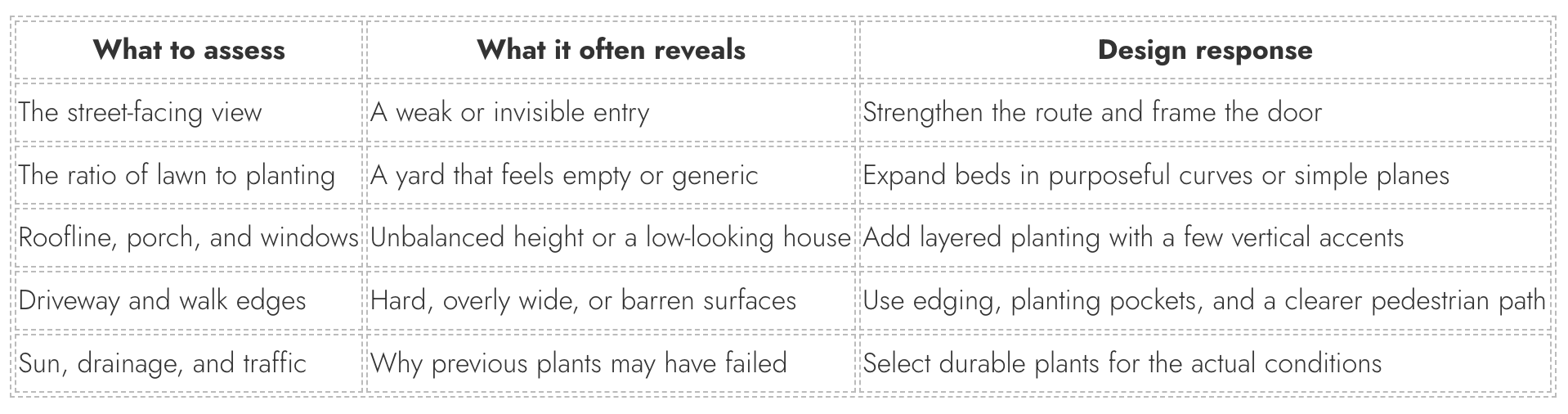
This audit is also the moment to decide what not to fight. If you dislike a very prominent garage, for example, you may never make it disappear, but you can reduce its visual dominance by improving the entry planting, adding a tree on the opposite side for balance, and giving the front door a more compelling role. Good landscaping does not demand perfection from the architecture. It edits what is there.
Choose One Big Idea for the Whole Front Yard
A front landscape begins to feel expensive when it has a coherent vocabulary. That does not mean every yard needs a named style, but it should have a clear mood. A sleek, contemporary home may suit broad sweeps of ornamental grasses, clipped evergreens, gravel, and restrained flowers. A traditional brick house can carry hydrangeas, boxwood-like forms, clipped hedges, and softer drifts of perennials. A cottage-inspired approach might use fuller beds, informal textures, an arbor, and a looser mix of flowers. The mistake is not mixing plants; it is mixing design languages with no hierarchy.
Before choosing individual species, write a one-sentence brief. It could be: “A calm, green entry with soft white flowers and warm gravel,” or “A low-maintenance, drought-tolerant yard with a modern desert-garden feel.” This sentence becomes a filter for every decision. If a bright tropical annual, a rustic wagon wheel, or a fussy rose does not belong in the sentence, it probably does not belong in the yard.
Think in plant roles before plant names. Every selection should serve as an anchor, screen, edging, seasonal accent, or supporting texture. When every plant tries to be the star, the result is visual noise.
Make the Front Door the Destination
The front door is often the most underused landscape asset. A visitor should understand, within a second or two, where to go. Yet many suburban yards give more visual weight to a garage, a broad driveway, or a random island bed than to the entry itself. Correcting that imbalance is one of the highest-return design moves you can make.
Then frame the doorway. Matching containers can be effective, but they are not the only answer. A pair of tall, restrained planters works beautifully on a porch with symmetry. On an asymmetrical façade, one larger planter or a sculptural evergreen may make more sense. The key is scale: a tiny pot next to a large door disappears, while an oversized planter can make even a simple entry feel grounded. Fill containers with a long-lived evergreen or structural grass, then add seasonal accents if you enjoy changing them.
Planting should help lead the eye toward the door rather than forming a hedge that hides it. A small tree or taller shrub can frame one side of the approach, while lower mounded plants soften the base of the porch on the other. Repeating one plant in groups along the walk can create a subtle visual rhythm. This is more effective than placing one of everything along the foundation, which often reads as a collection rather than a garden.
Fix Proportion Before Chasing Flowers
A great front yard has layers, just as a well-designed room does. The difference is that the layers are built with height, texture, and seasonal change rather than furniture. Most curb-appeal problems come down to poor proportion: beds that are too shallow, shrubs that are too small for the house, or a lawn that overwhelms everything else.
Foundation planting is a common culprit. A two-foot-deep strip filled with low, identical shrubs rarely makes a house look better. It usually reads as an afterthought. If space allows, widen the bed so there is room for a true planting composition. A deeper bed gives you the chance to place taller structural plants toward the house, medium-height mounding plants in front, and lower perennials or ground covers near the edge. This layering creates depth from the street and helps blend the building into the site.
Vertical elements matter too. If a one-story home sits on an open lot, it may need a small ornamental tree, multi-stem shrub, or tall ornamental grass to create lift. If the home is already tall and narrow, broad, layered planting may be more flattering than a row of upright evergreens that exaggerates the height. Use the house’s shape as your guide. The landscape should make its proportions feel more settled, not more extreme.
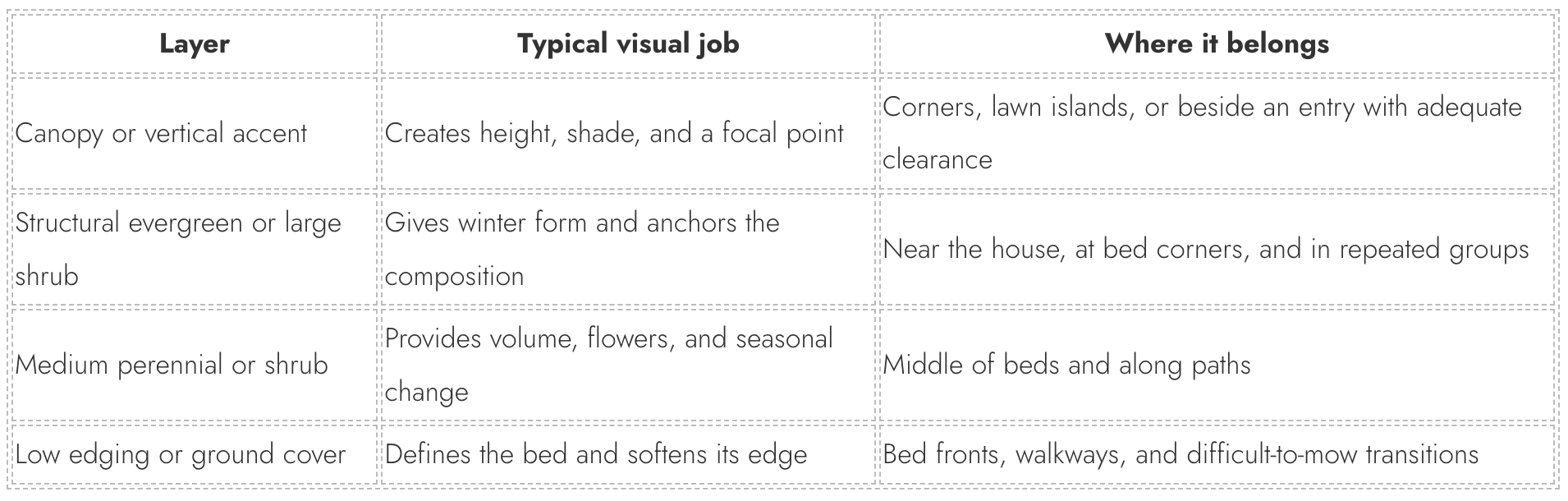
A useful rule of thumb is to avoid treating the foundation as a line that needs to be covered. Instead, imagine planting in broad, connected shapes that move outward from the house. A bed can swell around a corner, pull back to reveal an architectural feature, then extend toward the walk or driveway. This approach feels more natural and is far more forgiving than a thin ribbon of mulch tracing the perimeter of the building.
Build Beds With Shape, Repetition, and Negative Space
Once you know where your layers will go, draw the bed edges with a hose, rope, or marking paint before digging. This small step prevents many regrets. View the outline from the street, from the driveway, and from inside the house. Adjust until the curves or straight lines look calm and confident. Nervous, wavy borders tend to look fussy. Broad, intentional curves read as generous; crisp rectangles or long planes can look strikingly modern.
In a traditional setting, a sweeping crescent bed may soften a large lawn and draw the eye toward the porch. In a contemporary setting, a long rectangular bed parallel to the house can look equally elegant. The important thing is that the geometry repeats somewhere else. If one bed has a strong curve, echo a related curve near the walk or at a corner. If the design is all straight lines, keep that clarity through the edging and planters too.
Give the plants room to repeat. Repetition is one of the easiest ways to make an inexpensive planting look designed. Rather than buying twelve kinds of plants and using one of each, choose a smaller palette and use each selection in several places. A swath of the same flowering perennial, three matching evergreen mounds, or a recurring clump of grass creates visual confidence. You can still include special specimens, but they will have more impact when surrounded by a composed background.
Just as important is negative space. Not every inch needs a plant. A clean expanse of lawn, gravel, mulch, or ground cover can provide the pause that makes the planted portions look better. A yard feels cluttered when every edge is scalloped and every open space contains a small island bed. If the property is modest, fewer, larger beds will nearly always look more generous than many tiny ones.
Create Four-Season Interest Without Making It High-Maintenance
Curb appeal is easy to achieve for a few weeks in spring. The more satisfying goal is a yard that feels composed in every season without requiring constant rescue. The secret is to combine permanent structure with plants that take turns performing.
Start with evergreen presence. This does not have to mean a wall of formal evergreens. A few well-placed broadleaf evergreens, conifers, or climate-appropriate shrubs can keep a front bed from disappearing in winter. Their shapes should contrast with each other: perhaps one upright form, one rounded mound, and one lower spreading texture. Evergreens are the punctuation marks of the garden, not the entire sentence.
Next, select flowering shrubs and perennials for a succession of moments. Early bulbs can bring an entry to life after winter. Spring-flowering shrubs establish the first major show. Summer perennials and grasses sustain the beds, while late-blooming plants, foliage color, berries, or seed heads carry the design into autumn. You do not need a separate plant for every month; you need enough overlap that no season feels vacant.
For a low-maintenance scheme, choose plants that match the site from the start. Drought-tolerant plants belong in hot, fast-draining locations. Shade lovers belong in shade. Native and regionally adapted plants are often good candidates because they suit local conditions, but they still need thoughtful placement and proper establishment care. “Low-maintenance” does not mean “plant once and never touch.” It means the work is predictable: watering while plants establish, seasonal pruning where appropriate, occasional division or thinning, and a spring refresh rather than weekly troubleshooting.
Use Trees and Screening Strategically
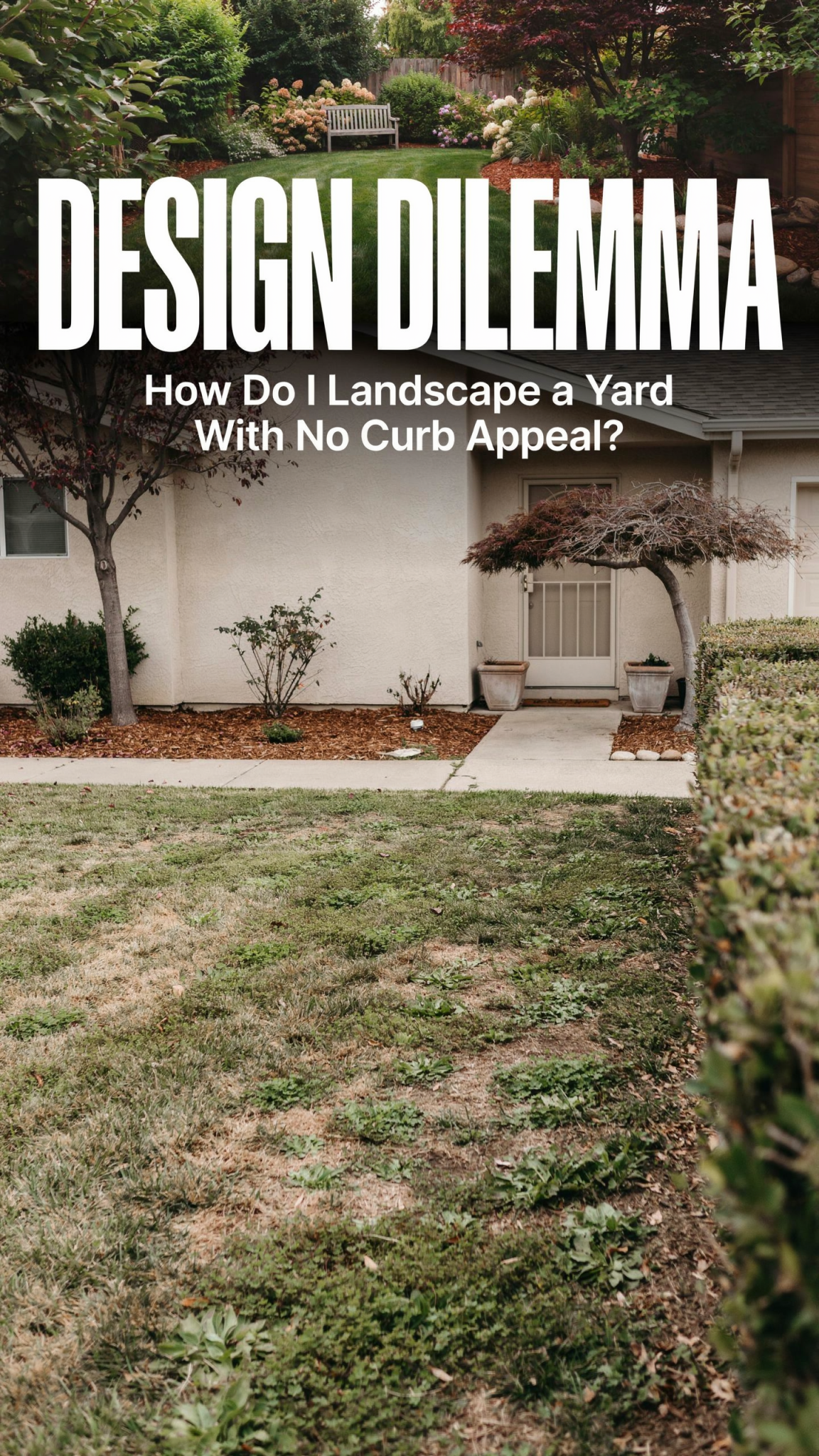
Look for a tree whose mature height and canopy spread suit the distance from the house, driveway, sidewalk, and overhead utilities. Small ornamental trees are useful closer to an entry, while a larger shade tree may belong farther out in the lawn or near a property edge. A multi-stem tree can add sculptural character and create a softer, garden-like effect. An upright form can mark a corner or frame a view without consuming a broad footprint.
Screening deserves restraint. If an air-conditioning unit, utility box, neighbor’s fence, or blank garage wall is ugly, the first instinct may be to plant a fast-growing hedge and forget it. Yet a dense, oversized screen can create a new problem: it blocks light, crowds windows, and demands constant pruning. Use a layered screen instead. Combine a small tree or taller shrub with medium shrubs and lower plantings. The eye will register the fullness, while the individual plants remain healthier and easier to manage.
Treat the Lawn as a Deliberate Surface
A lawn can be useful, restful, and handsome, but it should not automatically occupy every available square foot. On many properties, reducing lawn is the single biggest curb-appeal improvement because it creates room for planting beds with depth and definition. A broad, uninterrupted lawn tends to make small houses look isolated and large houses look less grounded.
Mow cleanly, edge regularly, and repair obvious bare patches before judging the lawn too harshly. A modest lawn with crisp edges can look intentional; a large lawn with ragged borders makes even beautiful shrubs look neglected. If grass struggles repeatedly in certain areas, let that be information. Replace that trouble spot with a bed, ground cover, mulch, or gravel rather than spending each season trying to force turf into the wrong conditions.
Add Finishing Details That Make the Design Feel Complete
After the large moves are in place, details have real power. Landscape lighting can be especially transformative because it turns the yard into an evening façade. Use it sparingly and aim it carefully. A soft wash on the entry, a gentle highlight on a beautiful tree, and low path lighting where safety requires it are enough. Avoid turning the front yard into a runway or spotlighting every plant individually. The most sophisticated outdoor lighting is felt before it is noticed.
Containers offer flexibility, especially near the door, at the end of a drive, or on a porch. Use fewer, larger pots rather than a crowd of small ones. One tall planter with a small tree or evergreen and a simple underplanting can look more composed than six mismatched pots full of unrelated annuals. This is also an easy place to introduce a seasonal color note without changing the entire landscape.
A Smart Order of Operations for Any Budget
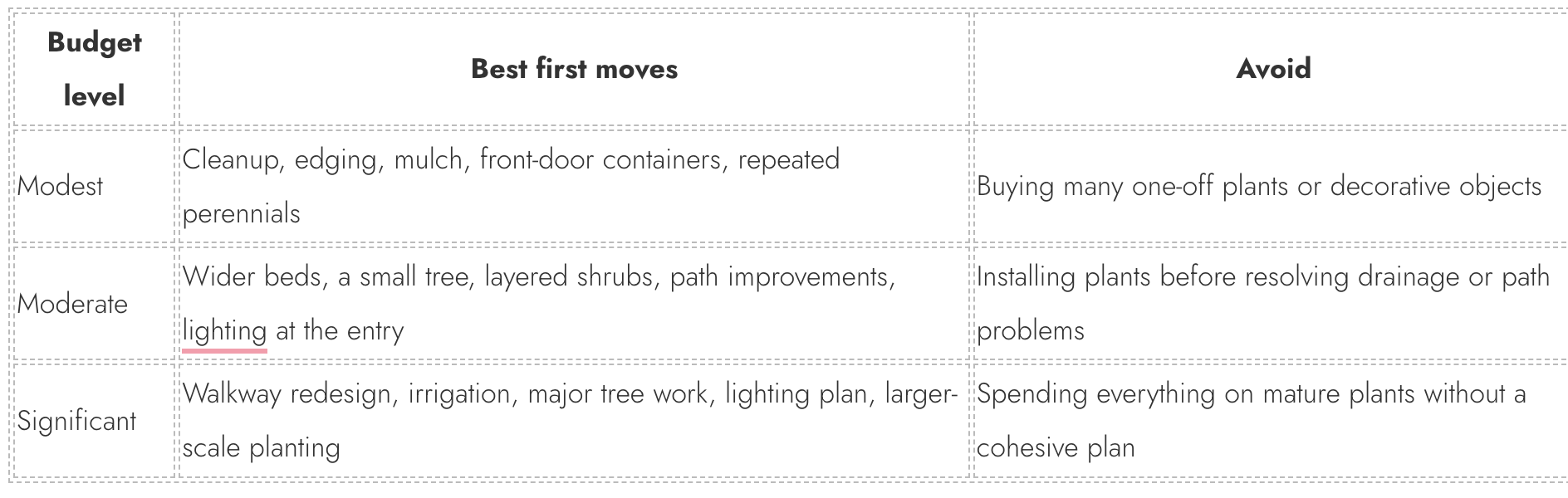
It is tempting to work from the nursery outward, but curb appeal improves most quickly when you tackle the most structural choices first. Start by removing what is visibly dead, overgrown, damaged, or poorly placed. Then address the hardscape and practical features: the walkway, edging, drainage issues, porch condition, and any irrigation needs. Only after those elements are settled should you install trees, shrubs, and perennials.
For a small budget, concentrate on the arrival zone. Improve the door, clean the path, define two or three beds, add mulch, and install a limited number of durable plants in repeated groups. A single specimen tree or pair of substantial containers may be a better investment than a cart full of small annuals. The transformation will not depend on having a lot of plants; it will come from clarity.
The Most Common Curb-Appeal Mistakes
Another common mistake is creating beds that are too narrow. Shallow foundation strips force plants into a single row and make it difficult to create the layers that give a landscape depth. Whenever possible, make fewer beds but make them wider.
Ignoring mature scale is another frequent problem. A landscape can look charming the day it is planted and become crowded, shady, and expensive to maintain three years later. Give plants their intended room. If immediate fullness matters, choose larger groupings of plants with a suitable mature size rather than squeezing in too many future giants.
Another misstep is allowing mulch, lawn, and pruning to become the whole ma