

For much of the last decade, home décor has been dressed in warm metals. Brushed brass, antique bronze, aged copper, and champagne finishes brought softness to kitchens, bathrooms, living rooms, and furniture. Chrome, meanwhile, was often treated as a relic of another era: too shiny, too commercial, too closely associated with builder-grade faucets, mid-century office furniture, or the futuristic interiors of old science fiction.
That reputation is changing. Chrome is returning to rooms not as a compulsory finish applied to every handle and hinge, but as a deliberate accent with a particular visual power. Its cool, mirrorlike surface catches daylight, repeats the colors around it, and gives even familiar silhouettes a sharper, more contemporary presence. It is appearing in sculptural lighting, furniture frames, accessories, and bathrooms, giving familiar spaces a sharper, more contemporary presence.
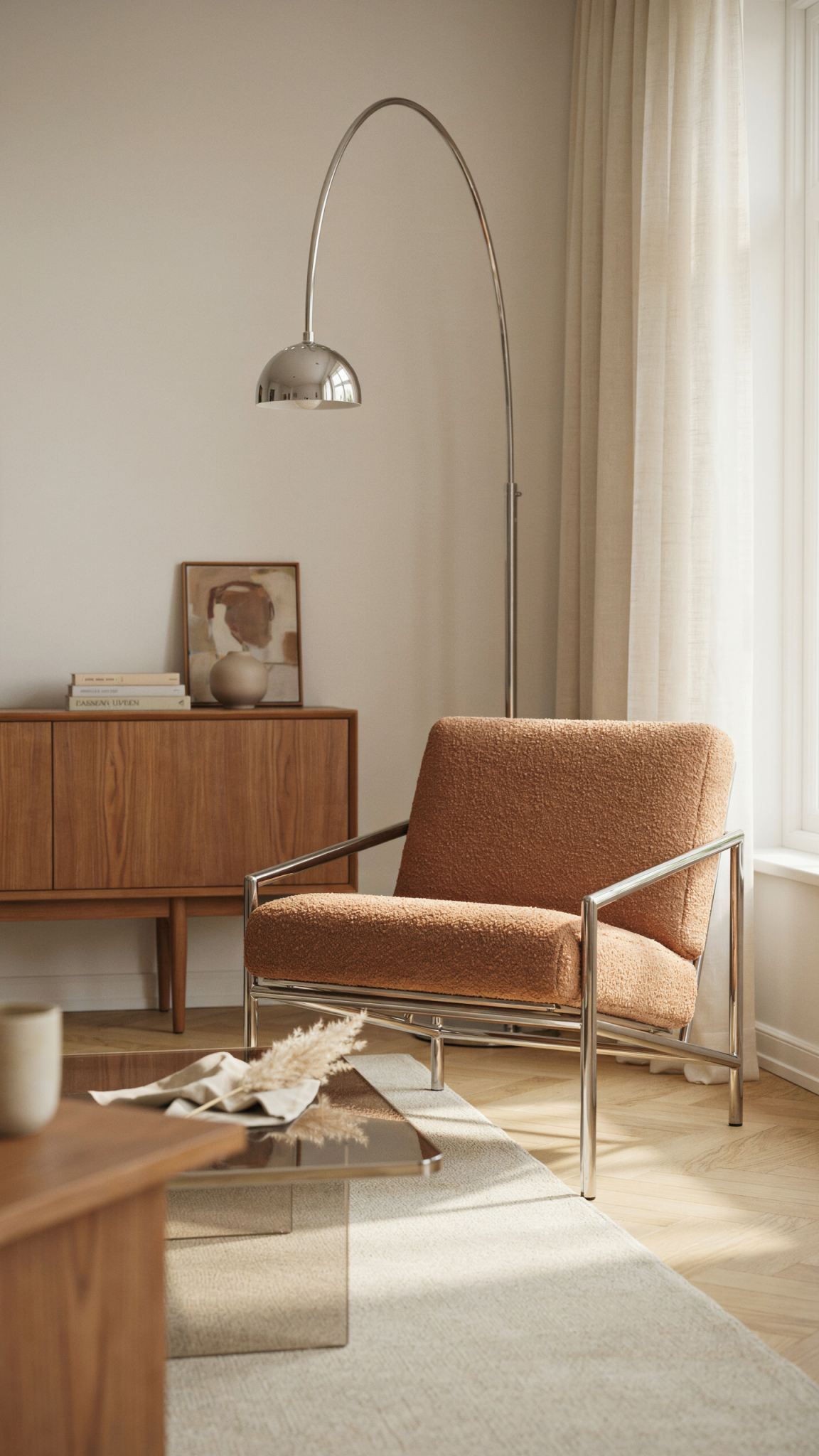
The renewed interest is not simply a nostalgic return to the 1980s or to Space Age design. Today’s chrome is being used in a more nuanced way. It appears beside walnut, linen, stone, wool, painted cabinetry, smoked glass, and richly colored walls. It can be playful or restrained, glamorous or utilitarian, retro or thoroughly modern. The key is not to ask whether an entire room should be chrome. The better question is: What can a small amount of reflective metal do for this particular space?
Why chrome is having a moment
Trends rarely emerge from one cause. Chrome’s resurgence is partly a reaction against the dominance of warm, matte finishes, but it also reflects broader changes in how people want their homes to feel. After years of beige minimalism and heavily coordinated “soft” interiors, many rooms are gaining contrast, shine, stronger silhouettes, and objects with a visible point of view.
Chrome offers all four. Its brightness creates an immediate highlight. Its cool undertone interrupts a palette that might otherwise become too brown or too tonal. Its industrial history gives it a sense of function, while its reflective surface adds a touch of glamour. Because it mirrors nearby colors, it can also behave more flexibly than a strongly colored metal: chrome may pick up the blue of a rug, the green of a plant, or the warmth of a wood floor without competing with those elements.
Designers are also rediscovering the appeal of materials associated with earlier periods. Chrome has a long design history, from Art Deco’s celebration of polished surfaces to the tubular furniture of modernism and the optimistic, machine-inspired forms of the mid-century and Space Age eras. A contemporary chrome chair or lamp can therefore feel both fresh and familiar. It carries cultural memory without requiring a room to become a period recreation.
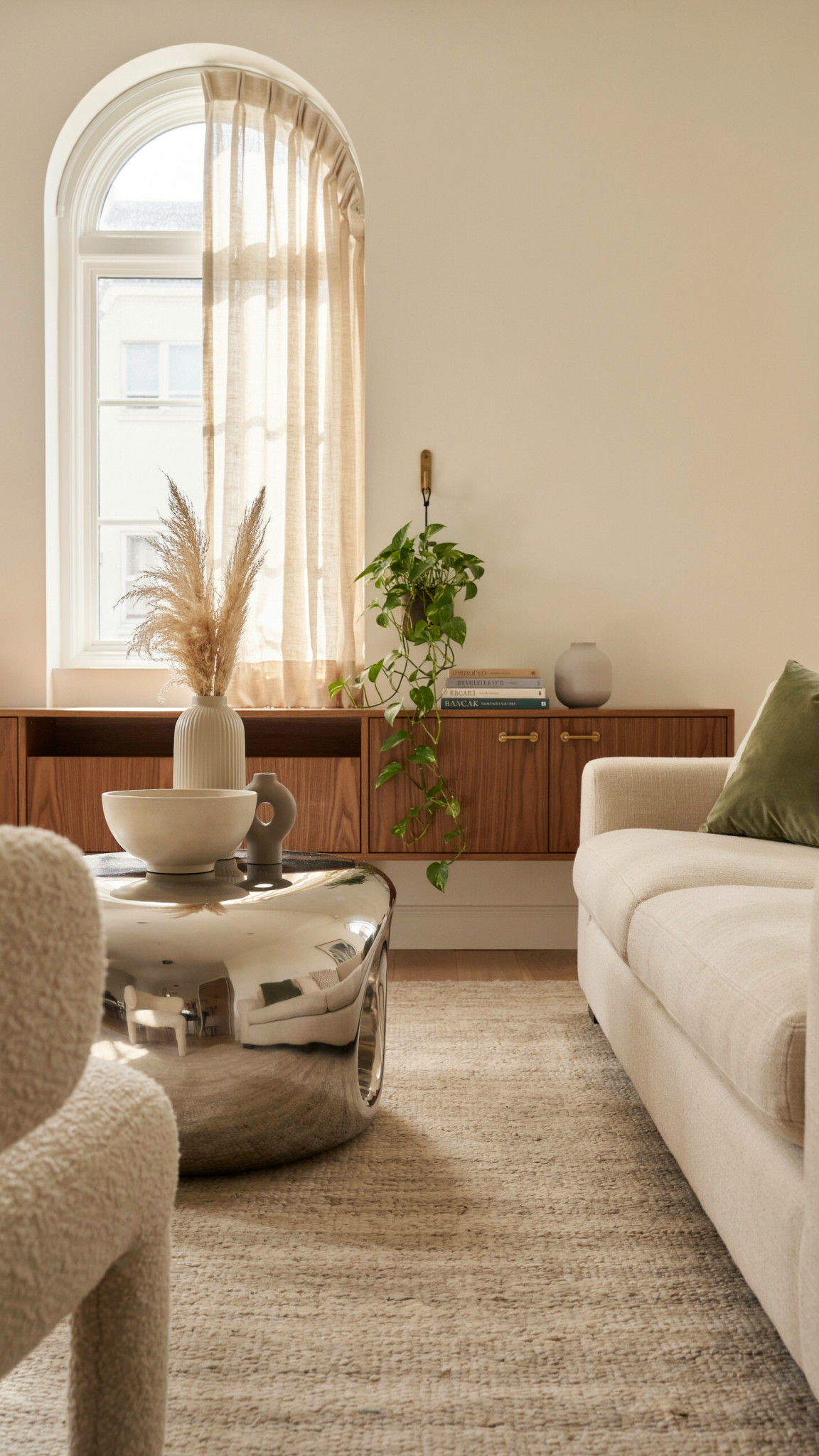
There is a practical reason for its return, too. Chrome works across a broad range of styles. In a minimalist interior, it reinforces clean geometry. In an industrial room, it echoes metal and machinery. In a traditional space, it can provide a crisp update to a classic console or bathroom. In a colorful eclectic room, it acts as a relatively neutral punctuation mark. Its versatility makes it easier to introduce than a more assertive finish such as unlacquered brass, which changes visibly over time and brings a stronger yellow-gold presence.
The best way to think about chrome is as the “jewellery” of the home: a focused detail rather than a finish applied to every surface. That analogy is useful. A mirror, watch, or pair of earrings can change the character of an outfit without replacing it. Chrome works similarly in a room.
Chrome is not the same as every silver finish
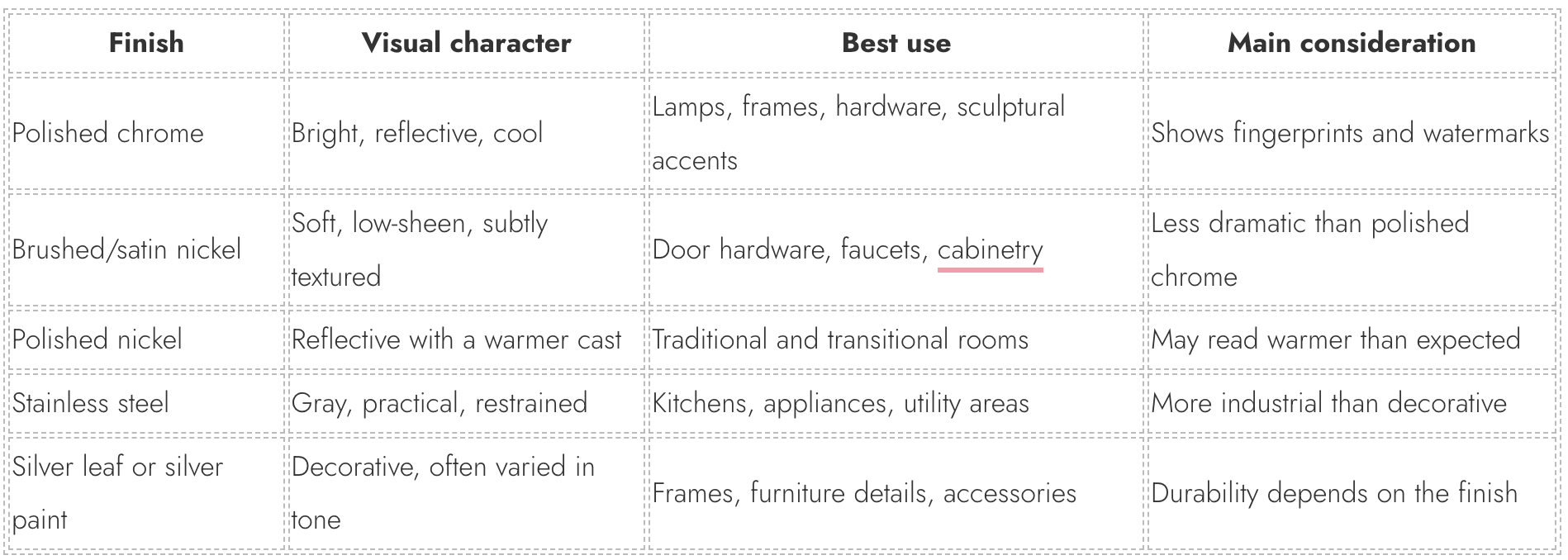
Before buying anything, it helps to distinguish chrome from the other cool metallic finishes that are often grouped under the general category of “silver.” Polished chrome is the brightest and most reflective option. It is usually applied as a thin decorative plating over another metal and has a clean, mirrorlike appearance.
Brushed or satin nickel is softer and less reflective. Its subtle grain can be easier to live with in high-touch areas because it tends to disguise fingerprints and small water spots better than a highly polished surface. Polished nickel may look similar to chrome at first glance, but it typically has a warmer, slightly yellow cast. Stainless steel has a more muted, gray appearance and is often chosen for appliances and work surfaces. Aluminum can be lighter and more matte, while silver leaf or silver-toned paint creates a decorative effect rather than a plated-metal surface.
The distinction matters because two products labeled “silver” may have very different visual temperatures and maintenance requirements. If the goal is the lively, reflective look driving the current chrome trend, search specifically for polished chrome or a clearly identified chrome finish. If you want the idea of chrome without quite as much shine, satin nickel or brushed stainless may be a better fit.
Start with one intentional chrome moment
The easiest mistake is to treat a returning trend as a shopping list. A room does not need a chrome coffee table, chrome lamp, chrome mirror, chrome hardware, and chrome sculpture simply because each item looks appealing in isolation. Begin instead with one meaningful object that solves a design problem.
A chrome floor lamp can brighten a dim corner. A small side table can make a heavy sofa arrangement feel lighter. A mirror with a narrow chrome frame can connect a bathroom to adjoining spaces. A set of cabinet pulls can provide a modest update without requiring new cabinetry. Once the first piece is in place, observe what it does to the room before adding more.
This approach has two advantages. It prevents overdecoration, and it allows chrome to respond to the existing architecture. A polished surface needs something to reflect. Its success depends on what surrounds it: a painted wall, a piece of art, a leafy plant, a textured textile, or a pool of daylight. The room should remain the subject; chrome should be the punctuation.
A helpful rule is to repeat a finish at least twice if you want it to feel intentional, but keep the repetitions varied in scale. For example, pair a chrome table lamp with a small framed mirror, or use chrome furniture legs alongside a discreet metal picture frame. Repetition creates visual rhythm; variety prevents the room from looking like a matching set.
The living room: add shine without losing comfort
The living room is an ideal place to experiment because textiles and upholstery naturally soften chrome’s harder visual qualities. Consider a chrome-framed lounge chair upholstered in velvet, boucle, leather, or a substantial woven fabric. The metal gives the silhouette definition while the upholstery keeps it inviting. A chrome-legged coffee table can perform a similar role, especially when its top is made from smoked glass, marble, travertine, or wood.
Lighting is another reliable entry point. A chrome mushroom lamp, arched floor lamp, or articulated task lamp can introduce a reflective note at eye level. Choose a shape with character rather than an anonymous shiny cylinder. Curves make chrome feel more sculptural and less institutional, while simple geometric forms support a minimalist scheme.
Mirrors can amplify the effect, but placement matters. A large mirror opposite a window may increase brightness, while a mirror facing a television or a cluttered shelf can reflect visual noise. A narrow chrome frame around a mirror is often enough; the frame does not need to be thick or ornate to make an impression.
To balance the coolness of chrome, bring in materials that invite touch: a wool rug, linen curtains, a nubby throw, a walnut cabinet, or a ceramic vessel with an irregular glaze. Color is equally useful. Rust, chocolate brown, oxblood, moss green, navy, and butter yellow can all make chrome feel more integrated and less stark. The contrast between a cool reflective surface and a warm, tactile one is often more compelling than a room in which every material has the same temperature.
The kitchen: use chrome where hands already go
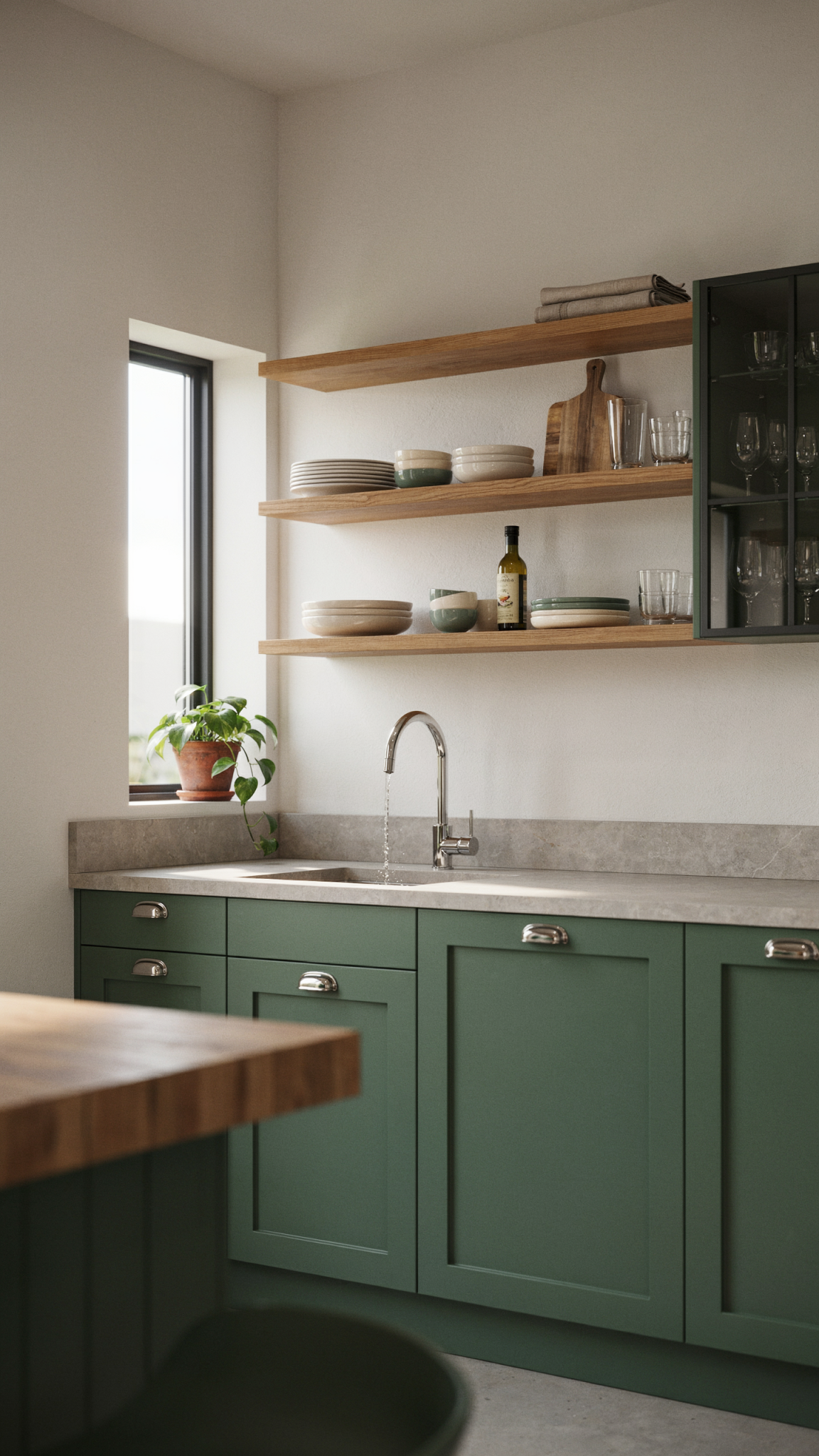
Kitchen hardware is one of the most practical ways to participate in the trend. Chrome drawer pulls, knobs, faucet details, pot rails, and bar-stool frames can sharpen a kitchen without changing its layout. The finish is especially effective against painted cabinetry in deep green, blue, charcoal, cream, or warm white. Against natural wood, it creates a clean counterpoint to the grain.
If you are replacing hardware, measure existing hole spacing before ordering. A beautiful pull is not useful if it requires extensive filling, drilling, or refinishing. For a modest refresh, replace only the most visible pieces: the island hardware, pantry pulls, or a faucet. A coordinated but not overly uniform approach can look more considered than changing every small fitting.