

You love your home, you like the sunlight, and you may even enjoy being outside until a neighbor opens a window, a dog walker pauses at exactly the wrong sightline, or dinner on the patio starts to feel like a performance for the houses behind you. The obvious answer seems to be a tall fence. Build a solid wall, block the view, and be done with it.
But a giant fence is often the visual equivalent of shutting the curtains at noon. It can turn a small yard into a narrow corridor, make a terrace feel boxed in, reduce breezes, and create an oddly defensive mood. It may also conflict with neighborhood rules, local height limits, or the character of the house. More importantly, it treats privacy as an all-or-nothing condition when most outdoor spaces need something more nuanced: not isolation, but a sense of retreat.
The most successful private gardens rarely announce, “Keep out.” Instead, they quietly direct the eye, soften exposure, and make the spaces where you sit feel intentionally sheltered. They use layers, movement, texture, and layout to create separation without sacrificing light or charm. Whether you have a postage-stamp city patio, a suburban side yard, or an exposed deck, the goal is the same: create a place that feels like yours without making it look like a fortified compound.
This is less about one clever product than about designing a sequence of filters. A view can be interrupted by a leafy branch, redirected by a pergola beam, softened by a sheer outdoor curtain, or simply made irrelevant because the seating has been moved six feet in a smarter direction. Once you start thinking this way, the giant fence stops being the default—and your yard gets much more interesting.
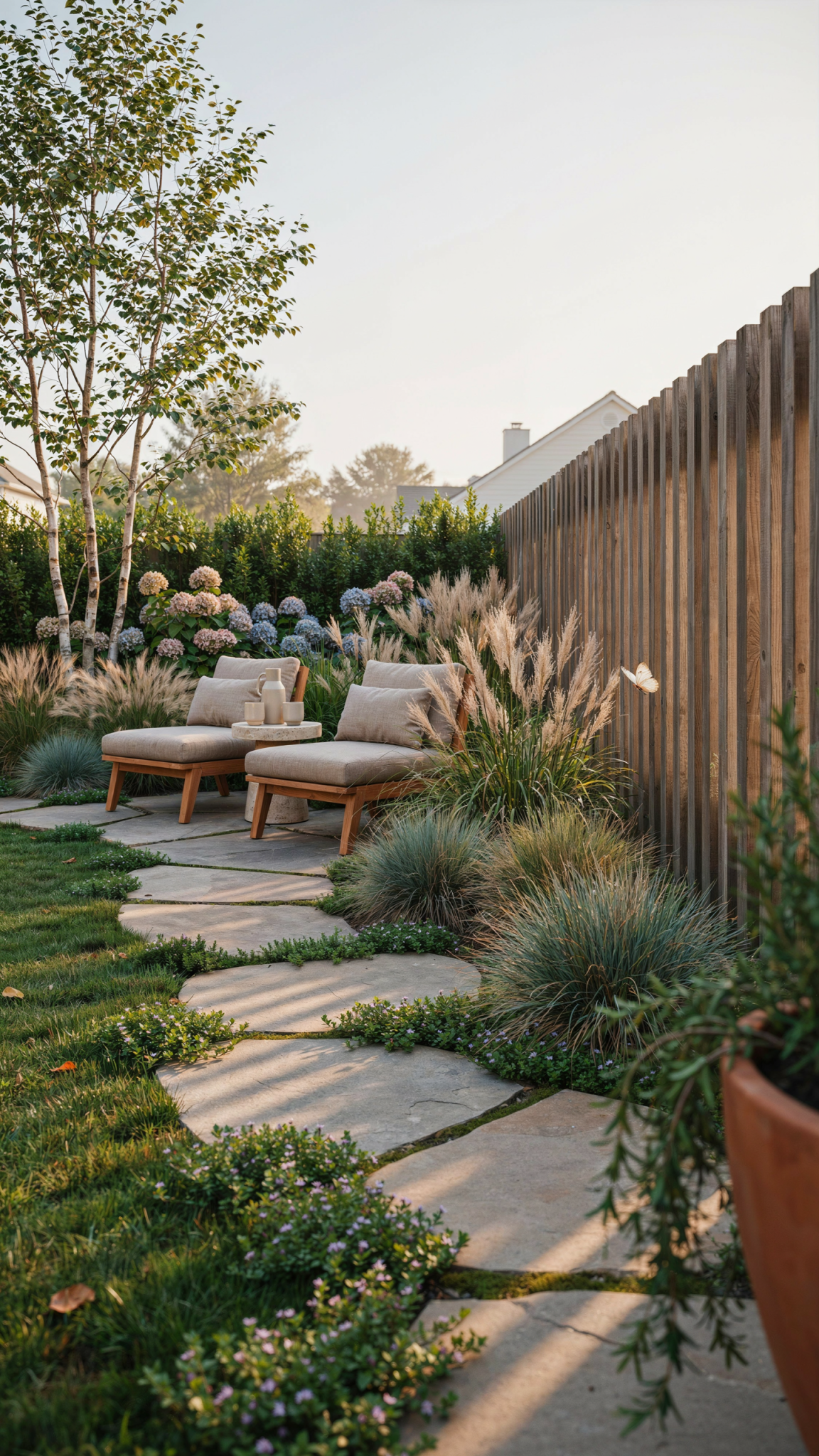
Begin With the View You Actually Need to Block
Before ordering plants or panels, spend time outside at the moments you use the space. Sit in your usual chair. Stand at the grill. Lie on the lounge chair. Look toward the windows, upper decks, sidewalks, and neighboring patios that make you feel exposed. You may discover that the problem is not the entire property line. It may be one second-story window, a narrow gap between buildings, or a direct view into a dining nook.
That distinction matters. If the unwanted view comes from above, a six-foot fence will do very little. If the issue is a neighbor’s driveway to one side, you may only need a screen near the seating area—not a continuous boundary treatment. When a space feels exposed, people tend to overcorrect. A more precise response is usually cheaper, prettier, and more effective.
Think of privacy in three dimensions: where you are, where the viewer is, and what sightline connects you. Privacy is created when something interrupts or distracts from that line. The interruption does not have to be opaque. In fact, partial screening often feels more natural because it preserves depth and daylight while removing the uncomfortable clarity of a direct view.
A useful first exercise is to make a small “privacy map.” Mark your outdoor zones, then note what is visible from each one. Use simple labels: side glance, direct overlook, overhead view, and street exposure. This turns a vague frustration into a manageable design brief.
| Privacy problem | Better first move | Why it works |
|---|---|---|
| Neighbors see directly into a patio | Add a localized screen or planted layer beside the seating area | Blocks the key sightline without closing the whole yard |
| A second-story window overlooks the garden | Use a pergola, canopy, or small tree with an elevated canopy | Solves the vertical angle a standard fence cannot reach |
| A sidewalk feels too close | Create a planted forecourt, low hedge, or raised planters | Adds a buffer while keeping the home welcoming |
| A narrow side yard feels exposed | Use vertical planting, a trellis, or staggered panels | Maintains air and light in a confined space |
| An open deck lacks intimacy | Define a room with curtains, slatted screens, or a roof element | Makes the deck feel furnished rather than exposed |
Design a Room, Not a Barrier
One of the most reliable ways to make an outdoor area feel private is to stop treating it as leftover lawn or paving. Treat it as a room. Indoor rooms feel private because they have boundaries, a focal point, furniture arranged with purpose, and a clear sense of where one is meant to sit. The boundaries do not all need to be walls. Outdoors, they can be created with planters, changes in level, fabric, branches, screens, or the edge of a roof.
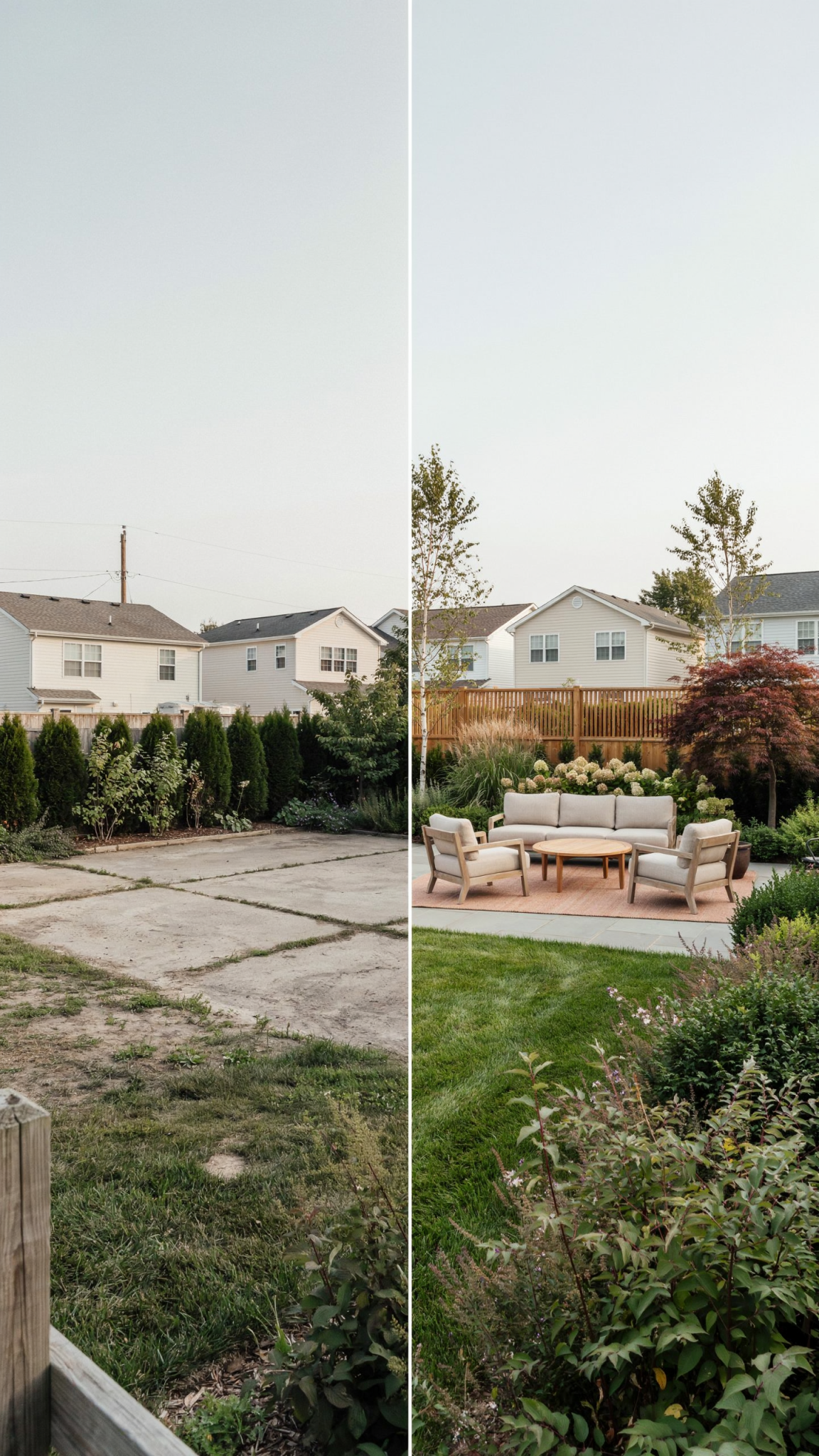
Start with the place you most want to enjoy. Maybe it is a two-chair coffee spot, a family dining table, or a chaise lounge for reading. Arrange the furniture so that the best view faces inward, toward a planting bed, fire bowl, water feature, or textured wall rather than toward the property line. This alone can make a dramatic difference. If the chairs point toward each other or toward a focal point, your attention naturally stays in the space rather than drifting to the neighbor’s kitchen window.
Rugs are surprisingly helpful here. An outdoor rug grounds a seating arrangement and signals that this is a destination, not a pass-through. Add a substantial coffee table, a lantern, and a tall planter at the open side. Suddenly the eye reads the scene as a complete composition. The surrounding views become background rather than the main event.
The goal is not to erase the outside world. It is to give your own outdoor space a stronger visual identity than the view beyond it.
Use Planting in Layers, Not One Solid Green Wall
Privacy planting is often reduced to a row of identical evergreens. There is nothing inherently wrong with an evergreen hedge, especially where year-round screening is essential. But a single dense line can feel static, take up more depth than expected, and create a maintenance commitment that only becomes obvious after a few growing seasons. A layered planting scheme usually feels softer, richer, and more intentional.
The simplest formula uses three heights. Start with a lower layer of ornamental grasses, flowering perennials, or small shrubs. Add medium-height shrubs to create body and visual weight. Then introduce a few taller elements—small multi-stem trees, bamboo in containers, large grasses, or climbers on a support—to interrupt longer views. The layers overlap in your line of sight, so they can create privacy without each plant needing to be enormous.
This style is particularly useful when you want screening that looks good from both sides. A mixed border has seasonal change, texture, and lightness. It also avoids the “living wall” effect that can make a garden feel smaller. If you are drawn to a contemporary look, try a restrained palette: upright grasses, clipped evergreen forms, pale flowering shrubs, and dark planters. For a looser, cottage-inspired garden, mix hydrangeas, serviceberry or multi-stem trees, ferns, and airy perennials. Mediterranean spaces can lean into olive-toned foliage, rosemary, lavender, and sculptural grasses, while a tropical scheme might use broad leaves and layered palms where the climate permits.
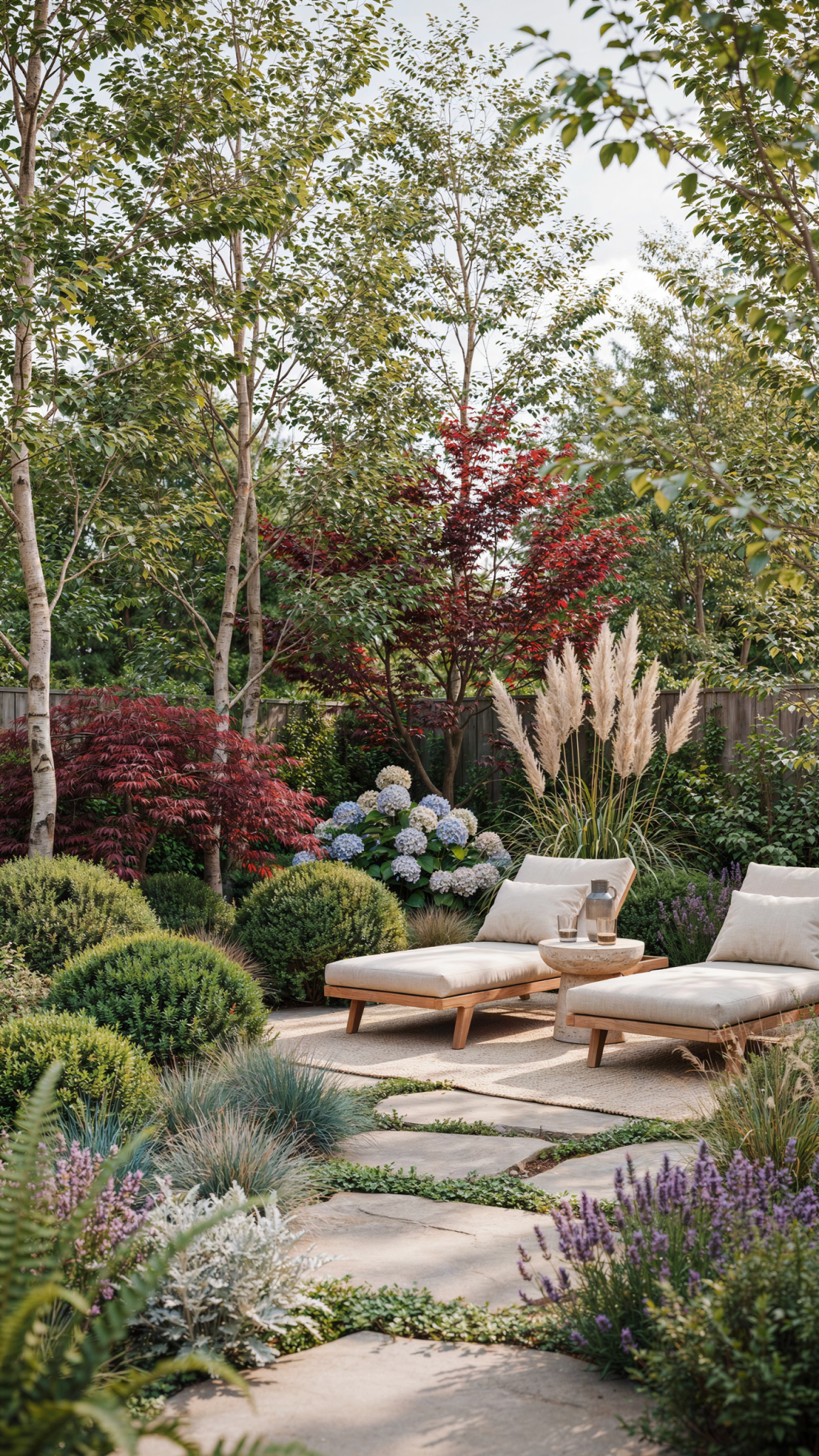
The best privacy planting also considers what happens in winter. Deciduous trees and ornamental grasses can be beautiful, but they may become transparent once leaves drop. Instead of abandoning them, pair them with an evergreen backbone. A few carefully positioned evergreen shrubs can preserve the essential screen, while deciduous layers bring the softness and seasonal character.
Choose Trees for Canopy, Not Just Height
When privacy comes from overlooking windows or adjacent roof decks, vertical height matters—but so does shape. A narrow columnar plant can hide a specific side view, but it may not do much for an overhead angle. A tree with a well-placed, airy canopy can be much more useful. The trick is to choose a form that filters the view from above while still allowing light to reach the seating zone below.
Multi-stem specimen trees are excellent at this job. Their branching structure has a sculptural quality, and their canopy can soften a view without producing the dark, oppressive effect of a dense evergreen mass. Clump-form trees also feel less formal than a rigid line of screening plants, which helps a backyard retain the relaxed character of a garden.
Placement is more important than quantity. A single small tree set at the end of a sightline can obscure a surprising amount. Imagine looking up from your favorite chair: you do not need the entire sky to be covered. You need one part of the frame—the line leading toward the overlooking window—to be softened. A tree placed closer to the seating area often does this more effectively than a taller tree planted at the far edge of the lot.
Let Screens Breathe
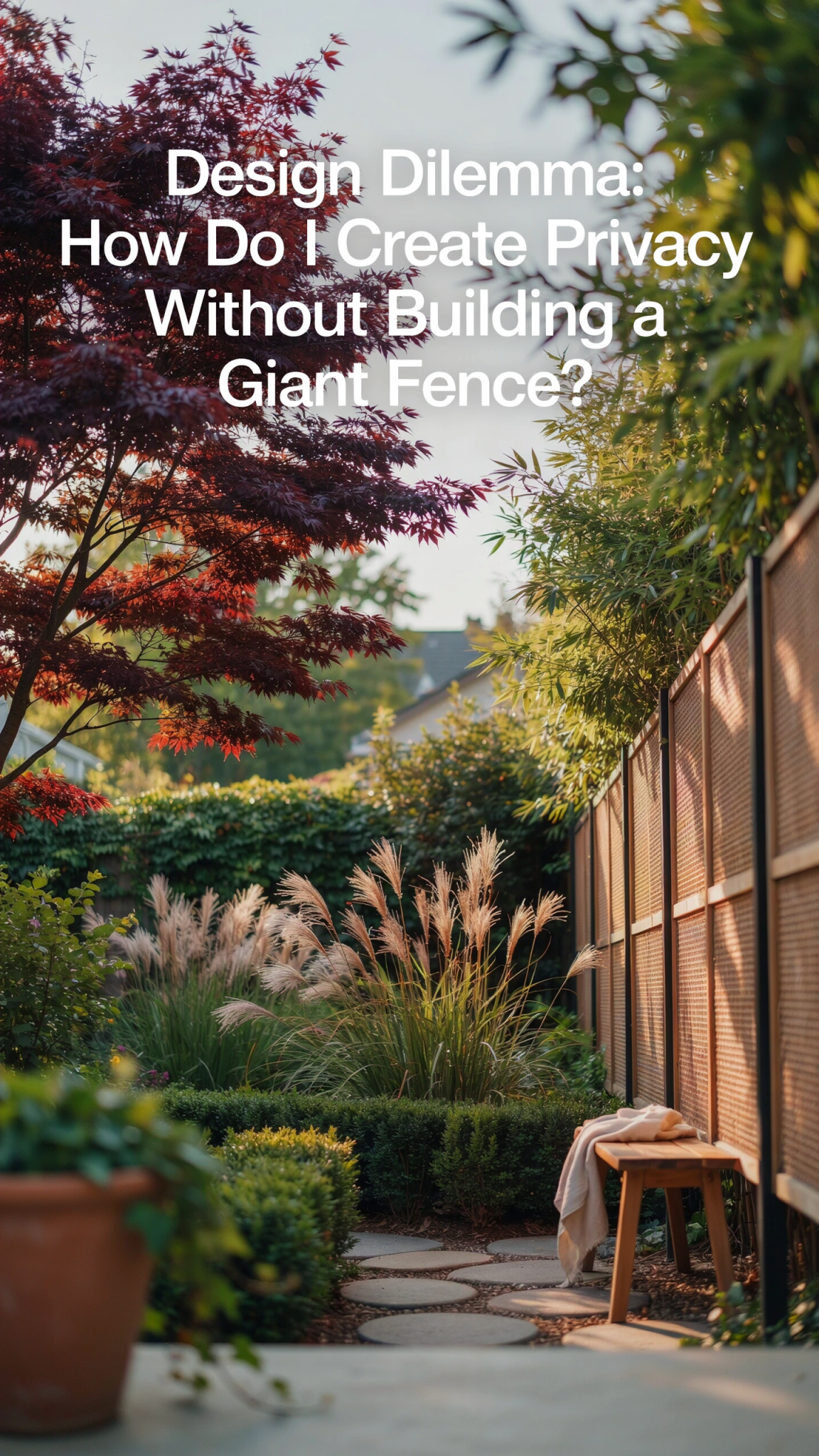
A privacy screen does not have to be a fence panel in disguise. The most attractive screens often have gaps, slats, weave, or perforation. They obscure the direct view while allowing air, dappled light, and glimpses of planting to pass through. This creates privacy that feels elegant rather than severe.
Horizontal timber slats are a familiar option, but they are only one expression. Slim vertical battens can make a low garden feel taller. A dark metal frame with timber infill can feel crisp and modern. Reed, willow, or woven hazel brings a more organic note. Powder-coated metal screens with perforated patterns are useful where you want a sharper architectural presence, especially beside a contemporary patio. The key is to choose a material and proportion that relate to the house rather than looking like an afterthought.
Freestanding screens are particularly valuable because they can be placed where the privacy issue occurs. For example, a six-foot-wide screen placed just behind a lounge chair can shield a nearby patio more effectively than 50 feet of new fencing at the boundary. A pair of screens angled slightly toward each other can frame an outdoor room, creating a sense of shelter without forming a hard enclosure.
Consider a screen as a backdrop for something beautiful. Train a climbing plant across it. Position a shallow water bowl in front of it. Let it support a wall light, a shelf for potted herbs, or a sculptural outdoor mirror that reflects planting rather than neighboring windows. A screen becomes more convincing when it contributes to the garden’s character, not merely to its defense.
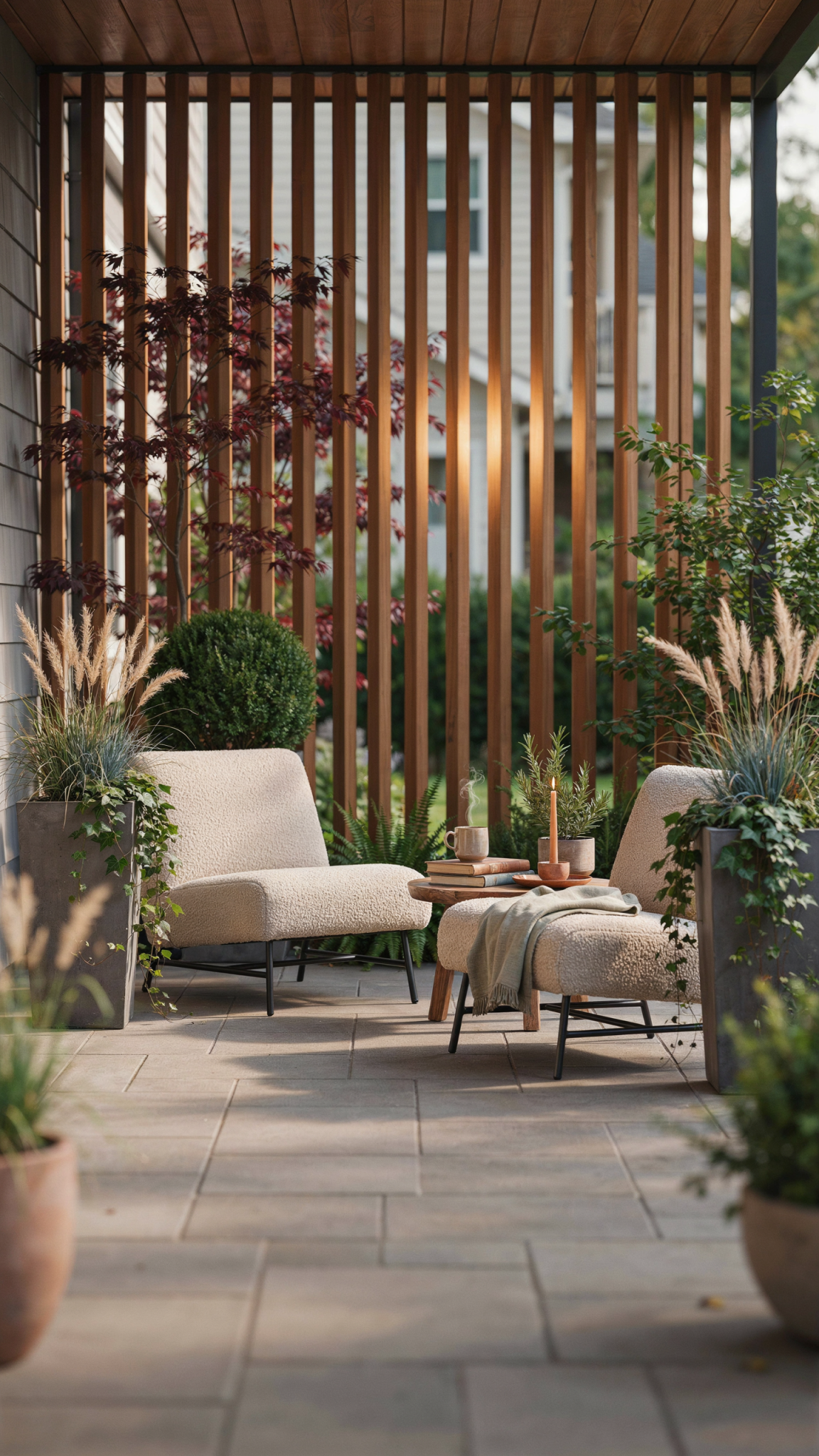
Build Privacy Overhead
Many backyards suffer from what could be called the “fishbowl effect”: the boundaries may be reasonably screened, but the space is visible from above. This is common near taller homes, apartments, raised decks, and hillside lots. Here, the most persuasive solution is often overhead structure.
A pergola is a classic answer because it defines an outdoor room without shutting it off. Its rafters break up sightlines from upper windows and create a pleasing pattern of light and shadow. It can be left open for a minimal, modern look or softened with vines, shade fabric, retractable panels, or a slatted roof. A pergola over a dining table says, quite clearly, “this is a room,” and that feeling of definition is a powerful form of privacy.
For smaller spaces, a cantilevered umbrella, shade sail, or outdoor canopy may do the same job with less construction. The right choice depends on whether you need sun protection, rain coverage, or simply visual screening. A shade sail set on a diagonal can be especially effective because it blocks a target